


Why do people living with HIV not initiate treatment? A systematic review of qualitative evidence from low- and middle-income countries
- PMID: 30059900
- PMCID: PMC6813776
- DOI: 10.1016/j.socscimed.2018.05.048
Why do people living with HIV not initiate treatment? A systematic review of qualitative evidence from low- and middle-income countries
Abstract
Background: Many people living with HIV (PLWH) who are eligible for antiretroviral therapy (ART) do not initiate treatment, leading to excess morbidity, mortality, and viral transmission. As countries move to treat all PLWH at diagnosis, it is critical to understand reasons for non-initiation.
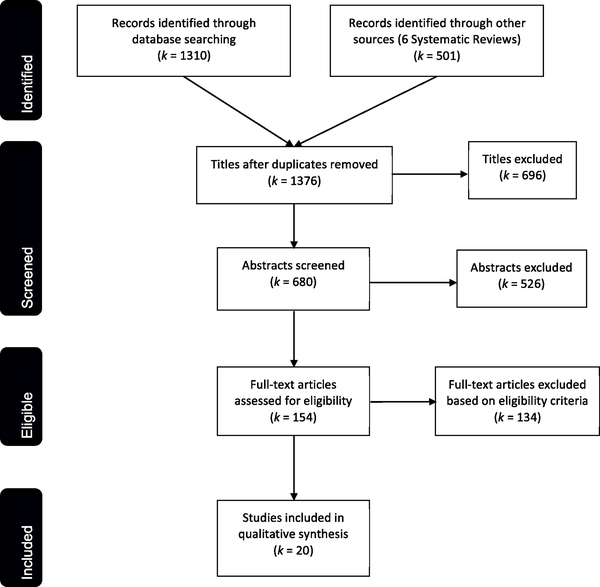
Methods: We conducted a systematic review of the qualitative literature on reasons for ART non-initiation in low- and middle-income countries. We screened 1376 titles, 680 abstracts, and 154 full-text reports of English-language qualitative studies published January 2000-April 2017; 20 met criteria for inclusion. Our analysis involved three steps. First, we used a "thematic synthesis" approach, identifying supply-side (facility) and demand-side (patient) factors commonly cited across different studies and organizing these factors into themes. Second, we conducted a theoretical mapping exercise, developing an explanatory model for patients' decision-making process to start (or not to start) ART, based on inductive analysis of evidence reviewed. Third, we used this explanatory model to identify opportunities to intervene to increase ART uptake.
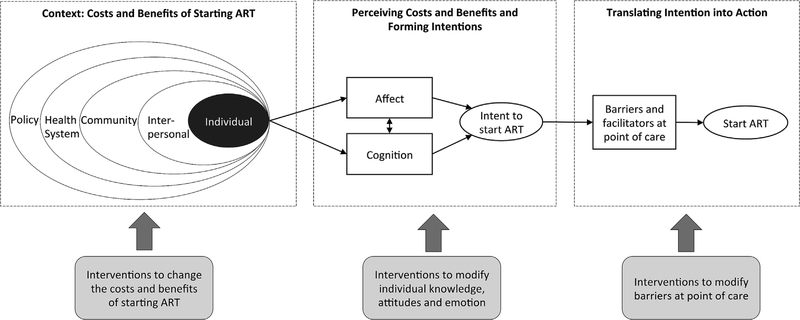
Results: Demand-side factors implicated in decisions not to start ART included feeling healthy, low social support, gender norms, HIV stigma, and difficulties translating intentions into actions. Supply-side factors included high care-seeking costs, concerns about confidentiality, low-quality health services, recommended lifestyle changes, and incomplete knowledge of treatment benefits. Developing an explanatory model, which we labeled the Transdisciplinary Model of Health Decision-Making, we posited that contextual factors determine the costs and benefits of ART; patients perceive this context (through cognitive and emotional appraisals) and form an intention whether or not to start; and these intentions may (or may not) be translated into actions. Interventions can target each of these three stages.
Conclusions: Reasons for not starting ART included consistent themes across studies. Future interventions could: (1) provide information on the large health and prevention benefits of ART and the low side effects of current regimens; (2) reduce stigma at the patient and community levels and increase confidentiality where stigma persists; (3) remove lifestyle requirements and support patients in integrating ART into their lives; and (4) alleviate economic burdens of ART. Interventions addressing reasons for non-initiation will be critical to the success of HIV "treat all" strategies.
Keywords: AIDS; ART; Antiretroviral therapy; Care cascade; Continuum of care; HIV; LMICs; Qualitative; Systematic review; Treatment refusal.
Copyright © 2018 The Authors. Published by Elsevier Ltd.. All rights reserved.
Figures
References
-
- Ajzen I, 1985. From intentions to actions: a theory of planned behavior. In: Action Control. Springer, pp. 11–39.
-
- Amuron B, Namara G, Birungi J, Nabiryo C, Levin J, Grosskurth H, Coutinho A, Jaffar S, 2009. Mortality and loss-to-follow-up during the pre-treatment period in an antiretroviral therapy programme under normal health service conditions in Uganda. BMC Publ. Health 9, 290. 10.1186/1471-2458-9-290. - DOI - PMC - PubMed
-
- Bakker I, van der Voordt T, Vink P, de Boon J, 2014. Pleasure, arousal, dominance: mehrabian and Russell revisited. Curr. Psychol 33, 405–421.
Publication types
MeSH terms
Substances
Grants and funding
LinkOut - more resources
Full Text Sources
Other Literature Sources
Medical
Research Materials
Miscellaneous
