Review
. 2018 Jul 27;7(3):66.
doi: 10.3390/antibiotics7030066.

Bacteriophages: Protagonists of a Post-Antibiotic Era

Affiliations
Review

Bacteriophages: Protagonists of a Post-Antibiotic Era

Pilar Domingo-Calap et al. Antibiotics (Basel). .

Abstract

Despite their long success for more than half a century, antibiotics are currently under the spotlight due to the emergence of multidrug-resistant bacteria. The development of new alternative treatments is of particular interest in the fight against bacterial resistance. Bacteriophages (phages) are natural killers of bacteria and are an excellent tool due to their specificity and ecological safety. Here, we highlight some of their advantages and drawbacks as potential therapeutic agents. Interestingly, phages are not only attractive from a clinical point of view, but other areas, such as agriculture, food control, or industry, are also areas for their potential application. Therefore, we propose phages as a real alternative to current antibiotics.

Keywords: antibiotic resistance; bacteriophages; enzybiotics; phage display; phage therapy.


Conflict of interest statement

The authors declare no conflict of interest.

Figures
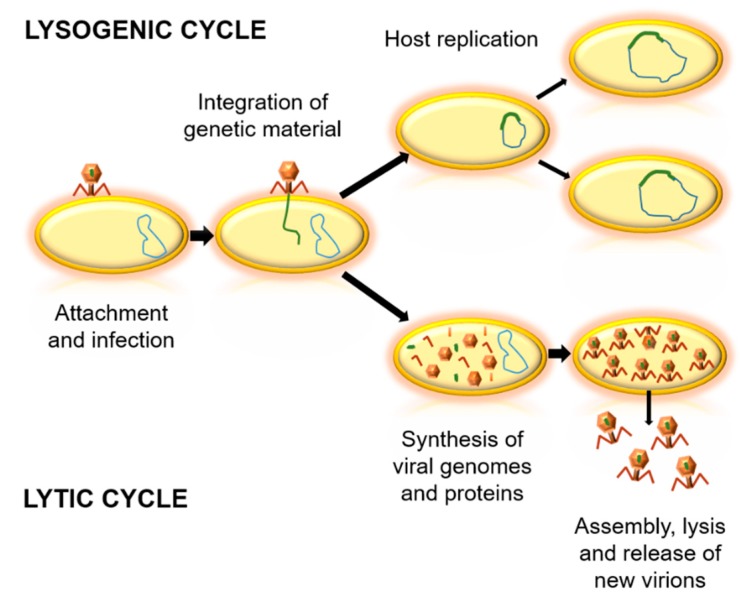
Figure 1
Figure 1
Biological cycles of phages. Firstly, the virus binds to the bacterial cell and injects its genetic material. In the lysogenic cycle, the integration of viral genetic material into the genome of the host occurs, and the bacterial cell replicates without producing virions. In the lytic cycle, viral genetic material is replicated and viral proteins are synthesized. Then, an assembly of virions is achieved, followed by the lysis of the bacteria and the release of new virions.
Figure 2
Figure 2
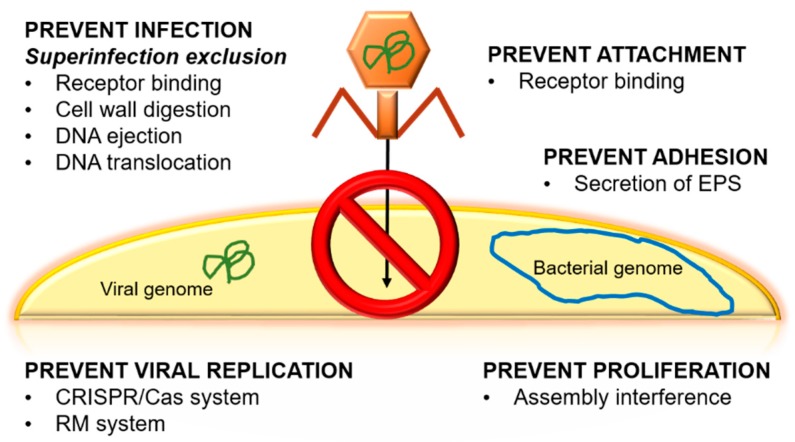
Principal natural mechanisms to prevent viral infection in bacteria. EPS: extracellular polymeric substances, CRISPR/Cas: Clustered Regularly Interspaced Short Palindromic Repeats/Caspase, RM: restriction modification.

References

    1. Domingo-Calap P., Georgel P., Bahram S. Back to the future: Bacteriophages as promising therapeutic tools. HLA. 2016;87:133–140. doi: 10.1111/tan.12742. - DOI - PubMed
    1. El-Shibiny A., El-Sahhar S. Bacteriophages: The possible solution to treat infections caused by pathogenic bacteria. Can. J. Microbiol. 2017;63:865–879. doi: 10.1139/cjm-2017-0030. - DOI - PubMed
    1. Cisek A., Dąbrowska I., Gregorczyk K., Wyżewski Z. Phage therapy in bacterial infections treatment: One hundred years after the discovery of bacteriophages. Curr. Microbiol. 2016;74:277–283. doi: 10.1007/s00284-016-1166-x. - DOI - PMC - PubMed
    1. Guzmán M. El bacteriófago, cien años de hallazgos trascendentales. Biomédica. 2015;35:159–161. - PubMed
    1. Trudil D. Phage lytic enzymes: A history. Virol. Sin. 2015;30:26–32. doi: 10.1007/s12250-014-3549-0. - DOI - PMC - PubMed