Review
. 2018 Jul 27;19(8):2199.
doi: 10.3390/ijms19082199.

Harmful Effects and Potential Benefits of Anti-Tumor Necrosis Factor (TNF)-α on the Liver

Affiliations
Review

Harmful Effects and Potential Benefits of Anti-Tumor Necrosis Factor (TNF)-α on the Liver

Loris Riccardo Lopetuso et al. Int J Mol Sci. .

Abstract

Anti-tumor necrosis factor (TNF)-α agents represent an effective treatment for chronic inflammatory diseases. However, some concerns about their potentially undesirable effects on liver function have been reported. On the other hand, evidence of their therapeutic effects on certain liver diseases is accumulating. Many data showed the safety of anti-TNF-α in patients with chronic hepatitis B and C and in liver transplanted patients even if a strict follow-up and prophylaxis are recommended in well-defined subgroups. On the other side, anti-TNF-α-induced liver injury is not a rare event. However, it is often reversible after anti-TNF-α withdrawal. Anti-TNF-α agents have been tested in advanced stages of severe alcoholic hepatitis and non-alcoholic fatty liver disease. Limited data on the efficacy of anti-TNF-α in patients with autoimmune hepatitis and primary biliary cholangitis are also available. In this review, we explored the hepatic safety concerns in patients receiving anti-TNF-α agents with and without pre-existent hepatic diseases. In addition, the available evidence on their potential benefits in the treatment of specific hepatic diseases is discussed.

Keywords: adalimumab; alcoholic hepatitis; autoimmune hepatitis; certolizumab pegol; drug-induced liver injury; etanercept; golimumab; hepatitis B virus; hepatitis C virus; infliximab; non-alcoholic fatty liver disease.


Conflict of interest statement

The authors declare no conflict of interest.

Figures
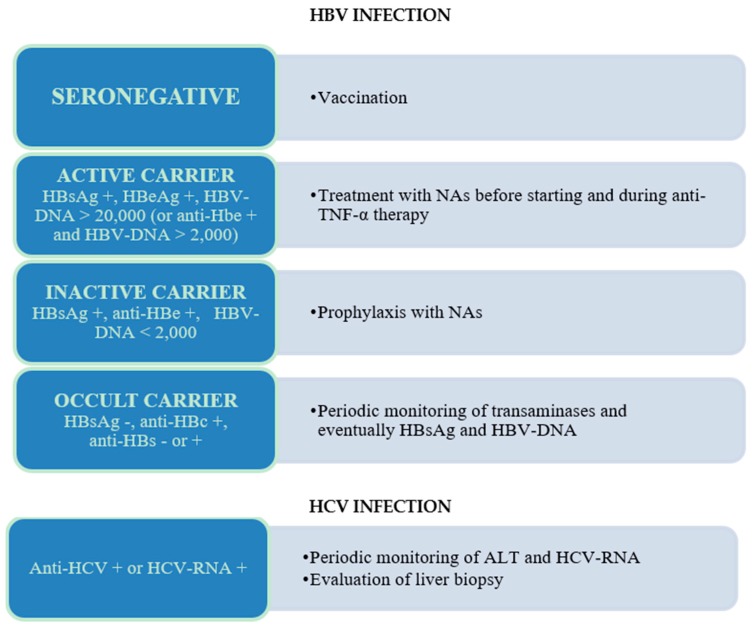
Figure 1
Figure 1
Recommendations for the management of patients according to the presence of different HBV and HCV markers. NAs, nucleoside analogues; ALT, alanine aminotransferase; TNF-α, tumor necrosis factor-α.
Figure 2
Figure 2
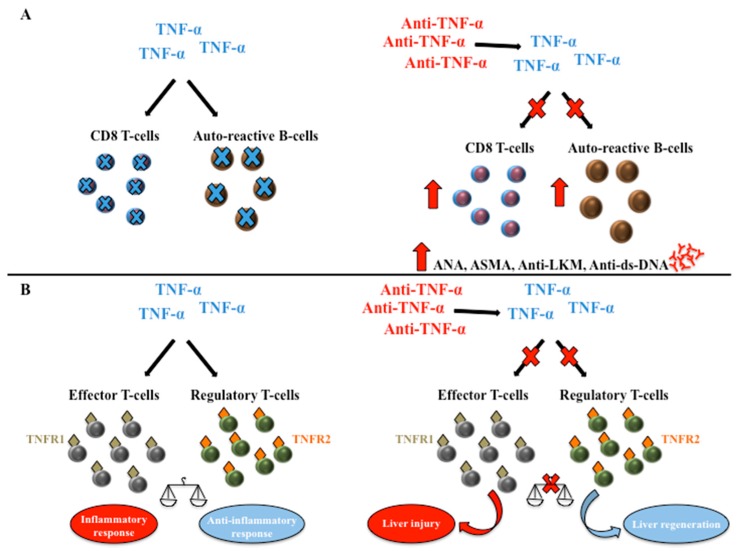
Working hypothesis for the anti-TNF-α-mediated mechanisms of liver damage. (A) TNF-α blockade could impair the normal suppression of auto-reactive B cell production and apoptosis of CD8 T cells leading to an increased lymphocyte presence. This could trigger the development of autoantibodies; (B) TNF-α can mediate a dual and opposing effect by acting on two TNF receptors (TNFR1 and TNFR2) expressed on T cells. TNF-α is able to stimulate effector T cell, mainly through TNFR1, which drives inflammatory response. On the other side, the activation of TNFR2 expressed on regulatory T cells leads to the prevention of autoimmunity and attenuation of inflammation. Thus, the blockade of TNF-α may either be able to determine further liver injury or regeneration by modulating the balance between effector and regulatory T cells. The direction of this response could also be influenced by the genetics and the immunological status of the host (e.g., cytokines, TNFR expression profile, cellular source of TNF). TNF-α, Tumor necrosis factor-α; TNFR1, Tumor necrosis factor-α receptor 1; TNFR2, Tumor necrosis factor-α receptor 2; ANA, anti-nuclear antibodies; ASMA, anti-smooth muscle antibodies; Anti-LKM, anti-liver kidney microsomal type 1 antibodies; Anti-ds-DNA, anti-double-strand DNA antibodies.
Figure 3
Figure 3
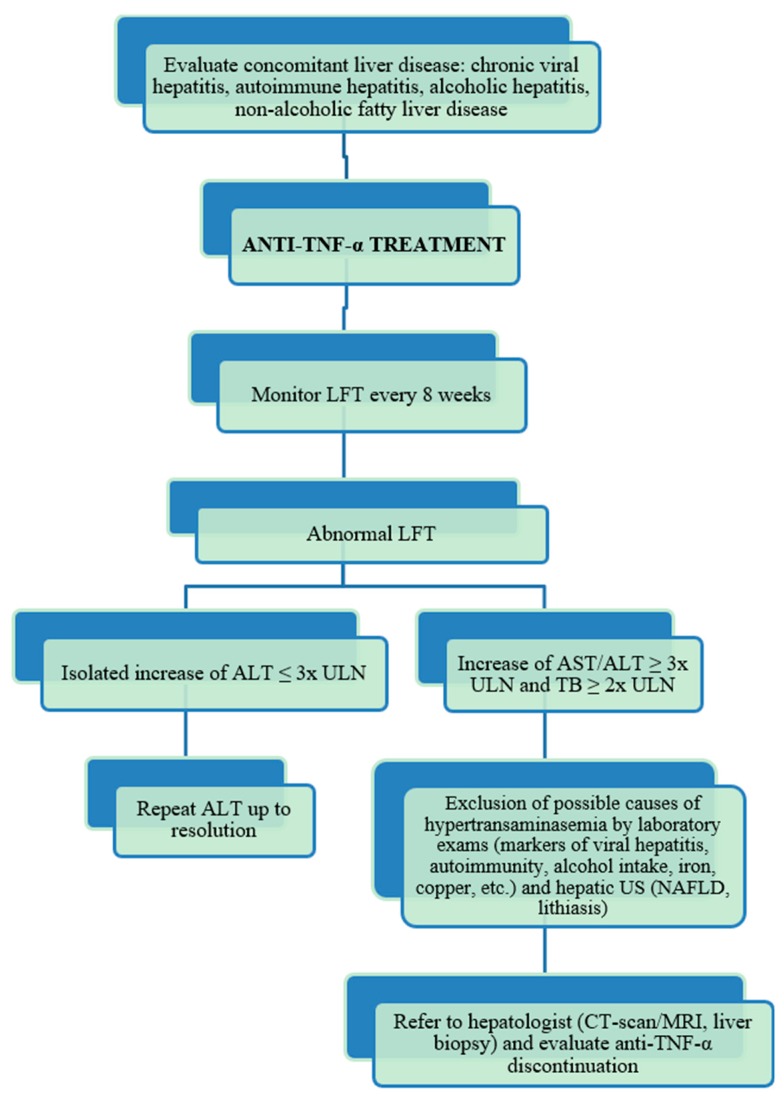
Algorithm for the diagnosis and management of anti-TNF-α-induced liver injury. TNF-α, tumor necrosis factor-α; LFT, liver function tests; ALT, alanine aminotransferase; ULN, upper limit of normal; US, ultrasound; NAFLD, non-alcoholic fatty liver disease; CT-scan, computed tomography-scan; MRI, magnetic resonance imaging.

References

    1. Papadakis K.A., Targan S.R. Tumor necrosis factor: Biology and therapeutic inhibitors. Gastroenterology. 2000;119:1148–1157. doi: 10.1053/gast.2000.18160. - DOI - PubMed
    1. Nesbitt A., Fossati G., Bergin M., Stephens P., Stephens S., Foulkes R., Brown D., Robinson M., Bourne T. Mechanism of action of certolizumab pegol (CDP870): In vitro comparison with other anti-tumor necrosis factor alpha agents. Inflamm. Bowel Dis. 2007;13:1323–1332. doi: 10.1002/ibd.20225. - DOI - PubMed
    1. Weaver A.L. Differentiating the new rheumatoid arthritis biologic therapies. J. Clin. Rheumatol. 2003;9:99–114. doi: 10.1097/01.RHU.0000062513.64012.1d. - DOI - PubMed
    1. Papa A., Mocci G., Bonizzi M., Felice C., Andrisani G., De Vitis I., Guidi L., Gasbarrini A. Use of infliximab in particular clinical settings: Management based on current evidence. Am. J. Gastroenterol. 2009;104:1575–1586. doi: 10.1038/ajg.2009.162. - DOI - PubMed
    1. Rossi R.E., Parisi I., Despott E.J., Burroughs A.K., O’Beirne J., Conte D., Hamilton M.I., Murray C.D. Anti-tumour necrosis factor agent and liver injury: Literature review, recommendations for management. World J. Gastroenterol. 2014;20:17352–17359. doi: 10.3748/wjg.v20.i46.17352. - DOI - PMC - PubMed

MeSH terms

Substances

LinkOut - more resources