


Identical and Nonidentical Twins: Risk and Factors Involved in Development of Islet Autoimmunity and Type 1 Diabetes
- PMID: 30061316
- PMCID: PMC6341285
- DOI: 10.2337/dc18-0288
Identical and Nonidentical Twins: Risk and Factors Involved in Development of Islet Autoimmunity and Type 1 Diabetes
Abstract
Objective: There are variable reports of risk of concordance for progression to islet autoantibodies and type 1 diabetes in identical twins after one twin is diagnosed. We examined development of positive autoantibodies and type 1 diabetes and the effects of genetic factors and common environment on autoantibody positivity in identical twins, nonidentical twins, and full siblings.
Research design and methods: Subjects from the TrialNet Pathway to Prevention Study (N = 48,026) were screened from 2004 to 2015 for islet autoantibodies (GAD antibody [GADA], insulinoma-associated antigen 2 [IA-2A], and autoantibodies against insulin [IAA]). Of these subjects, 17,226 (157 identical twins, 283 nonidentical twins, and 16,786 full siblings) were followed for autoantibody positivity or type 1 diabetes for a median of 2.1 years.
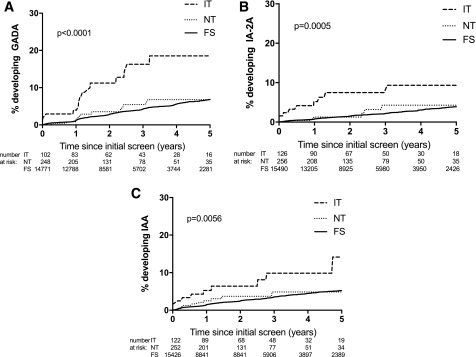
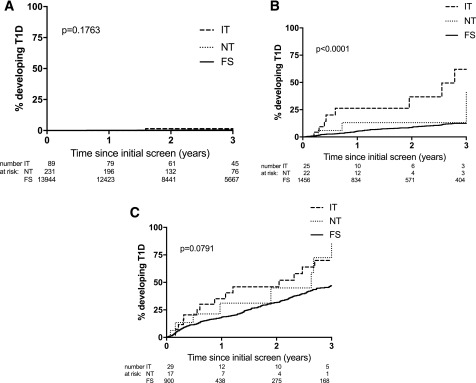
Results: At screening, identical twins were more likely to have positive GADA, IA-2A, and IAA than nonidentical twins or full siblings (all P < 0.0001). Younger age, male sex, and genetic factors were significant factors for expression of IA-2A, IAA, one or more positive autoantibodies, and two or more positive autoantibodies (all P ≤ 0.03). Initially autoantibody-positive identical twins had a 69% risk of diabetes by 3 years compared with 1.5% for initially autoantibody-negative identical twins. In nonidentical twins, type 1 diabetes risk by 3 years was 72% for initially multiple autoantibody-positive, 13% for single autoantibody-positive, and 0% for initially autoantibody-negative nonidentical twins. Full siblings had a 3-year type 1 diabetes risk of 47% for multiple autoantibody-positive, 12% for single autoantibody-positive, and 0.5% for initially autoantibody-negative subjects.
Conclusions: Risk of type 1 diabetes at 3 years is high for initially multiple and single autoantibody-positive identical twins and multiple autoantibody-positive nonidentical twins. Genetic predisposition, age, and male sex are significant risk factors for development of positive autoantibodies in twins.
© 2018 by the American Diabetes Association.
Figures
References
Publication types
MeSH terms
Substances
Grants and funding
- U01 DK085476/DK/NIDDK NIH HHS/United States
- T32 DK063687/DK/NIDDK NIH HHS/United States
- U01 DK061010/DK/NIDDK NIH HHS/United States
- U01 DK085499/DK/NIDDK NIH HHS/United States
- U01 DK085463/DK/NIDDK NIH HHS/United States
- U01 DK103266/DK/NIDDK NIH HHS/United States
- T32 DK065522/DK/NIDDK NIH HHS/United States
- P30 DK045735/DK/NIDDK NIH HHS/United States
- U01 DK061042/DK/NIDDK NIH HHS/United States
- U01 DK085509/DK/NIDDK NIH HHS/United States
- P30 DK017047/DK/NIDDK NIH HHS/United States
- U01 DK085466/DK/NIDDK NIH HHS/United States
- U01 DK103153/DK/NIDDK NIH HHS/United States
- U01 DK061058/DK/NIDDK NIH HHS/United States
- U01 DK085505/DK/NIDDK NIH HHS/United States
- U01 DK085453/DK/NIDDK NIH HHS/United States
- U01 DK061034/DK/NIDDK NIH HHS/United States
- U01 DK085461/DK/NIDDK NIH HHS/United States
- U01 DK103180/DK/NIDDK NIH HHS/United States
- U01 DK085465/DK/NIDDK NIH HHS/United States
- U01 DK085504/DK/NIDDK NIH HHS/United States
LinkOut - more resources
Full Text Sources
Other Literature Sources
Medical
