


Consensus study to define appropriate inaction and inappropriate inertia in the management of patients with hypertension in primary care
- PMID: 30061435
- PMCID: PMC6067345
- DOI: 10.1136/bmjopen-2017-020599
Consensus study to define appropriate inaction and inappropriate inertia in the management of patients with hypertension in primary care
Abstract
Objectives: To elaborate and validate operational definitions for appropriate inaction and for inappropriate inertia in the management of patients with hypertension in primary care.
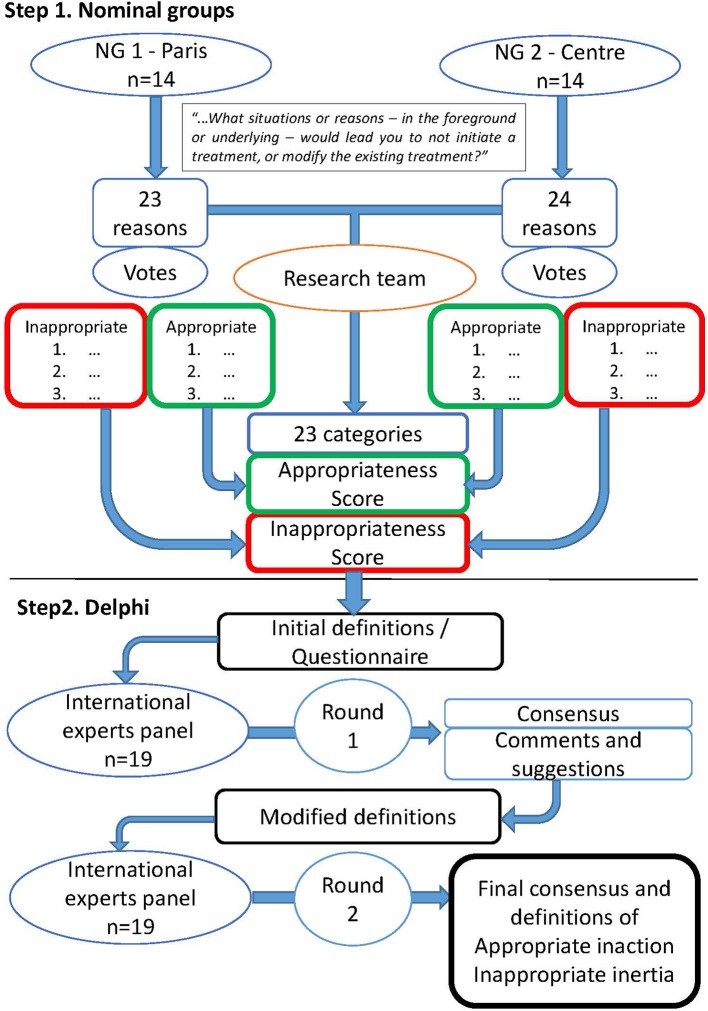
Design: A two-step approach was used to reach a definition consensus. First, nominal groups provided practice-based information on the two concepts. Second, a Delphi procedure was used to modify and validate the two definitions created from the nominal groups results.
Participants: 14 French practicing general practitioners participated in each of the two nominal groups, held in two different areas in France. For the Delphi procedure, 30 academics, international experts in the field, were contacted; 20 agreed to participate and 19 completed the procedure.
Results: Inappropriate inertia was defined as: to not initiate or intensify an antihypertensive treatment for a patient who is not at the blood pressure goals defined for this patient in the guidelines when all following conditions are fulfilled: (1) elevated blood pressure has been confirmed by self-measurement or ambulatory blood pressure monitoring, (2) there is no legitimate doubt on the reliability of the measurements, (3) there is no observance issue regarding pharmacological treatment, (4) there is no specific iatrogenic risk (which alters the risk-benefit balance of treatment for this patient), in particular orthostatic hypotension in the elderly, (5) there is no other medical priority more important and more urgent, and (6) access to treatment is not difficult. Appropriate inaction was defined as the exact mirror, that is, when at least one of the above conditions is not met.
Conclusion: Definitions of appropriate inaction and inappropriate inertia in the management of patients with hypertension have been established from empirical practice-based data and validated by an international panel of academics as useful for practice and research.
Keywords: hypertension; primary care; quality in health care; therapeutics.
© Author(s) (or their employer(s)) 2018. Re-use permitted under CC BY-NC. No commercial re-use. See rights and permissions. Published by BMJ.
Conflict of interest statement
Competing interests: None declared.
References
-
- World health organization. A global brief on hypertension. Silent killer, global public health crisis. Geneva: WHO, 2013.
MeSH terms
Substances
LinkOut - more resources
Full Text Sources
Other Literature Sources
Medical
Miscellaneous
