


Cardiovascular disease incidence after internal mammary chain irradiation and anthracycline-based chemotherapy for breast cancer
- PMID: 30065254
- PMCID: PMC6133926
- DOI: 10.1038/s41416-018-0159-x
Cardiovascular disease incidence after internal mammary chain irradiation and anthracycline-based chemotherapy for breast cancer
Abstract
Background: Improved breast cancer (BC) survival and evidence showing beneficial effects of internal mammary chain (IMC) irradiation underscore the importance of studying late cardiovascular effects of BC treatment.
Methods: We assessed cardiovascular disease (CVD) incidence in 14,645 Dutch BC patients aged <62 years, treated during 1970-2009. Analyses included proportional hazards models and general population comparisons.
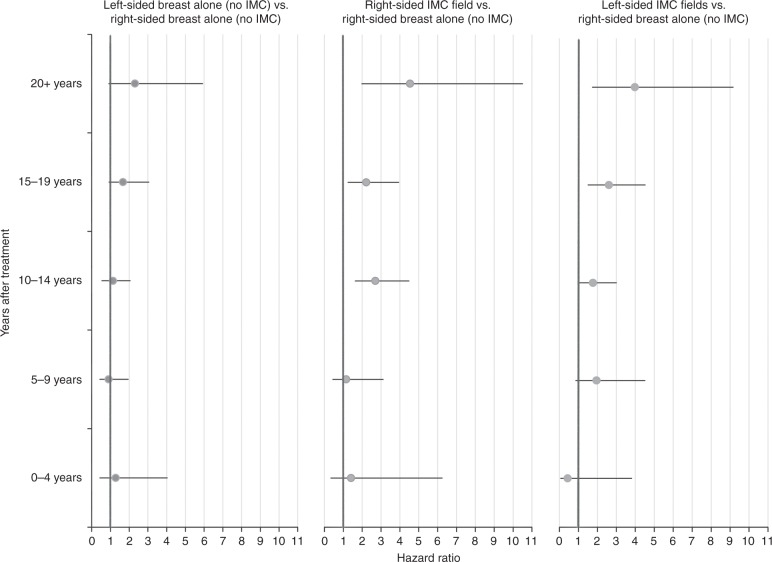
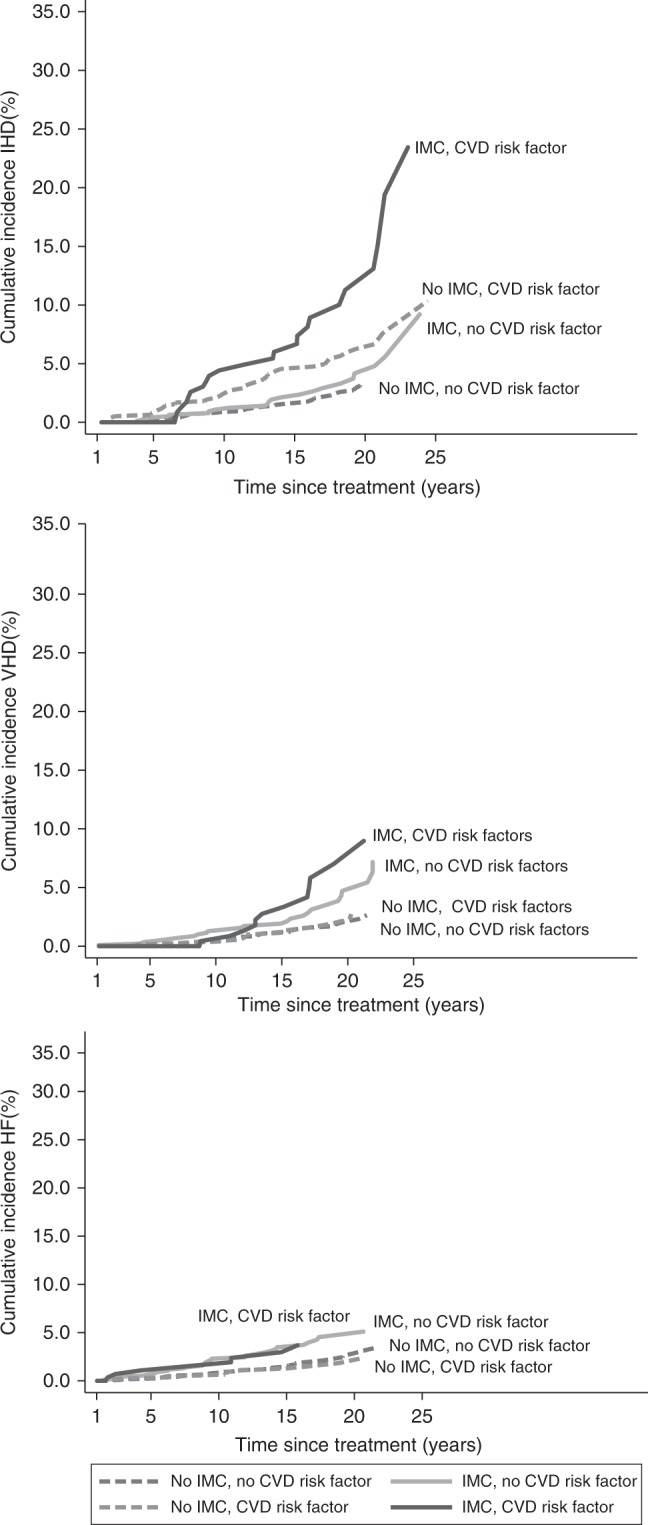
Results: CVD rate-ratio for left-versus-right breast irradiation without IMC was 1.11 (95% CI 0.93-1.32). Compared to right-sided breast irradiation only, IMC irradiation (interquartile range mean heart doses 9-17 Gy) was associated with increases in CVD rate overall, ischaemic heart disease (IHD), heart failure (HF) and valvular heart disease (hazard ratios (HRs): 1.6-2.4). IHD risk remained increased until at least 20 years after treatment. Anthracycline-based chemotherapy was associated with an increased HF rate (HR = 4.18, 95% CI 3.07-5.69), emerging <5 years and remaining increased at least 10-15 years after treatment. IMC irradiation combined with anthracycline-based chemotherapy was associated with substantially increased HF rate (HR = 9.23 95% CI 6.01-14.18), compared to neither IMC irradiation nor anthracycline-based chemotherapy.
Conclusions: Women treated with anthracycline-based chemotherapy and IMC irradiation (in an older era) with considerable mean heart dose exposure have substantially increased incidence of several CVDs. Screening may be appropriate for some BC patient groups.
Conflict of interest statement
The authors declare no competing interests.
Figures
References
-
- Early Breast Cancer Trialists’ Collaborative Group (EBCTCG) Effect of radiotherapy after breast-conserving surgery on 10-year recurrence and 15-year breast cancer death: meta-analysis of individual patient data for 10,801 women in 17 randomised trials. Lancet. 2011;378:1707–1716. doi: 10.1016/S0140-6736(11)60993-8. - DOI - PMC - PubMed
-
- Early Breast Cancer Trialists’ Collaborative Group (EBCTCG) Peto R, et al. Comparisons between different polychemotherapy regimens for early breast cancer: meta-analyses of long-term outcome among 100,000 women in 123 randomised trials. Lancet. 2012;379:432–444. doi: 10.1016/S0140-6736(11)61625-5. - DOI - PMC - PubMed
-
- Early Breast Cancer Trialists’ Collaborative Group (EBCTCG) McGale P, et al. Effect of radiotherapy after mastectomy and axillary surgery on 10-year recurrence and 20-year breast cancer mortality: meta-analysis of individual patient data for 8135 women in 22 randomised trials. Lancet. 2014;383:2127–2135. doi: 10.1016/S0140-6736(14)60488-8. - DOI - PMC - PubMed
Publication types
MeSH terms
Substances
Grants and funding
LinkOut - more resources
Full Text Sources
Other Literature Sources
Medical
Research Materials
Miscellaneous
