Review
. 2018 Jul 17:9:985.
doi: 10.3389/fpls.2018.00985. eCollection 2018.

CRISPR for Crop Improvement: An Update Review

Affiliations
Review

CRISPR for Crop Improvement: An Update Review

Deepa Jaganathan et al. Front Plant Sci. .

Abstract

The availability of genome sequences for several crops and advances in genome editing approaches has opened up possibilities to breed for almost any given desirable trait. Advancements in genome editing technologies such as zinc finger nucleases (ZFNs), transcription activator-like effector nucleases (TALENs) has made it possible for molecular biologists to more precisely target any gene of interest. However, these methodologies are expensive and time-consuming as they involve complicated steps that require protein engineering. Unlike first-generation genome editing tools, CRISPR/Cas9 genome editing involves simple designing and cloning methods, with the same Cas9 being potentially available for use with different guide RNAs targeting multiple sites in the genome. After proof-of-concept demonstrations in crop plants involving the primary CRISPR-Cas9 module, several modified Cas9 cassettes have been utilized in crop plants for improving target specificity and reducing off-target cleavage (e.g., Nmcas9, Sacas9, and Stcas9). Further, the availability of Cas9 enzymes from additional bacterial species has made available options to enhance specificity and efficiency of gene editing methodologies. This review summarizes the options available to plant biotechnologists to bring about crop improvement using CRISPR/Cas9 based genome editing tools and also presents studies where CRISPR/Cas9 has been used for enhancing biotic and abiotic stress tolerance. Application of these techniques will result in the development of non-genetically modified (Non-GMO) crops with the desired trait that can contribute to increased yield potential under biotic and abiotic stress conditions.

Keywords: CRISPR; TALEN; ZFN; abiotic stress; biotic stress; quantitative trait loci.


Figures
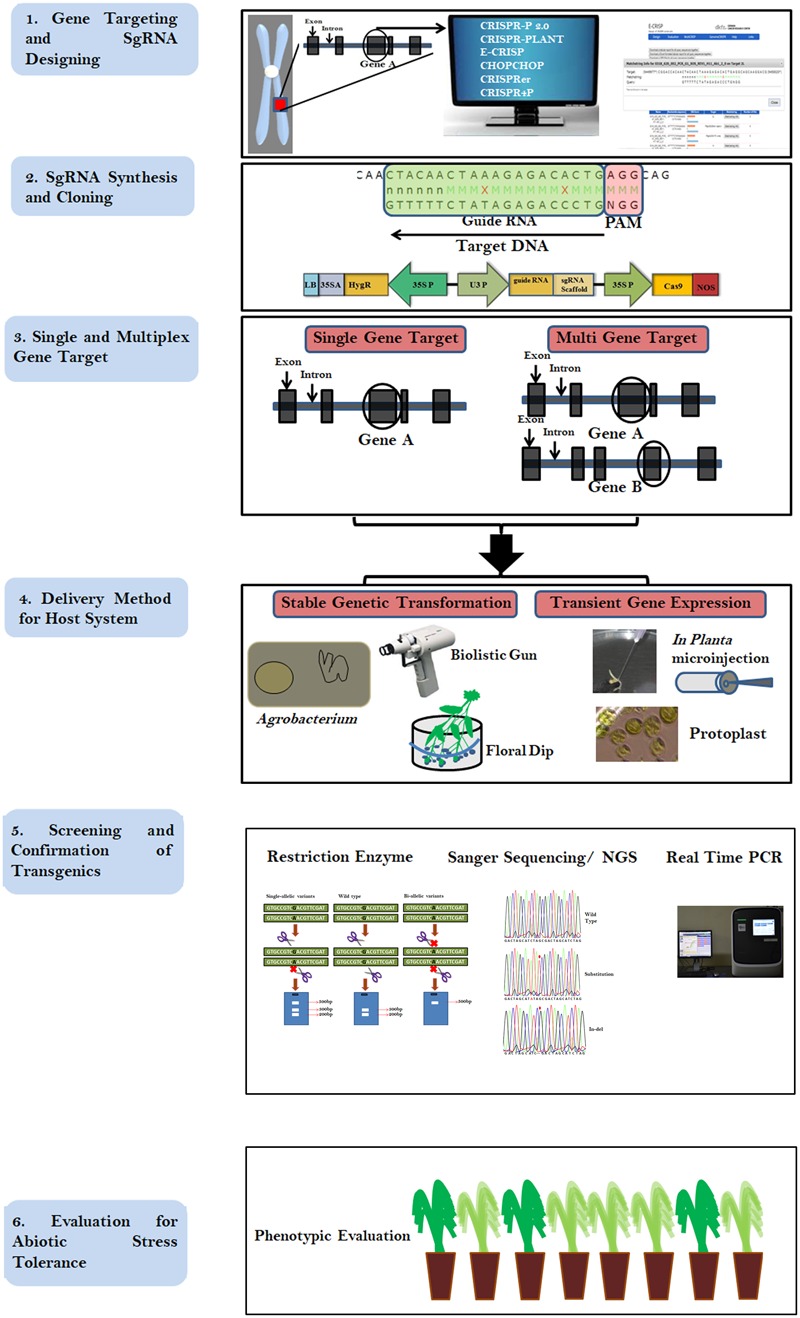
FIGURE 1
FIGURE 1
Flow chart describing the steps involved in CRISPR/Cas9 based genome editing. Step 1 describes the selection of gene and designing of gRNA, Step 2 describes the cloning of the gRNA in a suitable binary vector. Step 3 Shows the availability single and multiplex editing. Step 4 describes methods of transformation, Step 5 explains screening methods of edited crops and Step 6 demonstrates the evaluation and selection of the desirable transgene-free plant for the target trait.
FIGURE 2
FIGURE 2
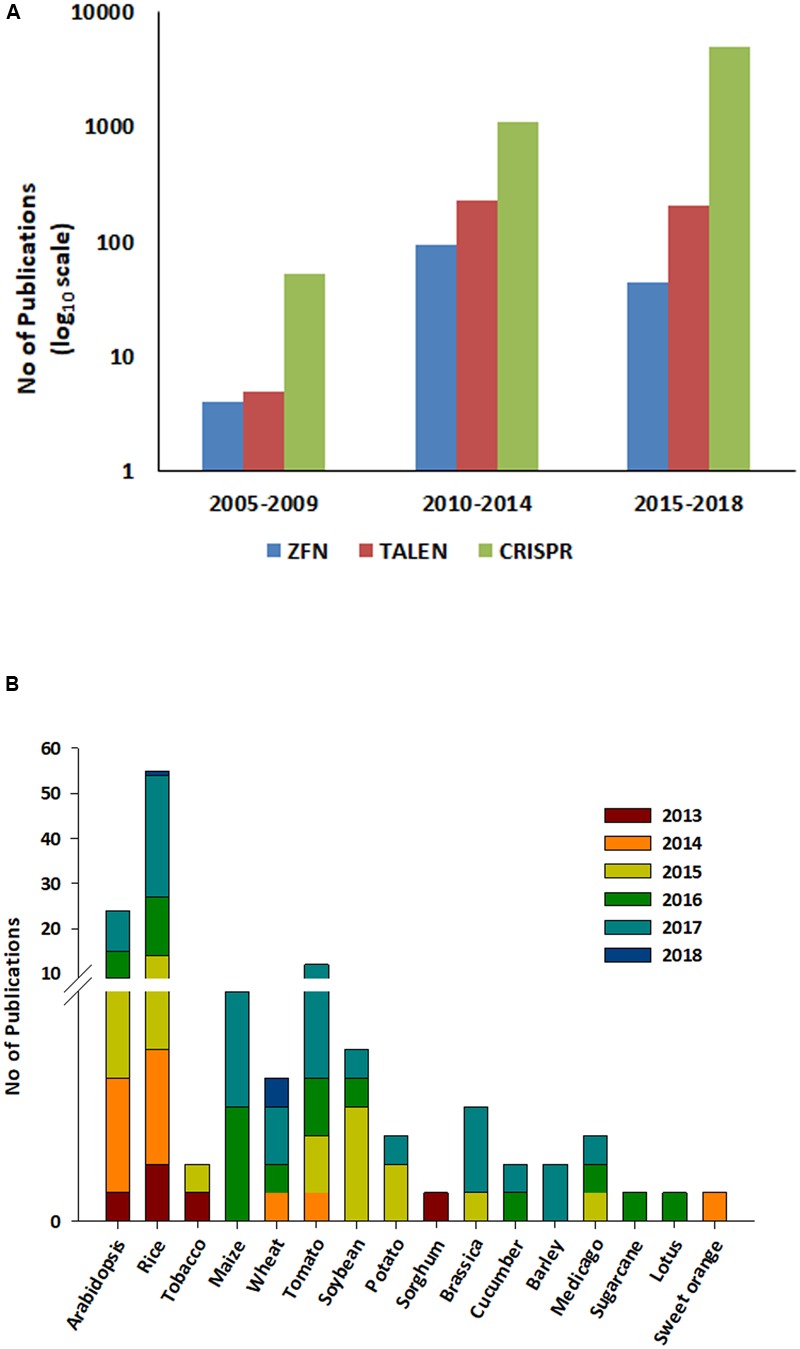
A research and review articles published on ZFN, TALEN, and CRISPR from 2005 to 2018. (A) ZFN, TALEN, and CRISPR were used as a search word in the title using the web of science search engine. Data was collected for three specified durations (i) 2005–2009, (ii) 2010–2014 and (iii) 2015–2018 (Feb 8th, 2018) (https://webofknowledge.com/). Each bar in the graph denotes each techniques and the color coding is described at the bottom of the figure. (B) Data on research articles published in plants during last 5 years (2013–2018). Data was collected using ‘CRISPR and crop name,’ e.g., ‘CRISPR rice’ in the title using the web of science 2013–2018 (https://webofknowledge.com/). Each bar denotes one year and the color coding is described at the top right of the figure.
FIGURE 3
FIGURE 3
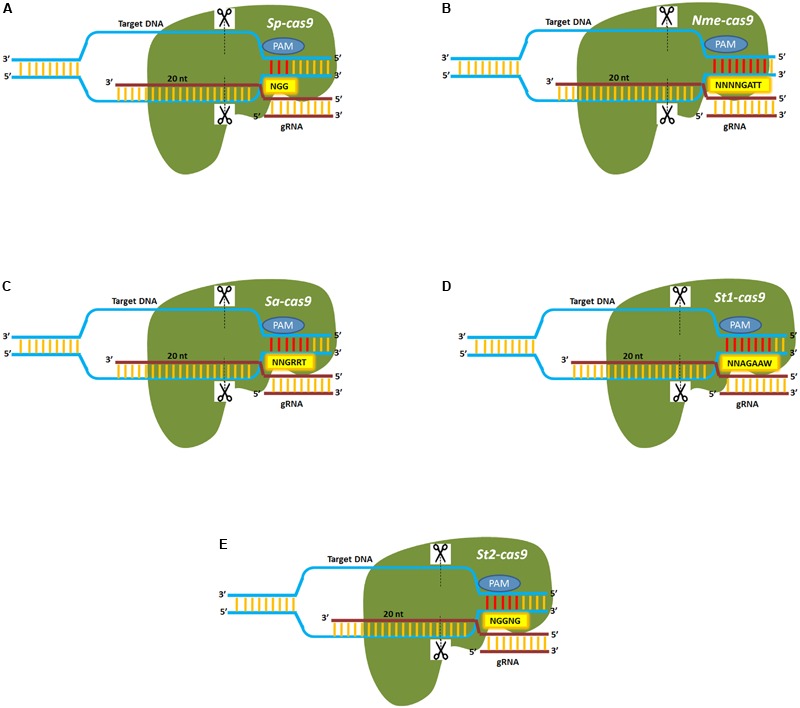
Cas9 orthologs from bacterial species show differences in their PAM repertoire. (A) Sp-cas9 derived from Streptococcus pyogenes recognizes a three nucleotide PAM (5′-NGG) sequence. (B) Nme-cas9 derived from Neisseria meningitidis recognizes an eight nucleotide PAM (5′-NNNNGATT) sequence. (C) Sa-cas9 derived from Staphylococcus aureus recognizes a six nucleotide PAM (5′-NNGRRT) sequence. (D) St1-cas9 derived from Streptococcus thermophilus recognizes a seven nucleotide PAM (5′-NNAGAAW) sequence. (E) St2-cas9 derived from Streptococcus thermophilus recognizes a five nucleotide PAM (5′-NGGNG) sequence. Dotted lines indicate the site of the double-strand break.
FIGURE 4
FIGURE 4
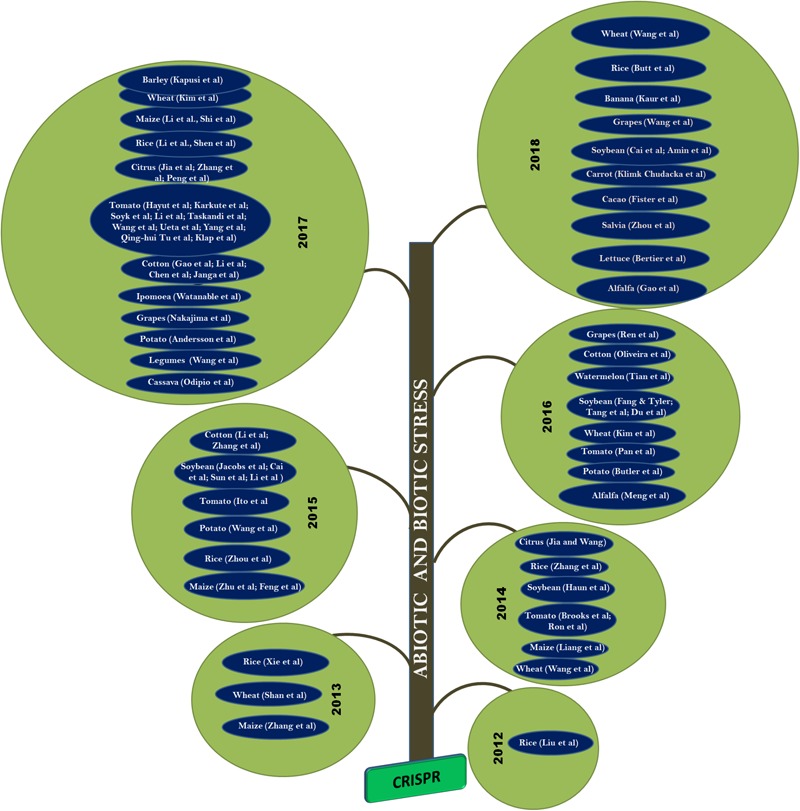
Application of CRISPR/Cas9 approach in plants: In 2013, CRISPR was demonstrated on rice, wheat, and maize. Whereas, in 2014, the technique was applied to tomato, soybean, and citrus. It was adopted in cotton and potato during 2015. Followed by watermelon, grapes, and alfalfa in 2016. CRIPSR/Cas was also applied to cassava, ipomoea, and legumes during 2017. Its is also applied to carrot, cacao, salvia, and lettuce during 2018 and many more crops yet to be reported.

References

    1. Ali Z., Abulfaraj A., Idris A., Ali S., Tashkandi M., Mahfouz M. M. (2015). CRISPR/Cas9-mediated viral interference in plants. Genome Biol. 16:238. 10.1186/s13059-015-0799-6 - DOI - PMC - PubMed
    1. Andersson M., Turesson H., Nicolia A., Falt A. S., Samuelsson M., Hofvander P. (2017). Efficient targeted multiallelic mutagenesis in tetraploid potato (Solanum tuberosum) by transient CRISPR-Cas9 expression in protoplasts. Plant Cell Rep. 36 117–128. 10.1007/s00299-016-2062-3 - DOI - PMC - PubMed
    1. Baltes N. J., Hummel A. W., Konecna E., Cegan R., Bruns A. N., Bisaro D. M., et al. (2015). Conferring resistance to geminiviruses with the CRISPR–Cas prokaryotic immune system. Nat. Plants 1:15145 10.1038/nplants.2015.145 - DOI - PMC - PubMed
    1. Bertier L. D., Ron M., Huo H., Bradford K. J., Britt A. B., Michelmore R. W. (2018). High-resolution analysis of the efficiency, heritability, and editing outcomes of CRISPR-Cas9 -induced modifications of NCED4 in lettuce (Lactuca sativa). G3 8 1513–1521. 10.1534/g3.117.300396 - DOI - PMC - PubMed
    1. Brooks C., Nekrasov V., Lippman Z. B., Van Eck J. (2014). Efficient gene editing in tomato in the first generation using the clustered regularly interspaced short palindromic repeats/CRISPR-associated9 system. Plant Physiol. 166 1292–1297. 10.1104/pp.114.247577 - DOI - PMC - PubMed