Comparative Study
. 2018 Jul 26;51(10):e7423.
doi: 10.1590/1414-431X20187423.

Intestinal cell migration damage induced by enteropathogenic Escherichia coli strains

Affiliations
Comparative Study

Intestinal cell migration damage induced by enteropathogenic Escherichia coli strains

P A Cavalcante et al. Braz J Med Biol Res. .

Abstract

Epithelial cell migration is an essential response to enteric pathogens such as enteropathogenic Escherichia coli (EPEC). This study aimed to investigate the effects of EPEC infection on intestinal epithelial cell migration in vitro, as well as the involvement of type III secretion system (T3SS) and Rho GTPases. Crypt intestinal epithelial cells (IEC-6) were infected with EPEC strains (E2348/69, ΔescF, and the LDI001 strain isolated from a malnourished Brazilian child) and commensal E. coli HS. Wound migration and cell death assays were performed at different time-points. Transcription and expression of Rho GTPases were evaluated using real-time PCR and western blotting. Overall, EPEC E2348/69 reduced migration and increased apoptosis and necrosis levels compared to EPEC LDI001 and E. coli HS strains. Moreover, EPEC LDI001 impaired cell migration at a higher level than E. coli HS and increased necrosis after 24 hours compared to the control group. The different profiles of virulence genes between the two wild-type EPEC strains, characterized by the absence of espL and nleE genes in the LDI001, might explain the phenotypic results, playing significant roles on cell migration impairment and cell death-related events. Moreover, the type III secretion system is determinant for the inhibition of intestinal epithelial cell migration by EPEC 2348/69, as its deletion prevented the effect. Active Rac1 concentrations were increased in E2348/69 and LDI001-infected cells, while the T3SS-deficient strain did not demonstrate this activation. This study contributes with valuable insight to characterize the mechanisms involved in the impairment of intestinal cell migration induced by EPEC.


Figures
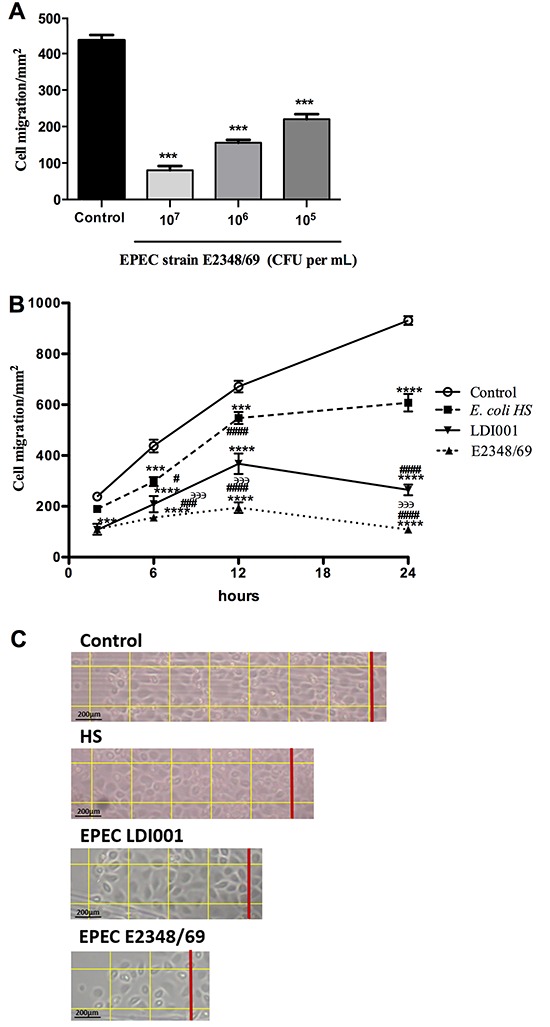
Figure 1.
Figure 1.. Effects of bacteria on IEC-6 cell migration. A, Concentration analysis of enteropathogenic Escherichia coli (EPEC) strain E2348/69 with 105, 106, and 107 cell forming units (CFU) per mL on cell migration at 6 h to determine optimum inoculum. B, Time-course analysis of damage on intestinal epithelial cells migration induced by EPEC strain E2348/69 and LDI001, and commensal E. coli strain HS (inoculum, 106 CFU per mL). Data are reported as mean±SE of three independent experiments (n=8). C, Intestinal cell migration after 24 h. The red line represents the initial cut and each square has an area of 0.1 mm2. Magnification 10×, bar: 200 μm. ***P<0.001 and ****P<0.0001 vs uninfected control; #P<0.05, ###P<0.001, and ####P<0.0001 vs E. coli strain HS; ϶϶϶P<0.001 vs EPEC strain LDI001 (ANOVA followed by Bonferroni's post-test).
Figure 2.
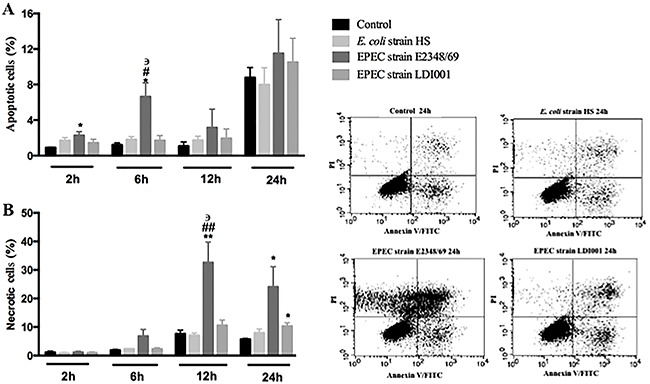
Figure 2.. Kinetic analysis of apoptosis (A) and necrosis (B) rates on intestinal epithelial IEC-6 cell induced by enteropathogenic Escherichia coli (EPEC) strains E2348/69 and LDI001 and commensal E. coli strain HS (inocula, 106 CFU per mL). Data are reported as mean±SE of three independent experiments. *P<0.05 and **P<0.01 vs uninfected control; #P<0.05 and ##P<0.01 vs E. coli strain HS; ϶P<0.05 vs EPEC strain LDI001 (ANOVA followed by Bonferroni's post-test).
Figure 3.
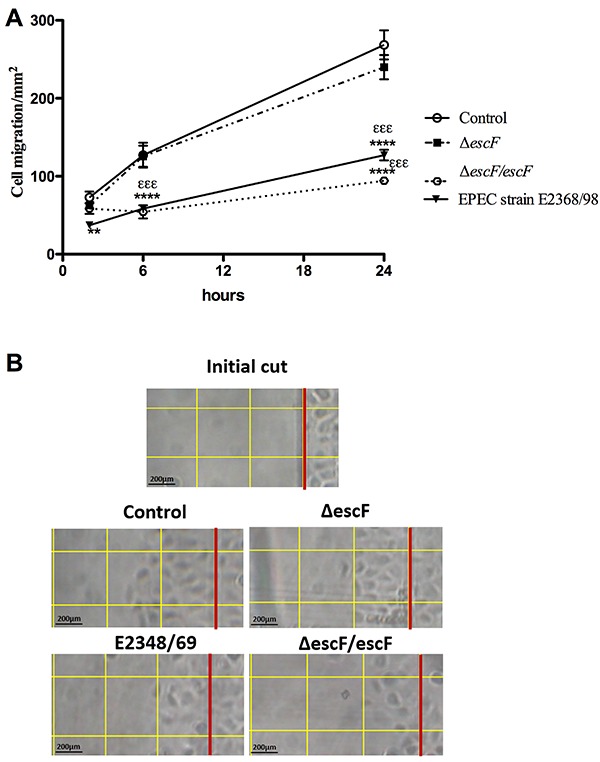
Figure 3.. Effects of enteropathogenic Escherichia coli (EPEC) strain E2348/69, EscF-complemented (ΔescF/escF), and type III secretion system (T3SS)-deletion mutant (ΔescF) infection on migration of IEC-6 cells A. Data are reported as mean±SE of three independent experiments (n=7). **P<0.01 and ****P<0.001 vs uninfected control; εεεP<0.001 vs ΔescF EPEC strain (ANOVA followed by Bonferroni's post-test). B, Intestinal cell migration after 6 h. The red line represents the initial cut and each square has an area of 0.1 mm2. Magnification 10×, bar: 200 μm.
Figure 4.
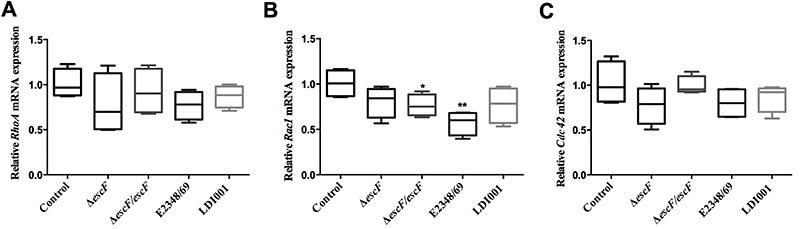
Figure 4.. Expression of the transcription of small Rho GTPases RhoA (A), Rac1 (B), and Cdc42 (C) by IEC-6 cells after infection with enteropathogenic Escherichia coli (EPEC) strain E2348/69, EscF-complemented (ΔescF/escF) and T3SS-deletion mutant (ΔescF). Results were determined by quantitative RT-PCR and normalized to ywhaz (housekeeping gene) and were performed by the ΔΔCT method. Data are reported as means±SE of three independent experiments. *P<0.05 and **P<0.01 vs uninfected control (ANOVA followed by Bonferroni's post-test).
Figure 5.
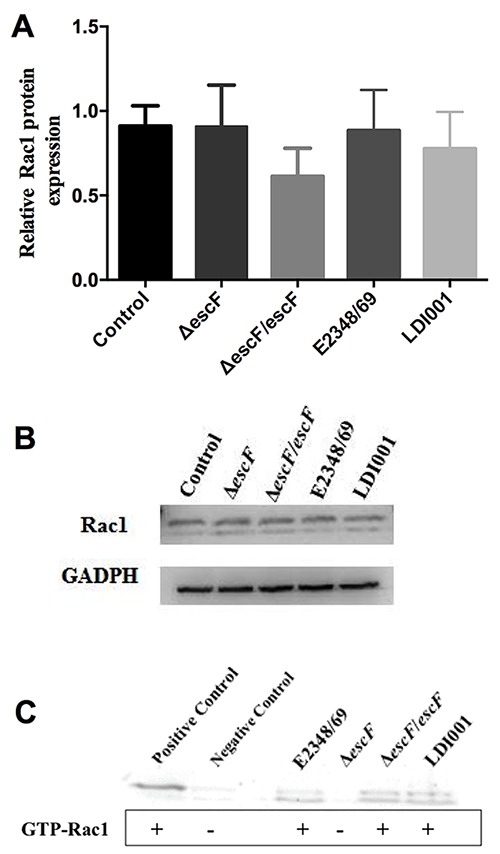
Figure 5.. Enteropathogenic Escherichia coli (EPEC) strains E2348/69, EscF-complemented (ΔescF/escF) and T3SS-deletion mutant (ΔescF) infection did not affect protein expression of Rac1 in IEC-6 cells (western blot analysis) (A and B). EPEC strains, except the type III secretion system (T3SS)-deficient strain, promoted Rac1 activation (C). Data are reported as means±SE of three independent experiments.

References

    1. Kotloff KL, Nataro JP, Blackwelder WC, Nasrin D, Farag TH, Panchalingam S, et al. Burden and aetiology of diarrhoeal disease in infants and young children in developing countries (the global enteric multicenter study, GEMS): a prospective, case-control study. Lancet. 2013;382:209–222. doi: 10.1016/S0140-6736(13)60844-2. - DOI - PubMed
    1. Alikhani MY, Mirsalehian A, Aslani MM. Detection of typical and atypical enteropathogenic Escherichia coli (EPEC) in Iranian children with and without diarrhoea. J Med Microbiol. 2006;55:1159–1163. doi: 10.1099/jmm.0.46539-0. - DOI - PubMed
    1. Vieira MA, Dos Santos LF, Dias RC, Camargo CH, Pinheiro SR, Gomes TA, et al. Atypical enteropathogenic Escherichia coli as etiologic agents of sporadic and outbreak-associated diarrhea in Brazil. J Med Microbiol. 2016;65:998–1006. doi: 10.1099/jmm.0.000313. - DOI - PubMed
    1. Croxen MA, Law RJ, Scholz R, Keeney KM, Wlodarska M, Finlay BB. Recent advances in understanding enteric pathogenic Escherichia coli. Clin Microbiol Rev. 2013;26:822–880. doi: 10.1128/CMR.00022-13. - DOI - PMC - PubMed
    1. Lapointe TK, O'Connor PM, Buret AG. The role of epithelial malfunction in the pathogenesis of enteropathogenic E. coli-induced diarrhea. Lab Invest. 2009;89:964–970. doi: 10.1038/labinvest.2009.69. - DOI - PubMed

Publication types

MeSH terms