. 2018 Aug 1;9(1):3004.
doi: 10.1038/s41467-018-05109-4.

High protein copy number is required to suppress stochasticity in the cyanobacterial circadian clock

Affiliations

High protein copy number is required to suppress stochasticity in the cyanobacterial circadian clock

Justin Chew et al. Nat Commun. .

Abstract

Circadian clocks generate reliable ~24-h rhythms despite being based on stochastic biochemical reactions. The circadian clock in Synechococcus elongatus uses a post-translational oscillator that cycles deterministically in a test tube. Because the volume of a single bacterial cell is much smaller than a macroscopic reaction, we asked how clocks in single cells function reliably. Here, we show that S. elongatus cells must express many thousands of copies of Kai proteins to effectively suppress timing errors. Stochastic modeling shows that this requirement stems from noise amplification in the post-translational feedback loop that sustains oscillations. The much smaller cyanobacterium Prochlorococcus expresses only hundreds of Kai protein copies and has a simpler, hourglass-like Kai system. We show that this timer strategy can outperform a free-running clock if internal noise is significant. This conclusion has implications for clock evolution and synthetic oscillator design, and it suggests hourglass-like behavior may be widespread in microbes.


Conflict of interest statement

The authors declare no competing interests.

Figures
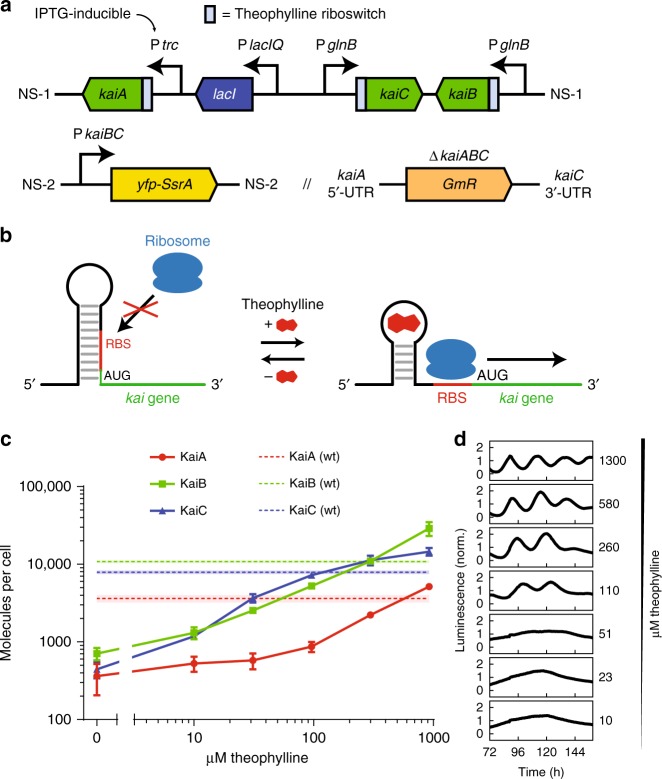
Fig. 1
Fig. 1
Characterization of the Kai copy-number tunable strain. a A theophylline riboswitch regulates translational efficiency of all three kai genes, and transcriptional regulation of kaiA is controlled by an IPTG-inducible promoter. Clock state is reported by EYFP-SsrA expressed from the kaiBC promoter. b Theophylline regulates translation by freeing the ribosome binding site upstream of each kai gene. c Kai copy numbers plotted as a function of theophylline concentration with 1 μM IPTG (solid line), and Kai copy numbers in wild-type cells (dotted line). Vertical error bars or shaded area indicate standard error of the mean from three replicates. d Colony-level oscillations detected with a bioluminescent reporter in the copy number tunable strain with 1 μM IPTG and various theophylline concentrations
Fig. 2
Fig. 2
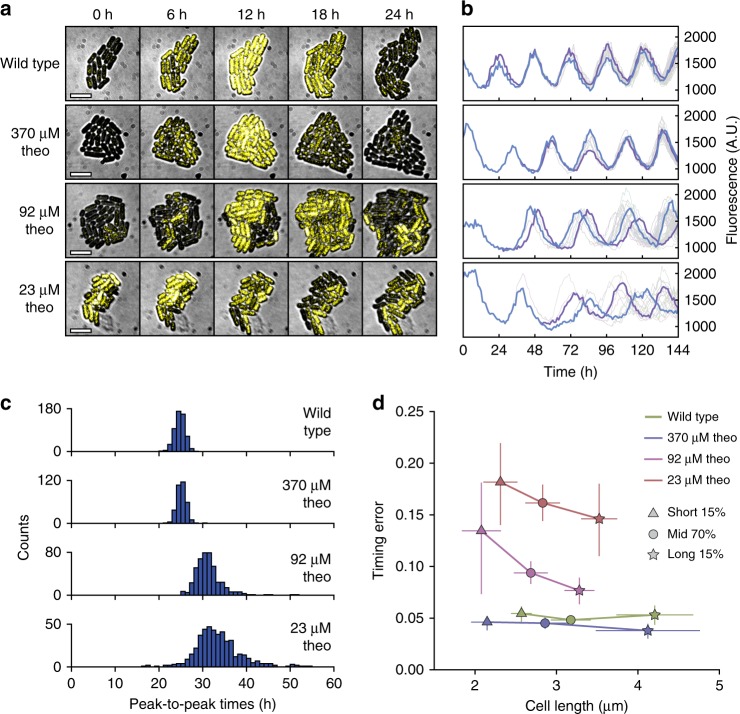
Single cell microscopy reveals desynchronized oscillations at low Kai copy number. a Filmstrips of YFP oscillations in wild-type cells and the copy number tunable strain induced with 1 μM IPTG and various theophylline concentrations (brightfield and YFP fluorescence overlaid). Scale bar: 5 μm. b Single cell oscillator trajectories (gray) with two example cell lineages highlighted (blue and purple). c Distributions of peak-to-peak times in wild-type and copy number tunable cells; n = 536 (wildtype), 336 (370 μM), 455 (92 μM), 616 (23 μM). d Cell length vs. timing error (standard deviation/mean of peak-to-peak intervals) in the 15% shortest cells (triangles), middle 70% cells (circles), and 15% longest cells (stars) for each condition. Vertical error bars indicate 95% confidence intervals from bootstrapping (5000 iterations), and horizontal error bars indicate standard deviation in cell length
Fig. 3
Fig. 3
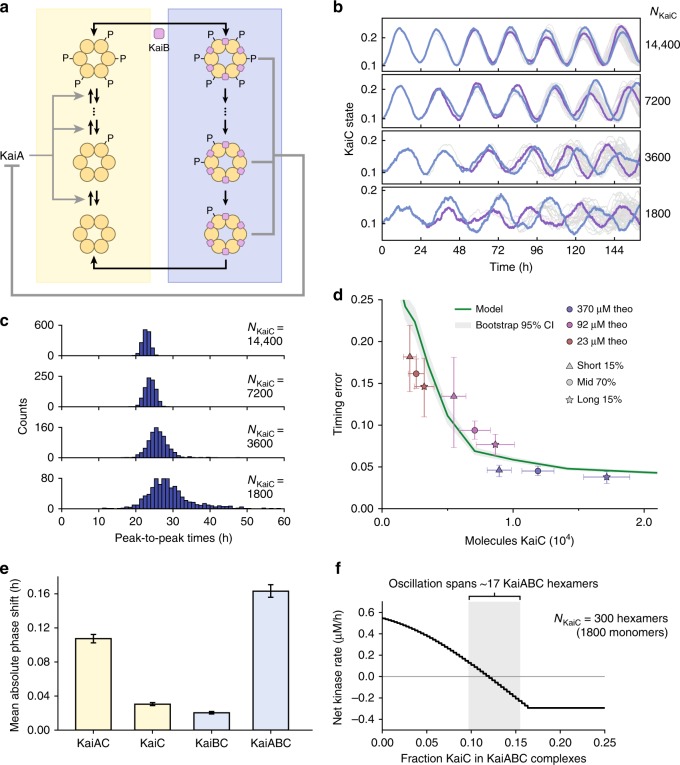
KaiA-dependent negative feedback loop is the noise bottleneck in a stochastic model of the Kai system. a Model of post-translational oscillator. KaiC hexamers undergo ordered phosphorylation (yellow box) and dephosphorylation (blue box). KaiA is required for KaiC phosphorylation, and dephosphorylating KaiC binds to KaiB to sequester and inhibit KaiA. (see Supplementary Fig. S5). b Simulated stochastic single cell trajectories (gray) at various Kai copy numbers with two example traces highlighted (blue and purple). “KaiC state” indicates the average position of KaiC molecules in the oscillator loop. c Distributions of peak-to-peak time intervals in the stochastic model. d Comparison of model and experimental data. Vertical error bars indicate 95% confidence interval from bootstrapping (5000 iterations). Horizontal error bars indicate standard error of the mean (n = 3). Gray interval indicates the 95% bootstrapping confidence interval for the model. e Mean phase shift caused by Poisson noise perturbations to molecular species in the model (n = 500 trials). Error bars indicate 95% confidence interval from bootstrapping. f Instantaneous KaiC phosphorylation rate vs. fraction of KaiC in KaiABC complexes in the stochastic model for NKaiC = 300 hexamers. Shaded area indicates the range over which KaiABC complexes oscillate
Fig. 4
Fig. 4
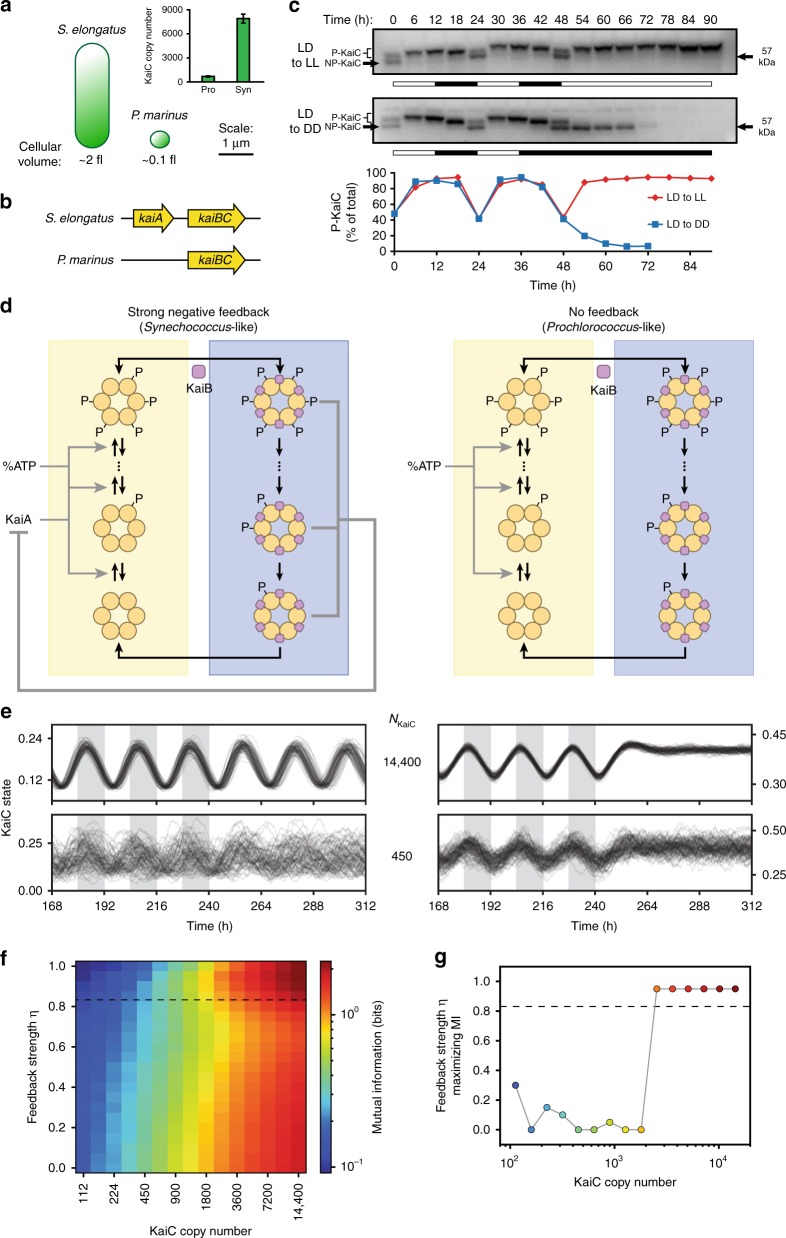
Removing the negative feedback loop creates a noise-resistant environmental timer in a Prochlorococcus-like system. a Comparison of cell volume and KaiC copy number in Prochlorococcus marinus vs. Synechococcus elongatus. Copy number (inset) determined by quantitative western blot (n = 3). b Prochlorococcus has a simplified Kai architecture that lacks kaiA. c Top: western blot time course showing Prochlorococcus KaiC (ProKaiC) phosphorylation in cultures incubated in light-dark cycles followed by constant light or constant dark. Bottom: quantification of ProKaiC phosphorylation. d Comparisons of model architectures corresponding to Synechococcus (left, strong feedback) and Prochlorococcus (right, no feedback). e Simulations of Kai systems with strong feedback (left) and no feedback (right) in light-dark cycles (shaded regions), followed by constant light at high copy number (top, 14,400 KaiC copies) and low copy number (bottom, 450 KaiC copies). “KaiC state” indicates the average position of KaiC molecules in the oscillator loop. f Mutual information between the clock and time of day during light-dark cycles in the presence of environmental fluctuations (see Supplementary Information). Stable oscillations occur for feedback strength above 0.83 (dashed line). g Feedback strength that maximizes mutual information as a function of KaiC copy number. Above the dashed line, the system shows self-sustaining circadian rhythms. Marker colors correspond to the colorbar in f

References

    1. Woelfle MA, Ouyang Y, Phanvijhitsiri K, Johnson CH. The adaptive value of circadian clocks: an experimental assessment in cyanobacteria. Curr. Biol. 2004;14:1481–1486. doi: 10.1016/j.cub.2004.08.023. - DOI - PubMed
    1. Spoelstra K, Wikelski M, Daan S, Loudon AS, Hau M. Natural selection against a circadian clock gene mutation in mice. Proc. Natl Acad. Sci. USA. 2016;113:686–691. doi: 10.1073/pnas.1516442113. - DOI - PMC - PubMed
    1. Elowitz MB, Leibler S. A synthetic oscillatory network of transcriptional regulators. Nature. 2000;403:335–338. doi: 10.1038/35002125. - DOI - PubMed
    1. Stricker J, et al. A fast, robust and tunable synthetic gene oscillator. Nature. 2008;456:516–519. doi: 10.1038/nature07389. - DOI - PMC - PubMed
    1. Tigges M, Marquez-Lago TT, Stelling J, Fussenegger M. A tunable synthetic mammalian oscillator. Nature. 2009;457:309–312. doi: 10.1038/nature07616. - DOI - PubMed

Publication types

Substances

LinkOut - more resources