


Evidence for functional state transitions in intensively-managed soil ecosystems
- PMID: 30068982
- PMCID: PMC6070522
- DOI: 10.1038/s41598-018-29925-2
Evidence for functional state transitions in intensively-managed soil ecosystems
Abstract
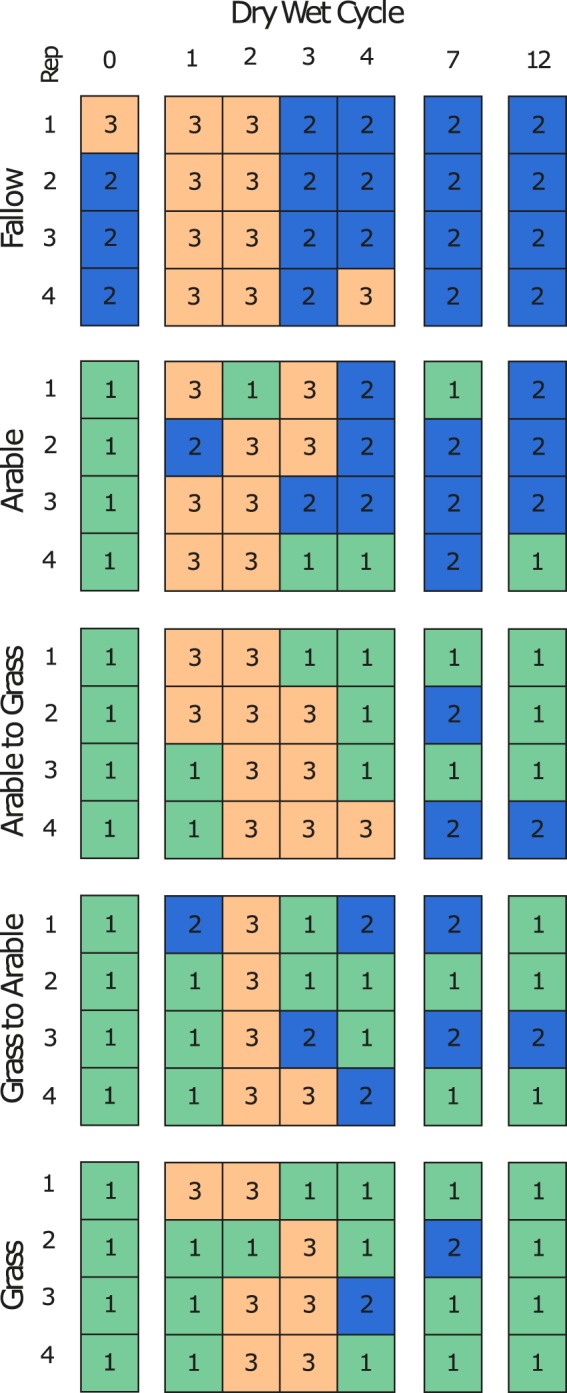
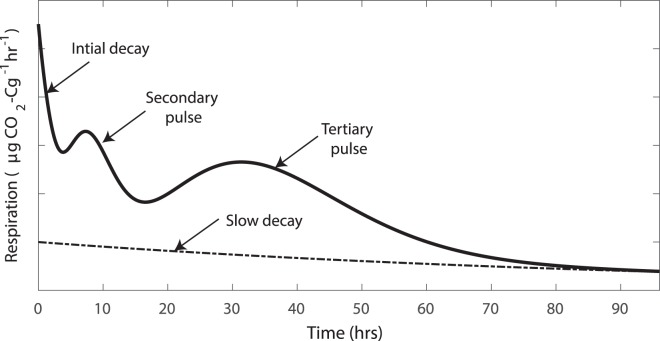
Soils are fundamental to terrestrial ecosystem functioning and food security, thus their resilience to disturbances is critical. Furthermore, they provide effective models of complex natural systems to explore resilience concepts over experimentally-tractable short timescales. We studied soils derived from experimental plots with different land-use histories of long-term grass, arable and fallow to determine whether regimes of extreme drying and re-wetting would tip the systems into alternative stable states, contingent on their historical management. Prior to disturbance, grass and arable soils produced similar respiration responses when processing an introduced complex carbon substrate. A distinct respiration response from fallow soil here indicated a different prior functional state. Initial dry:wet disturbances reduced the respiration in all soils, suggesting that the microbial community was perturbed such that its function was impaired. After 12 drying and rewetting cycles, despite the extreme disturbance regime, soil from the grass plots, and those that had recently been grass, adapted and returned to their prior functional state. Arable soils were less resilient and shifted towards a functional state more similar to that of the fallow soil. Hence repeated stresses can apparently induce persistent shifts in functional states in soils, which are influenced by management history.
Conflict of interest statement
The authors declare no competing interests.
Figures


References
-
- IPCC. Managing the Risks of Extreme Events and Disasters to Advance Climate Change Adaptation. A Special Report of Working Groups I and II of the Intergovernmental Panel on Climate Change. (eds Field, C. B. et al.) (Cambridge University Press, 2012).
-
- Hirsch PR, et al. Starving the soil of plant inputs for 50 years reduces abundance but not diversity of soil bacterial communities. Soil Biol. Biochem. 2009;41:2021–2024. doi: 10.1016/j.soilbio.2009.07.011. - DOI
Publication types
Associated data
Grants and funding
LinkOut - more resources
Full Text Sources
Other Literature Sources
Molecular Biology Databases
