


Systematic review and meta-analysis: Efficacy of patented probiotic, VSL#3, in irritable bowel syndrome
- PMID: 30069978
- PMCID: PMC6249050
- DOI: 10.1111/nmo.13427
Systematic review and meta-analysis: Efficacy of patented probiotic, VSL#3, in irritable bowel syndrome
Abstract
Background: VSL#3 is a patented probiotic for which several clinical trials suggest benefits on motor function, bloating, and symptoms of irritable bowel syndrome (IBS).
Objectives: To quantify effects of VSL#3 on abdominal pain, stool consistency, overall response, abdominal bloating, and quality of life (QOL) in IBS through meta-analysis.
Methods: MEDLINE (OvidSP and PubMed), EMBASE, Web of Science, and Scopus were searched up to May 2017. Using a fixed effects model, we pooled data from intention-to-treat analyses of randomized trials (RCTs) comparing VSL#3 to placebo in IBS. Data were reported as relative risk (RR), overall mean difference (MD), or standardized MD (SMD) with 95% confidence intervals (CI). Quality of evidence was rated using the GRADE approach.
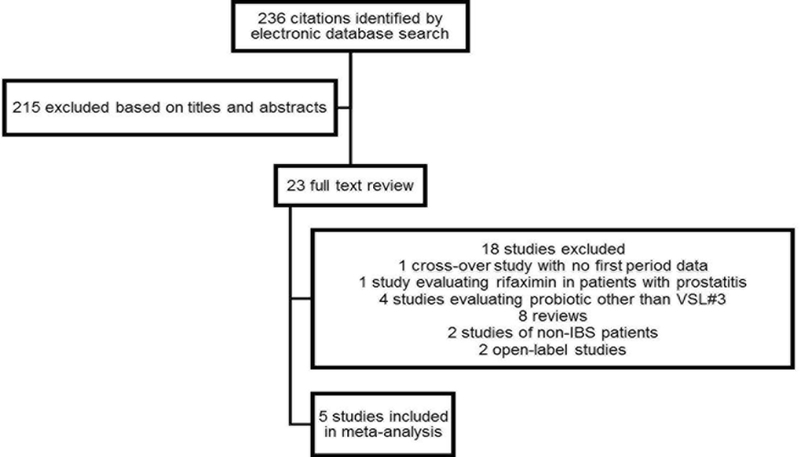
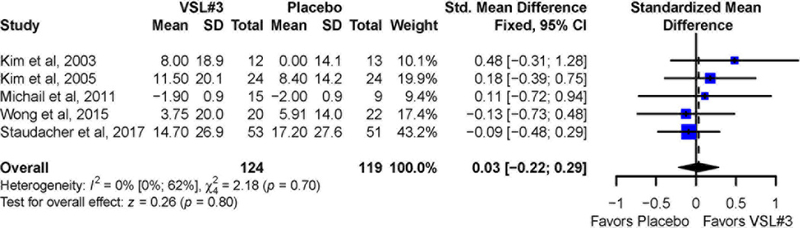
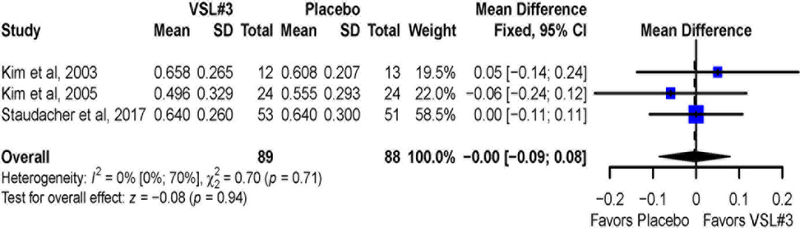
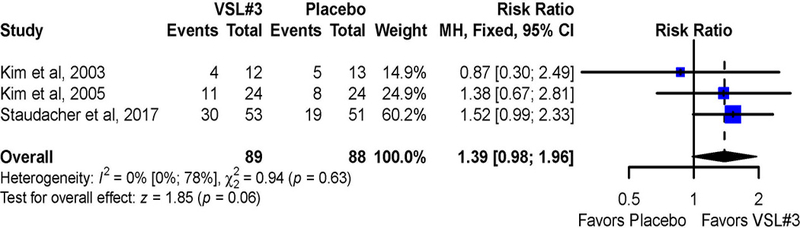
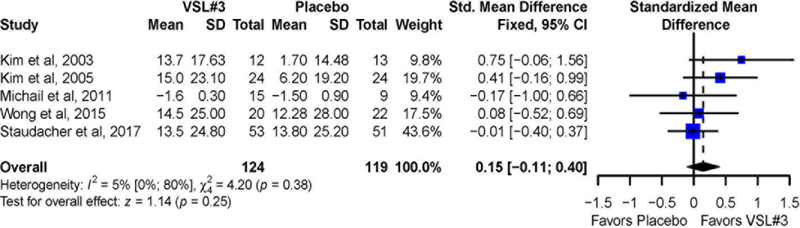
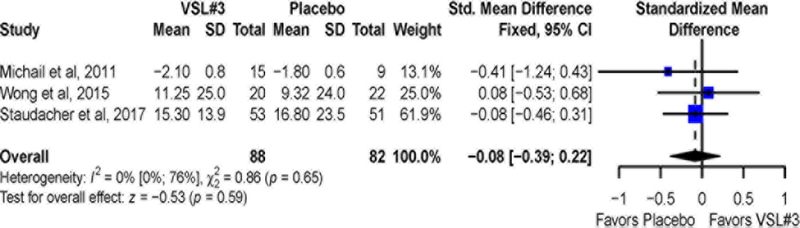
Key results: Among 236 citations, 5 RCTs (243 patients) were included. No significant differences were observed for abdominal pain (SMD = -0.03; 95% CI -0.29 to 0.22), bloating (SMD = -0.15; 95% CI -0.40 to 0.11), proportion of bowel movements with normal consistency (overall MD = 0; 95% CI -0.09 to 0.08), or IBS-QOL (SMD = 0.08; 95% CI -0.22 to 0.39). VSL#3 was associated with a nearly statistically significant increase in overall response (RR = 1.39; 95% CI 0.99-1.98).
Conclusions & inferences: In this systematic review and meta-analysis, there was a trend toward improvement in overall response with VSL#3, but no clear evidence effectiveness for IBS. However, the number and sample sizes of the trials are small and the overall quality of evidence for 3 of the 5 outcomes was low. Larger trials evaluating validated endpoints in well-defined IBS patients are warranted.
Keywords: VSL#3; irritable bowel syndrome; probiotic; systematic review.
© 2018 John Wiley & Sons Ltd.
Figures
Comment in
-
Not more, but less studies are warranted-If you take your meta-analysis seriously.Neurogastroenterol Motil. 2019 Jan;31(1):e13473. doi: 10.1111/nmo.13473. Neurogastroenterol Motil. 2019. PMID: 30556262 No abstract available.
-
Refers to: Paul Enck. Not more, but less studies are warranted-If you take your meta-analysis seriously.Neurogastroenterol Motil. 2019 Jan;31(1):e13490. doi: 10.1111/nmo.13490. Neurogastroenterol Motil. 2019. PMID: 30556264 Free PMC article.
References
-
- Sperber AD, Dumitrascu D, Fukudo S, et al. The global prevalence of IBS in adults remains elusive due to the heterogeneity of studies: a Rome Foundation working team literature review. Gut 2017;66:1075–1082. - PubMed
-
- Mearin F, Lacy BE, Chang L, et al. Bowel Disorders. Gastroenterology 2016. - PubMed
-
- Parkes GC, Brostoff J, Whelan K, et al. Gastrointestinal microbiota in irritable bowel syndrome: their role in its pathogenesis and treatment. Am J Gastroenterol 2008;103:1557–67. - PubMed
Publication types
MeSH terms
Grants and funding
LinkOut - more resources
Full Text Sources
Other Literature Sources
