Review
. 2018 Sep;7(9):651-663.
doi: 10.1002/sctm.18-0024. Epub 2018 Aug 1.

Concise Review: Mesenchymal Stem Cell-Based Drug Delivery: The Good, the Bad, the Ugly, and the Promise

Affiliations
Review

Concise Review: Mesenchymal Stem Cell-Based Drug Delivery: The Good, the Bad, the Ugly, and the Promise

Timothy E G Krueger et al. Stem Cells Transl Med. 2018 Sep.

Abstract

The development of mesenchymal stem cells (MSCs) as cell-based drug delivery vectors for numerous clinical indications, including cancer, has significant promise. However, a considerable challenge for effective translation of these approaches is the limited tumor tropism and broad biodistribution observed using conventional MSCs, which raises concerns for toxicity to nontarget peripheral tissues (i.e., the bad). Consequently, there are a variety of synthetic engineering platforms in active development to improve tumor-selective targeting via increased homing efficiency and/or specificity of drug activation, some of which are already being evaluated clinically (i.e., the good). Unfortunately, the lack of robust quantification and widespread adoption of standardized methodologies with high sensitivity and resolution has made accurate comparisons across studies difficult, which has significantly impeded progress (i.e., the ugly). Herein, we provide a concise review of active and passive MSC homing mechanisms and biodistribution postinfusion; in addition to in vivo cell tracking methodologies and strategies to enhance tumor targeting with a focus on MSC-based drug delivery strategies for cancer therapy. Stem Cells Translational Medicine 2018;1-13.

Keywords: Cell size; Cell-based therapy; Drug delivery; Homing; In vivo cell tracking; Mesenchymal stem cell.


Figures

Figure 1
Figure 1
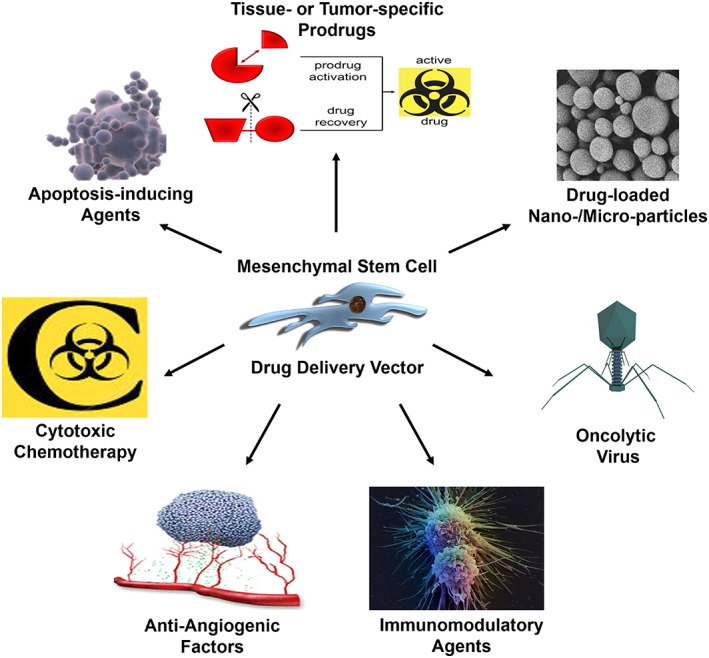
Mesenchymal stem cell (MSC)‐based drug delivery strategies. The tumor tropism of MSCs can be exploited to deliver a wide variety of therapeutic agents for the treatment of cancer, such as apoptosis‐inducing agents, cytotoxic chemotherapy, anti‐angiogenic factors, immunomodulatory agents, oncolytic viruses, drug‐loaded nanoparticles/microparticles, and tissue‐ or tumor‐specific prodrugs.
Figure 2
Figure 2
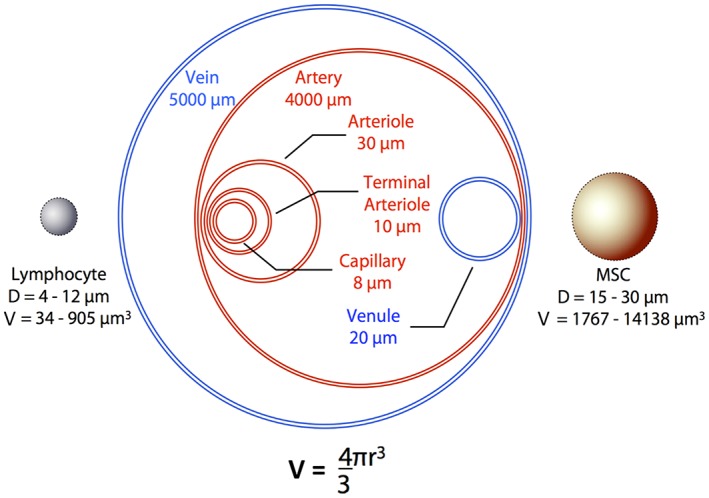
Mechanical barriers to MSC trafficking via systemic circulation. The large cell size of MSCs, particularly following ex vivo expansion, is a significant physical barrier that prevents efficient and complete dispersion through small vessels in the vascular network. This severely limits access of exogenously introduced MSCs to many target tissues, including tumors. Abbreviations: D, diameter; MSC, mesenchymal stem cell; V, volume.
Figure 3
Figure 3
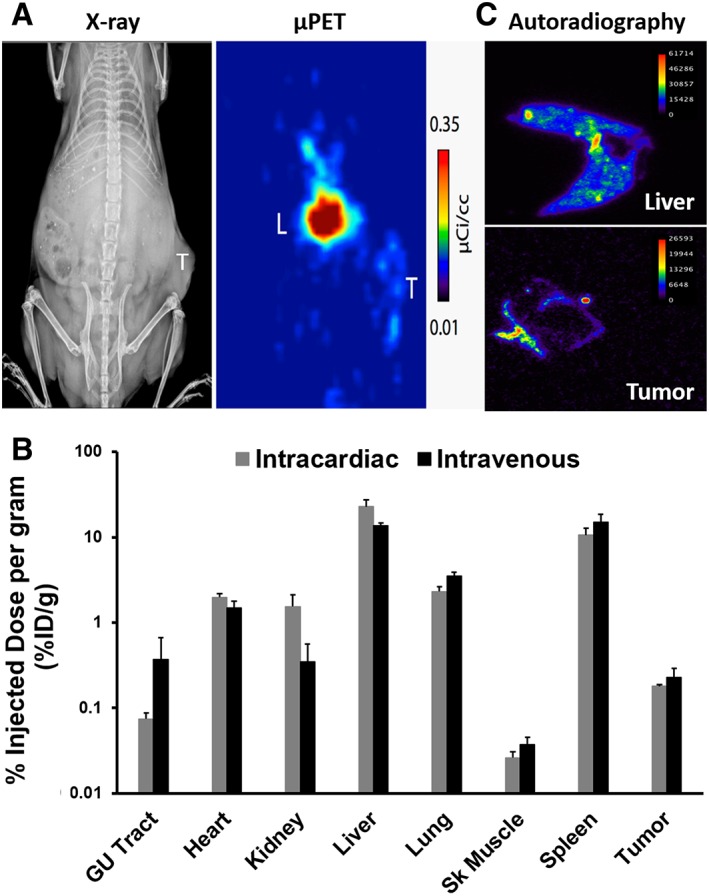
In vivo cell tracking of systemically‐infused 89Zr‐labeled human MSCs in a prostate cancer xenograft model. (A): X‐ray and μPET imaging documenting accumulation of the radiolabel in the liver and tumor (PC3) at 7 days post‐IV infusion. (B): Biodistribution of 89Zr‐labeled MSCs at 7 days post‐IV or ‐IC infusion determined by ex vivo scintigraphy. (C): Autoradiography detailing sub‐organ distribution of 89Zr‐labeled MSCs, confirming localization restricted to the tumor periphery. Abbreviation: μPET, microPET.

References

    1. Phinney DG. Functional heterogeneity of mesenchymal stem cells: Implications for cell therapy. J Cell Biochem 2012;113:2806–2812. 10.1002/jcb.24166 - DOI - PubMed
    1. Caplan AI. Adult mesenchymal stem cells: When, where, and how. Stem Cells Int 2015;2015:628767–628766. 10.1155/2015/628767 - DOI - PMC - PubMed
    1. Brennen WN, Denmeade SR, Isaacs JT. Mesenchymal stem cells as a vector for the inflammatory prostate microenvironment. Endocr Relat Cancer 2013;20:R269–R290. 10.1530/ERC-13-0151 - DOI - PMC - PubMed
    1. D'Souza N, Rossignoli F, Golinelli G et al. Mesenchymal stem/stromal cells as a delivery platform in cell and gene therapies. BMC Med 2015;13:186 10.1186/s12916-015-0426-0 - DOI - PMC - PubMed
    1. Hagenhoff A, Bruns CJ, Zhao Y et al. Harnessing mesenchymal stem cell homing as an anticancer therapy. Expert Opin Biol Ther 2016;16:1079–1092. 10.1080/14712598.2016.1196179 - DOI - PubMed

Publication types