


High-flow nasal cannula oxygen therapy decreases postextubation neuroventilatory drive and work of breathing in patients with chronic obstructive pulmonary disease
- PMID: 30071876
- PMCID: PMC6091018
- DOI: 10.1186/s13054-018-2107-9
High-flow nasal cannula oxygen therapy decreases postextubation neuroventilatory drive and work of breathing in patients with chronic obstructive pulmonary disease
Abstract
Background: The physiological effects of high-flow nasal cannula O2 therapy (HFNC) have been evaluated mainly in patients with hypoxemic respiratory failure. In this study, we compared the effects of HFNC and conventional low-flow O2 therapy on the neuroventilatory drive and work of breathing postextubation in patients with a background of chronic obstructive pulmonary disease (COPD) who had received mechanical ventilation for hypercapnic respiratory failure.
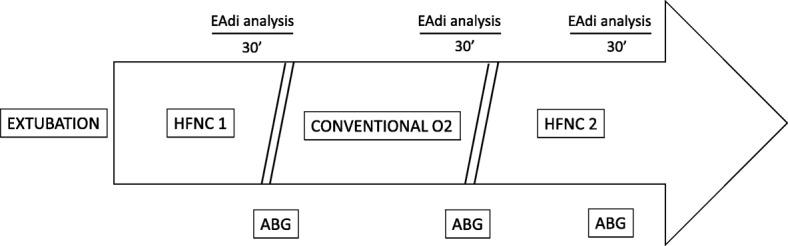
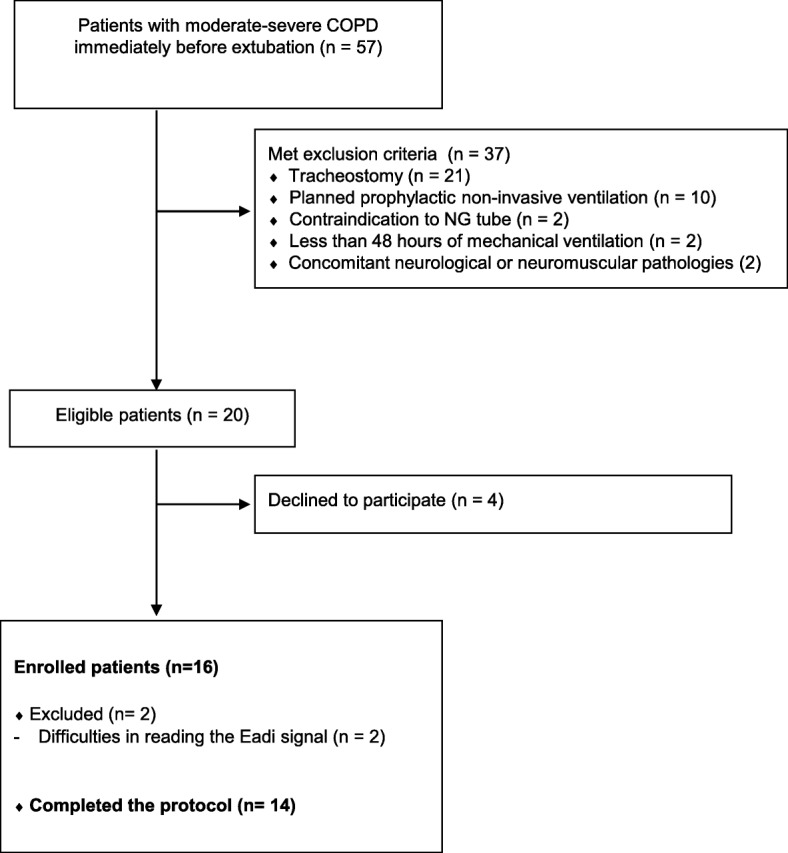
Methods: This was a single center, unblinded, cross-over study on 14 postextubation COPD patients who were recovering from an episode of acute hypercapnic respiratory failure of various etiologies. After extubation, each patient received two 1-h periods of HFNC (HFNC1 and HFNC2) alternated with 1 h of conventional low-flow O2 therapy via a face mask. The inspiratory fraction of oxygen was titrated to achieve an arterial O2 saturation target of 88-92%. Gas exchange, breathing pattern, neuroventilatory drive (electrical diaphragmatic activity (EAdi)) and work of breathing (inspiratory trans-diaphragmatic pressure-time product per minute (PTPDI/min)) were recorded.
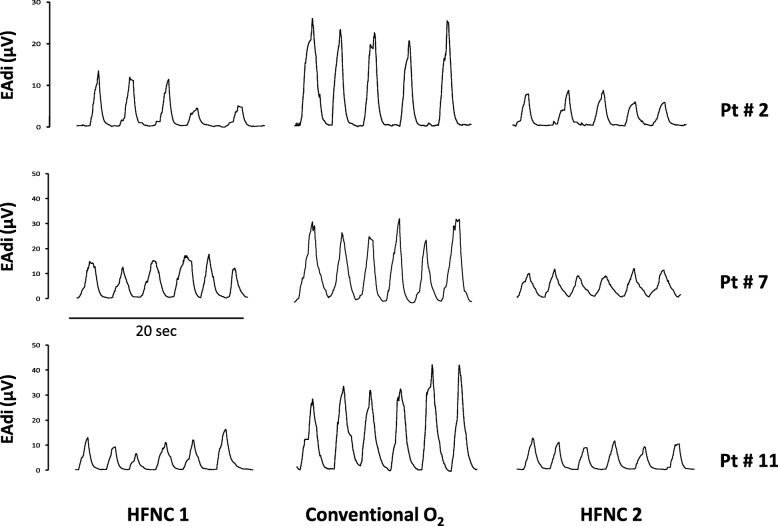
Results: EAdi peak increased from a mean (±SD) of 15.4 ± 6.4 to 23.6 ± 10.5 μV switching from HFNC1 to conventional O2, and then returned to 15.2 ± 6.4 μV during HFNC2 (conventional O2: p < 0.05 versus HFNC1 and HFNC2). Similarly, the PTPDI/min increased from 135 ± 60 to 211 ± 70 cmH2O/s/min, and then decreased again during HFNC2 to 132 ± 56 (conventional O2: p < 0.05 versus HFNC1 and HFNC2).
Conclusions: In patients with COPD, the application of HFNC postextubation significantly decreased the neuroventilatory drive and work of breathing compared with conventional O2 therapy.
Keywords: Chronic obstructive pulmonary disease; High-flow nasal cannula oxygen therapy; Neuroventilatory drive; Weaning from mechanical ventilation; Work of breathing.
Conflict of interest statement
Ethical approval was obtained by the local ethics committee (Azienda Ospedaliero-Universitaria Policlinico di Bari Ethic Committee, protocol number: 885/C.E., May 2014). All patients or their relatives provided informed consent to participate.
Not applicable.
SG has given talks in symposia organized by Getinge Critical Care (Solna Sweden), Estor Critical Care (Mirandola, Italy), and Fisher and Paykel (Auckland, New Zealand), and has received compensation for related travel and accommodation fees. He declares no other relationship or activities that could appear to have influence the submitted work. The remaining authors declare that they have no competing interests.
Springer Nature remains neutral with regard to jurisdictional claims in published maps and institutional affiliations.
Figures

Comment in
-
Potential confounders for the effect of high-flow nasal cannula oxygen therapy.Crit Care. 2019 Jan 17;23(1):17. doi: 10.1186/s13054-019-2310-3. Crit Care. 2019. PMID: 30654830 Free PMC article. No abstract available.
-
Chronisches respiratorisches Versagen, Weaning.Med Klin Intensivmed Notfmed. 2019 Mar;114(2):96-97. doi: 10.1007/s00063-018-0525-8. Med Klin Intensivmed Notfmed. 2019. PMID: 30847530 German. No abstract available.
References
-
- Spoletini G, Alotaibi M, Blasi F, Hill NS. Heated humidified high-flow nasal oxygen in adults: mechanisms of action and clinical implications. Chest. 2015;148(1):253–61. - PubMed
Publication types
MeSH terms
LinkOut - more resources
Full Text Sources
Other Literature Sources
Medical
