


Unique Dispositional Precursors to Early-Onset Conduct Problems and Criminal Offending in Adulthood
- PMID: 30071979
- PMCID: PMC7045361
- DOI: 10.1016/j.jaac.2018.04.013
Unique Dispositional Precursors to Early-Onset Conduct Problems and Criminal Offending in Adulthood
Abstract
Objective: The aims of this study were to examine whether dispositional interpersonal callousness, negative emotionality, and hyperactivity/impulsivity uniquely influence the development of childhood-onset conduct problems and persistent criminal behavior in males, and to determine whether specific facets of negative emotionality (dysregulated anger versus anxiety) in childhood are differentially associated with the development of chronic antisocial behavior.
Method: Childhood dispositional features and conduct problems were assessed semiannually using parent- and teacher-report measures across 9 consecutive assessments in a school-based sample of 503 boys (∼7-11 years of age). Participants' criminal behavior was assessed using official records from adolescence into the early 30s.
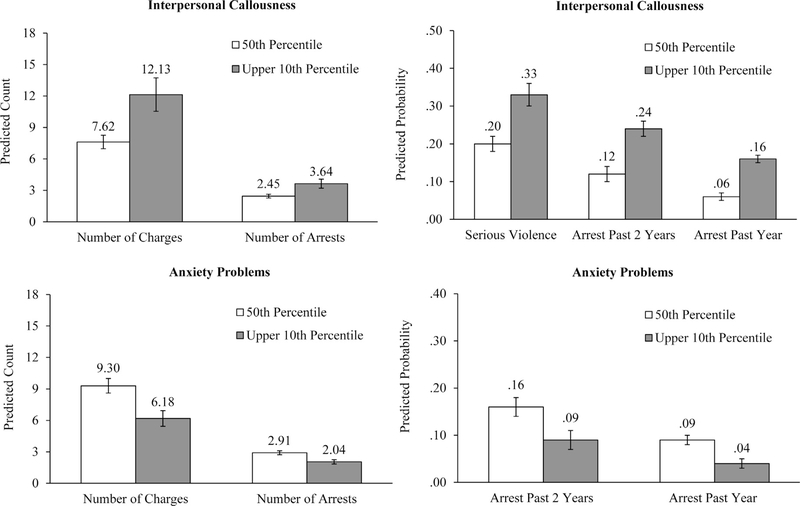
Results: Interpersonal callousness, dysregulated anger, and hyperactivity/impulsivity were uniquely associated with the development of childhood-onset conduct problems. None of these features significantly predicted official records of juvenile offending after controlling for co- occurring conduct problems. However, interpersonal callousness was robustly and uniquely associated with a pattern of persistent and violent adult offending that continued into the early 30s. In contrast, anxiety problems were inversely associated with criminal offending in adolescence and adulthood after controlling for conduct problems and the other dispositional factors.
Conclusion: Findings are consistent with theoretical models indicating that interpersonal callousness, dysregulated anger, and hyperactivity/impulsivity influence the development of childhood conduct problems. In contrast, anxiety problems in childhood tend to reduce the likelihood that boys will engage in later criminal offending. Results suggest that delinquency prevention programs should target children exhibiting features of interpersonal callousness, given that they are at high risk for engaging in chronic and violent offending in adulthood.
Keywords: anger; callous/unemotional; crime; hyperactivity/impulsivity; violence.
Copyright © 2018 American Academy of Child and Adolescent Psychiatry. Published by Elsevier Inc. All rights reserved.
Conflict of interest statement
Disclosure: Drs. Pardini, Byrd, Hawes, and Docherty report no biomedical financial interests or potential conflicts of interest.
Figures
Comment in
-
Links Between Childhood Traits and Adult Criminal Behaviors.J Am Acad Child Adolesc Psychiatry. 2018 Aug;57(8):542-543. doi: 10.1016/j.jaac.2018.06.001. J Am Acad Child Adolesc Psychiatry. 2018. PMID: 30071973
References
-
- Odgers CL, Moffitt TE, Broadbent JM, et al. Female and male antisocial trajectories: from childhood origins to adult outcomes. Dev Psychopathol. 2008;20: 673–716. - PubMed
-
- Frick PJ, Viding E. Antisocial behavior from a developmental psychopathology perspective. Dev Psychopathol. 2009;21:1111–1131. - PubMed
-
- Frick PJ, Ray JV, Thornton LC, Kahn RE. Annual research review: a developmental psychopathology approach to understanding callous-unemotional traits in children and adolescents with serious conduct problems. J Child Psychol Psychiatry. 2014;55: 532–548. - PubMed
Publication types
MeSH terms
Grants and funding
LinkOut - more resources
Full Text Sources
Other Literature Sources
Medical
