Review
. 2018 Aug 2;71(3):409-418.
doi: 10.1016/j.molcel.2018.07.027.

SUMO-Mediated Regulation of Nuclear Functions and Signaling Processes

Affiliations
Review

SUMO-Mediated Regulation of Nuclear Functions and Signaling Processes

Xiaolan Zhao. Mol Cell. .

Abstract

Since the discovery of SUMO twenty years ago, SUMO conjugation has become a widely recognized post-translational modification that targets a myriad of proteins in many processes. Great progress has been made in understanding the SUMO pathway enzymes, substrate sumoylation, and the interplay between sumoylation and other regulatory mechanisms in a variety of contexts. As these research directions continue to generate insights into SUMO-based regulation, several mechanisms by which sumoylation and desumoylation can orchestrate large biological effects are emerging. These include the ability to target multiple proteins within the same cellular structure or process, respond dynamically to external and internal stimuli, and modulate signaling pathways involving other post-translational modifications. Focusing on nuclear function and intracellular signaling, this review highlights a broad spectrum of historical data and recent advances with the aim of providing an overview of mechanisms underlying SUMO-mediated global effects to stimulate further inquiry into intriguing roles of SUMO.


Figures

Figure 1:
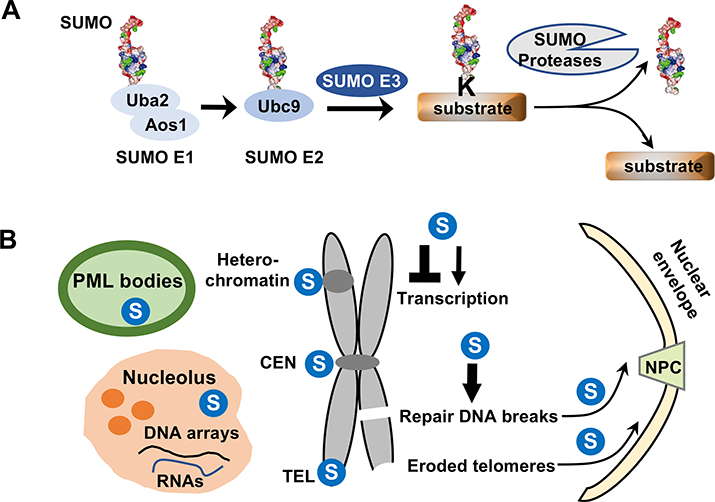
Figure 1:. Dynamic SUMO conjugation cycle and its multiple effects on nuclear structure and functions.
A. Conjugation and deconjugation of SUMO (shown in 3D structure rendering) are outlined. SUMO forms a thioester bond with the heterodimeric E1 (Aos1/Uba2) in an ATP-dependent manner. SUMO is then transferred to the E2 (Ubc9), again forming a thioester bond. SUMO is conjugated to the lysine residue (K) on the substrate with the help of SUMO E3. Only a single SUMO conjugation is shown, but multiple SUMOs or SUMO chains can also be found on substrates. SUMO proteases cleave SUMO from the substrate. B. A brief summary of major effects of sumoylation on nuclear structure and functions. Nuclear domains and chromosomal regions enriched with SUMO are indicated by formula image. Sumoylation also regulates transcription and DNA lesion repair as indicated. Arrow: positive effects; lines: negative effects. Arrows pointing to the nuclear pore complex (NPC) and nuclear envelope indicate SUMO-mediated DNA movement toward these locations.
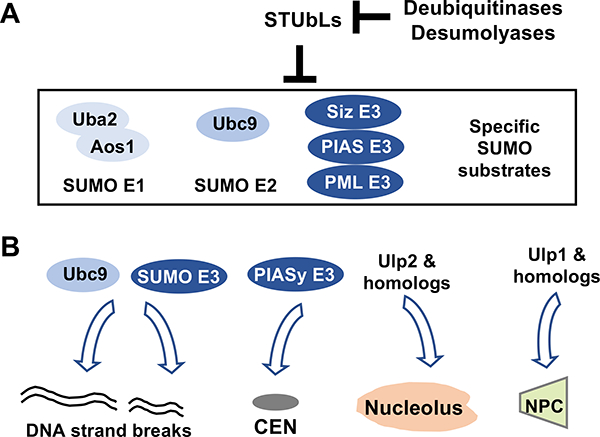
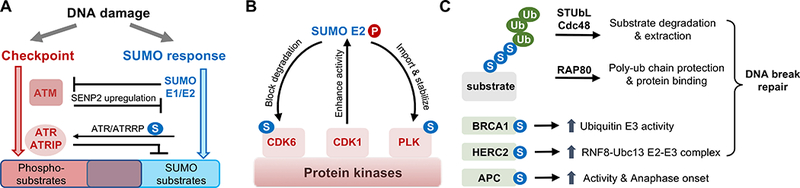
Figure 2:
Figure 2:. Examples of SUMO pathway regulation.
A. SUMO E1, E2, multiple SUMO E3s, and specific SUMO substrates can be targeted by STUbL-mediated protein degradation, an effect that can be counteracted by specific deubiquitinases or desumoylases. B. SUMO E2, SUMO E3s, and desumoylases can be targeted to specific nuclear and chromosomal structures to induce large scale changes in sumoylation.
Figure 3:
Figure 3:. Examples of crosstalk between SUMO-based regulation and other signaling processes
A. Interactions with the DNA damage checkpoint pathways. As described in the text, genome stress such as those caused by genotoxin treatment can induce a SUMO-based response and the ATM/ATR checkpoint kinase-mediated response. The two responses are independent but overlapping, and exhibit context-dependent and multi-layered genetic interactions. The enzymes in the two pathways show both positive (arrows) and negative (lines) genetic interactions as summarized in the text. In addition, they can target a group of common substrates, which provide another layer of crosstalk. B. SUMO E2 interactions with protein kinases. As described in the text, CDK1-mediated phosphorylation of SUMO E2 can increases E2 activity. Phosphorylated SUMO E2 can promote the sumoylation of the polo-kinase (PLK) and CDK6 in different cellular contexts. These sumoylation events can positively influence substrate kinase functions. C. Crosstalk with ubiquitination pathways. As detailed in the text, the hybrid SUMO-ubiquitin chain generated by STUbLs can lead to protein degradation or Cdc48 segregase-mediated protein extraction, but may also result in recruitment of proteins like RAP80, which recognize hybrid chains. RAP80 recruits additional proteins to DNA breaks and favors end-joining repair. SUMO can also modify ubiquitin ligases, such BRCA1, HERC2, and APC. Their sumoylation promotes specific activities or scaffolding roles, as depicted. Several types of this regulation occur during DSB repair.

References

    1. Ayaydin F, and Dasso M (2004). Distinct in vivo dynamics of vertebrate SUMO paralogues. Mol Biol Cell 15, 5208–5218. - PMC - PubMed
    1. Azuma Y, Arnaoutov A, and Dasso M (2003). SUMO-2/3 regulates topoisomerase II in mitosis. J Cell Biol 163, 477–487. - PMC - PubMed
    1. Bachant J, Alcasabas A, Blat Y, Kleckner N, and Elledge SJ (2002). The SUMO-1 isopeptidase Smt4 is linked to centromeric cohesion through SUMO-1 modification of DNA topoisomerase II. Mol Cell 9, 1169–1182. - PubMed
    1. Baldwin ML, Julius JA, Tang XY, Wang YC, and Bachant J (2009). The yeast SUMO isopeptidase Smt4/Ulp2 and the polo kinase Cdc5 act in an opposing fashion to regulate sumoylation in mitosis and cohesion at centromeres. Cell Cycle 8, 3406–3419. - PubMed
    1. Banani SF, Lee HO, Hyman AA, and Rosen MK (2017). Biomolecular condensates: organizers of cellular biochemistry. Nat Rev Mol Cell Bio 18, 285–298. - PMC - PubMed

Publication types

MeSH terms

Substances