


Risk factors for relapse and recurrence of depression in adults and how they operate: A four-phase systematic review and meta-synthesis
- PMID: 30075313
- PMCID: PMC6237833
- DOI: 10.1016/j.cpr.2018.07.005
Risk factors for relapse and recurrence of depression in adults and how they operate: A four-phase systematic review and meta-synthesis
Abstract
Purpose: To review and synthesise prognostic indices that predict subsequent risk, prescriptive indices that moderate treatment response, and mechanisms that underlie each with respect to relapse and recurrence of depression in adults.
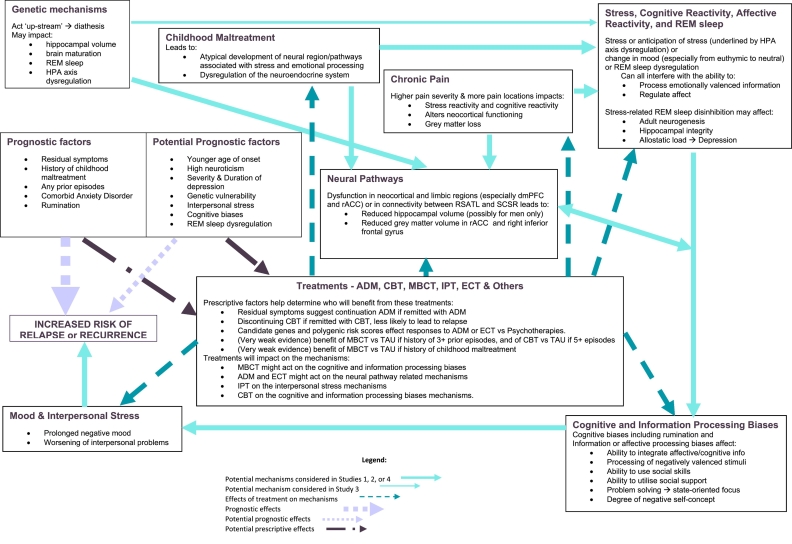
Results and conclusions: Childhood maltreatment, post-treatment residual symptoms, and a history of recurrence emerged as strong prognostic indicators of risk and each could be used prescriptively to indicate who benefits most from continued or prophylactic treatment. Targeting prognostic indices or their "down-stream" consequences will be particularly beneficial because each is either a cause or a consequence of the causal mechanisms underlying risk of recurrence. The cognitive and neural mechanisms that underlie the prognostic indices are likely addressed by the effects of treatments that are moderated by the prescriptive factors. For example, psychosocial interventions that target the consequences of childhood maltreatment, extending pharmacotherapy or adapting psychological therapies to deal with residual symptoms, or using cognitive or mindfulness-based therapies for those with prior histories of recurrence. Future research that focuses on understanding causal pathways that link childhood maltreatment, or cognitive diatheses, to dysfunction in the neocortical and limbic pathways that process affective information and facilitate cognitive control, might result in more enduring effects of treatments for depression.
Keywords: Depression; Depressive disorder; Major; Recurrence; Review; Risk factors.
Copyright © 2018 The Authors. Published by Elsevier Ltd.. All rights reserved.
Figures


References
-
- Angst J., Kupfer D.J., Rosenbaum J.F. Recovery from depression: Risk or reality? Acta Psychiatrica Scandinavica. 1996;93:413–419. - PubMed
-
- Arnone D., McKie S., Juhasz G., Thomas E.J., Downey D., Williams S. State-dependent changes in hippocampal grey matter in depression. Molecular Psychiatry. 2012;18:1265–1272. - PubMed
-
- Baldessarini R.J., Forte A., Selle V., Sim K., Tondo L., Undurraga J., Vázquez G.H. Morbidity in depressive disorders. Psychotherapy and Psychosomatics. 2017;86:65–72. - PubMed
Publication types
MeSH terms
Grants and funding
LinkOut - more resources
Full Text Sources
Other Literature Sources
Medical
Molecular Biology Databases
