. 2018 Sep 12;38(37):8031-8043.
doi: 10.1523/JNEUROSCI.0653-18.2018. Epub 2018 Aug 3.

Estrogen Regulation of GRK2 Inactivates Kappa Opioid Receptor Signaling Mediating Analgesia, But Not Aversion

Affiliations

Estrogen Regulation of GRK2 Inactivates Kappa Opioid Receptor Signaling Mediating Analgesia, But Not Aversion

Antony D Abraham et al. J Neurosci. .

Abstract

Activation of κ opioid receptors (KORs) produces analgesia and aversion via distinct intracellular signaling pathways, but whether G protein-biased KOR agonists can be designed to have clinical utility will depend on a better understanding of the signaling mechanisms involved. We found that KOR activation produced conditioned place aversion and potentiated CPP for cocaine in male and female C57BL/6N mice. Consistent with this, males and females both showed arrestin-mediated increases in phospho-p38 MAPK following KOR activation. Unlike in males, however, KOR activation had inconsistent analgesic effects in females and KOR increased Gβγ-mediated ERK phosphorylation in males, but not females. KOR desensitization was not responsible for the lack of response in females because neither Grk3 nor Pdyn gene knock-out enhanced analgesia. Instead, responsiveness was estrous cycle dependent because KOR analgesia was evident during low estrogen phases of the cycle and in ovariectomized (OVX) females. Estradiol treatment of OVX females suppressed KOR-mediated analgesia, demonstrating that estradiol was sufficient to blunt Gβγ-mediated KOR signals. G protein-coupled receptor kinase 2 (GRK2) is known to regulate ERK activation, and we found that the inhibitory, phosphorylated form of GRK2 was significantly higher in intact females. GRK2/3 inhibition by CMPD101 increased KOR stimulation of phospho-ERK in females, decreased sex differences in KOR-mediated inhibition of dopamine release, and enhanced mu opioid receptor and KOR-mediated analgesia in females. In OVX females, estradiol increased the association between GRK2 and Gβγ. These studies suggest that estradiol, through increased phosphorylation of GRK2 and possible sequestration of Gβγ by GRK2, blunts G protein-mediated signals.SIGNIFICANCE STATEMENT Chronic pain disorders are more prevalent in females than males, but opioid receptor agonists show inconsistent analgesic efficacy in females. κ opioid receptor (KOR) agonists have been tested in clinical trials for treating pain disorders based on their analgesic properties and low addictive potential. However, the molecular mechanisms underlying sex differences in KOR actions were previously unknown. Our studies identify an intracellular mechanism involving estradiol regulation of G protein-coupled receptor kinase 2 that is responsible for sexually dimorphic analgesic responses following opioid receptor activation. Understanding this mechanism will be critical for developing effective nonaddictive opioid analgesics for use in women and characterizing sexually dimorphic effects in other inhibitory G protein-coupled receptor signaling responses.

Keywords: analgesia; biased signal transduction; estrogen; kappa opioid receptor; morphine; sex differences.


Figures

Figure 1.
Figure 1.
KOR activation in females produces aversion, but not analgesia. A, Conditioned place aversion to U50488 (2.5 mg/kg) was observed in both males and females (n = 13–16 per group) compared with saline-treated mice (males p < 0.05; females p < 0.05). B, Consistent with prior reports (Russo et al., 2003), female mice were more sensitive than males to cocaine conditioning. rFSS (cross-hatched bars) increased cocaine preference (n = 7–19 per group) in males conditioned with 15 mg/kg cocaine and females with 7.5 mg/kg cocaine. There was no significant effect of sex on cocaine CPP potentiation, but there was a significant main effect of stress and a significant interaction between sex and dose. C, U50488, but not saline, increased latency to tail withdrawal in males (n = 3 saline, n = 6 U50488; p < 0.01) in a warm water tail flick assay, but U50488 treatment of females produced a small increase latency that was not significantly different from saline-treated mice (n = 11 saline, n = 27 U50488). Latency to flick was significantly different between males and females treated with U50488 (p < 0.05). D, To assess whether the lack of effect at 30 min after injection was due to a difference in the pharmacokinetics of U50488, female mice were tested every 10 min and showed no significant effect at any time during the 60 min (n = 6). E, Using the hot plate to interrogate different analgesic circuits, males treated with U50488 (n = 6–9 per group) showed a significant (p < 0.001) increase in latency to jump/lick in the hot plate assay compared with saline treatment and were significantly different (p < 0.001) from U50488-treated females. F, Following application of 5′GNTI, a compound that induces compulsive scratching (Inan et al., 2011), males and females (n = 13; n = 12) treated with nalfurafine (50 μg/kg), a KOR agonist, had significantly decreased (p < 0.0001; p < 0.001) scratching behaviors compared with saline-treated males or females (n = 15; n = 10). Error bars indicate SEM. *p < 0.05, **p < 0.01, ***p < 0.001, n.s., not significant.
Figure 2.
Figure 2.
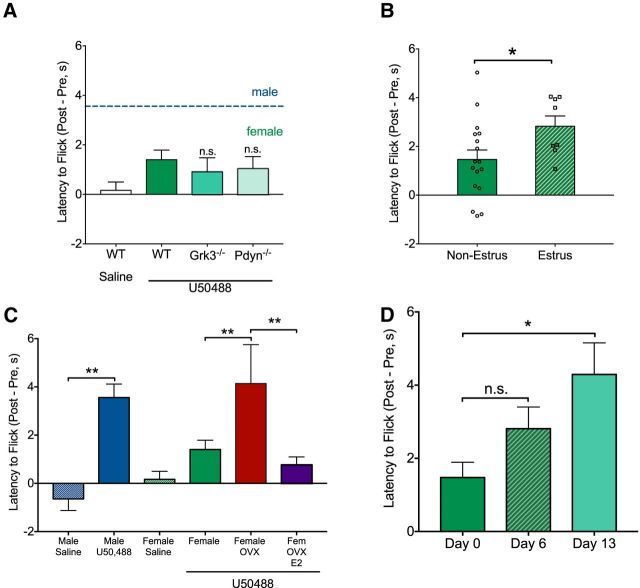
Lack of antinociceptive response to KOR activation in females is estrogen sensitive and is not attributable to KOR desensitization. A, U50488 treatment of female GRK3 knock-out (Grk3−/−, n = 4) and dynorphin knock-out (Pdyn−/−, n = 5) mice did not increase tail withdrawal latencies. WT female data are replotted from Figure 1C for analysis in A, B, and C. B, WT females (n = 25) were assessed for cycle following tail flick and divided into high estrogen (diestrus/proestrus/metestrus; n = 17) or low estrogen (estrus; n = 8) groups. KOR activation produced significantly greater (p < 0.05) antinociception in the low estrogen group compared with the high estrogen group. C, Male and intact female data are replotted from Figure 1C for comparison with OVX females (n = 8). OVX significantly increased (p < 0.01) analgesic response to KOR activation and systemic 17β-estradiol treatment (E2; 50 μg/kg; 0.1% ethanol/0.1% Cremaphor EL/99% saline; Cayman Chemical) in OVX females (n = 9) significantly (p < 0.01) blunted KOR-mediated analgesia compared with OVX females. D, Tail flick latencies were significantly increased during pregnancy on day 13 compared with prepregnancy responses to KOR activation. (p < 0.05) Error bars indicate SEM. *p < 0.05, **p < 0.01, n.s., not significant.
Figure 3.
Figure 3.
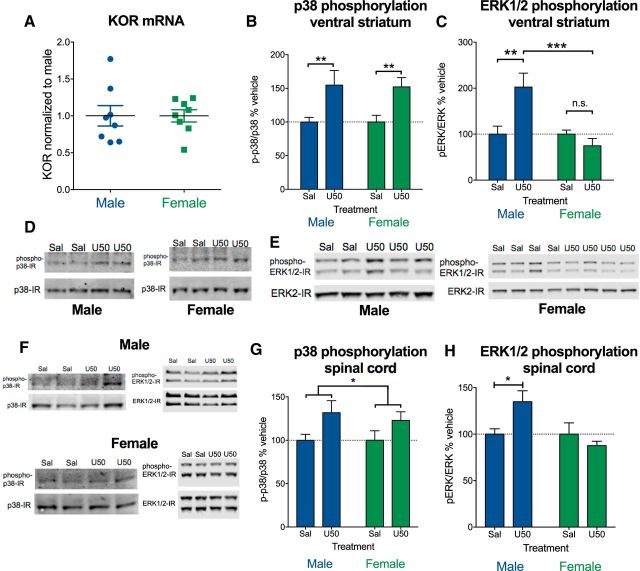
KOR activation produces p38 MAPK phosphorylation in males and females, but not ERK 1/2 phosphorylation in females. A, Striatal mRNA from male and female mice was isolated and analyzed for KOR expression by qRT-PCR. No difference in KOR expression was observed (n = 8 per group) (B,C). Mice were injected with U50488 (10 mg/kg, i.p.) or saline 15 or 30 min before isolating striatal proteins. Phosphorylation of p38 (B) and ERK1/2 phosphorylation (C) in ventral striatum of male and female mice by Western blot analysis is shown. B, U50488 induced p38 phosphorylation in male and female mice. There was a significant effect of U50488 (p < 0.001), with no difference between males (n = 11) and females (n = 8). C, U50488 induced ERK1/2 phosphorylation (p < 0.001) in male (n = 5–6) but not female (n = 8) mice and males were significantly different from females (p < 0.001). D, Representative blots for B. E, Representative blots for C. F, Representative blots for G and H. G, U50488 induced p38 phosphorylation in male and female mice (n = 7–9 per group) in spinal cord homogenates (bracket indicates main effect of treatment; p < 0.05). H, U50488 induced ERK phosphorylation in male (n = 7–9 per group) but not female (n = 9 per group) mice (p < 0.05). Error bars indicate SEM.*p < 0.05, **p < 0.01, ***p < 0.001, n.s., not significant.
Figure 4.
Figure 4.
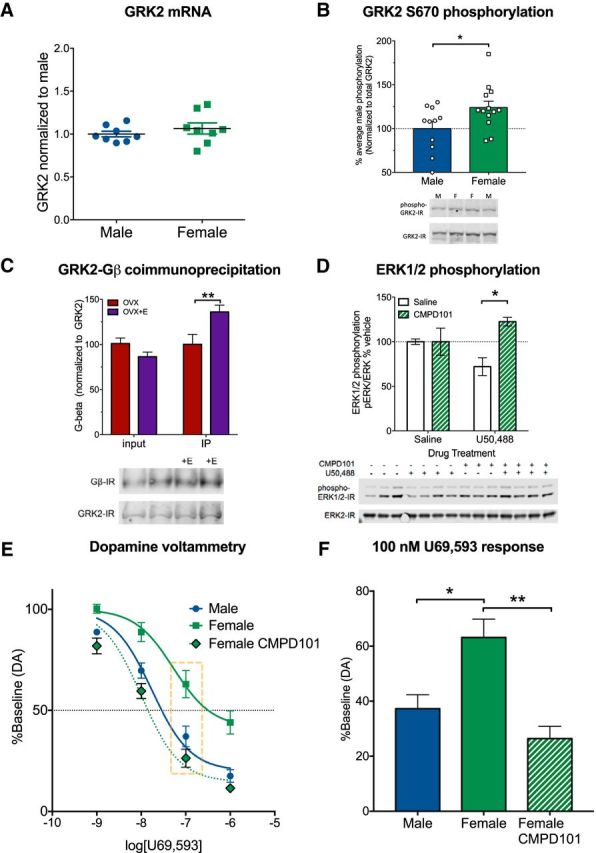
GRK2 sequesters Gβγ to decrease KOR-mediated ERK phosphorylation and dopamine release inhibition in females. A, Striatal mRNA from male and female mice was isolated and analyzed for GRK2 expression. No difference in GRK2 expression was observed (n = 8 per group). B, Striatal protein from male and female mice was isolated and analyzed for GRK2 phosphorylation at Ser670 by Western blot. Phosphorylation of Ser670 was significantly elevated in female mice compared with male mice (p < 0.05, n = 11–13). C, GRK2 was immunoprecipitated from striatal homogenates of ovariectomized female mice treated with vehicle or estradiol (50 μg/kg; 60 min before tissue collection). Samples were then immunoblotted for GRK2 and Gβ. No differences were observed in Gβ in total protein, but estradiol increased Gβ in GRK2 immunoprecipitates (p < 0.005, n = 8–10). D, Female mice were treated with CMPD101 (1.25 mg/kg) 30 min before U50488 (10 mg/kg, 15 min). Striatal proteins were isolated and analyzed for ERK1/2 phosphorylation (n = 3–4). CMPD101 pretreatment significantly (p < 0.01) elevated ERK1/2 phosphorylation following U50488. E, Concentration–response curves for U50488 inhibition of evoked dopamine release were determined using fast scan cyclic voltammetry in slices (n = 5–9 per group) from male and female mice. Nonlinear regression showed that KOR-mediated dopamine inhibition was significantly different between control and CMPD101-treated females. F, Dopamine release inhibition at the 100 nm dose of U50488 from E was examined. U50488 at 100 nm produced significantly less inhibition of dopamine release in slices from females than from males or females in the presence of 30 μm CMPD101. Error bars indicate SEM. *p < 0.05, **p < 0.01.
Figure 5.
Figure 5.
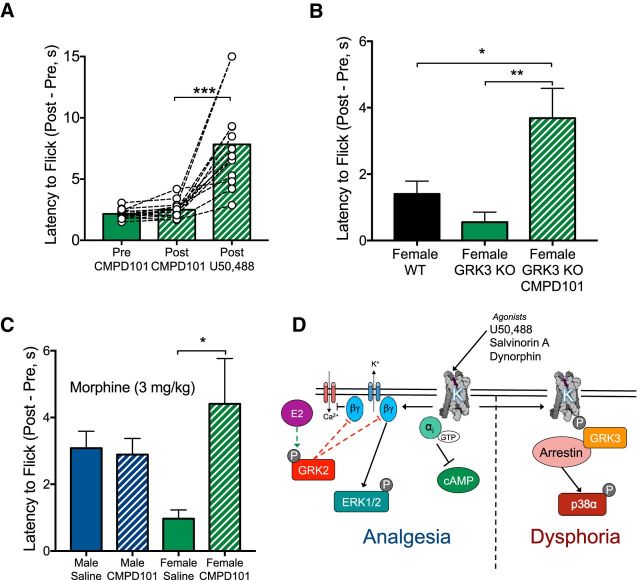
Pharmacological inhibition of GRK2/3 enhances opioid-mediated analgesia in females. A, Pretreatment with CMPD101 did not alter baseline tail flick latency in females (n = 13). CMPD101 pretreatment significantly increased latency to flick with U50488 treatment in females (p < 0.001). B, Female WT data are replotted from Figure 1C. Female Grk3−/− mice (n = 9–14 per group) pretreated with CMPD101 showed a significant increase in latency to flick compared with WT females (p < 0.05) or Grk3−/− (p < 0.01) pretreated with saline. C, Submaximal dose (3 mg/kg) of morphine produces analgesia in males (n = 7–8 per group), with no effect of CMPD101, but the analgesic effect of morphine is blunted in females pretreated with saline (n = 8 per group) compared with females pretreated with CMPD101 (p < 0.05). D, In the proposed model, elevated estradiol (E2) in female mice results in GRK2 phosphorylation and enhanced sequestration of the Gβγ subunits. This results in reduced Gβγ signaling, including a reduction in analgesic responses. In contrast, GRK3/arrestin-mediated signaling is left largely intact, maintaining the aversive response. Error bars indicate SEM. *p < 0.05, **p < 0.01, ***p < 0.001.

References

    1. Abraham AD, Fontaine HM, Song AJ, Andrews MM, Baird MA, Kieffer BL, Land BB, Chavkin C (2018) Kappa opioid receptor activation in dopamine neurons disrupts behavioral inhibition. Neuropsychopharmacology 43:362–372. 10.1038/npp.2017.133 - DOI - PMC - PubMed
    1. Belcheva MM, Vogel Z, Ignatova E, Avidor-Reiss T, Zippel R, Levy R, Young EC, Barg J, Coscia CJ (1998) Opioid modulation of extracellular signal-regulated protein kinase activity is ras-dependent and involves gbetagamma subunits. J Neurochem 70:635–645. - PMC - PubMed
    1. Belcheva MM, Clark AL, Haas PD, Serna JS, Hahn JW, Kiss A, Coscia CJ (2005) μ and κ opioid receptors activate ERK/MAPK via different protein kinase C isoforms and secondary messengers in astrocytes. J Biol Chem 280:27662–27669. 10.1074/jbc.M502593200 - DOI - PMC - PubMed
    1. Berkley KJ. (1997) Sex differences in pain. Behav Brain Sci 20:371–380; discussion 435–513. - PubMed
    1. Broad J, Maurel D, Kung VW, Hicks GA, Schemann M, Barnes MR, Kenakin TP, Granier S, Sanger GJ (2016) Human native kappa opioid receptor functions not predicted by recombinant receptors: implications for drug design. Sci Rep 6:30797. 10.1038/srep30797 - DOI - PMC - PubMed

Publication types

MeSH terms

LinkOut - more resources