


Review
doi: 10.1186/s13722-018-0117-1.
Emergency department screening and interventions for substance use disorders
Affiliations
- PMID: 30078375
- PMCID: PMC6077851
- DOI: 10.1186/s13722-018-0117-1
Item in Clipboard
Review
Emergency department screening and interventions for substance use disorders
Addict Sci Clin Pract.
.
Erratum in
-
Correction to: Emergency department screening and interventions for substance use disorders.Addict Sci Clin Pract. 2019 Jul 16;14(1):26. doi: 10.1186/s13722-019-0155-3. Addict Sci Clin Pract. 2019. PMID: 31311584 Free PMC article.
Abstract
The emergency department (ED) has long been recognized as providing critical access to the health care system for many, yet only in the past few decades has the ED visit been recognized as an opportunity to identify and link patients to care for substance use disorders (SUDs). This review explores the evidence for ED-based screening, psychosocial and pharmacological interventions, and linkage to treatment for the spectrum of SUDs including high risk alcohol use and alcohol, opioid, tobacco and other SUDs. Despite knowledge gaps, methodological challenges and some inconsistency across interventions studied, opportunities for EDs to improve the care of patients across the spectrum of SUDs are robust.
Figures
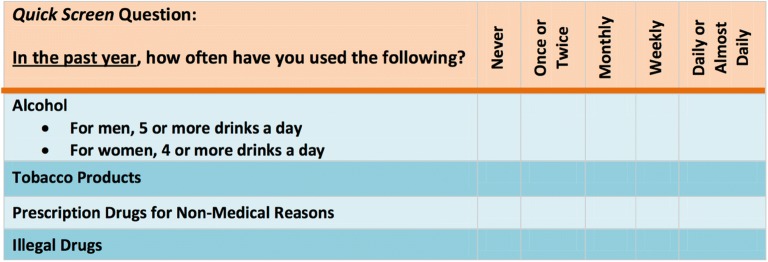
NIDA Quick Screen for substance use disorders. If the patient says “No” for all drugs in the Quick Screen, reinforce abstinence. Screening is complete. If patient says “Yes” to one or more days of heavy drinking, note that patient is an at-risk drinker. If patient says “Yes” to use of tobacco: Any current tobacco use places a patient at risk. If the patient says “Yes” to use of illegal drugs or prescription drugs for non-medical reasons, proceed to Question 1 of the NIDA-Modified ASSIST. Adapted from NIDA Screening for Drug Use in General Medical Settings Resource Guide [67, 68]
References
-
- The DAWN Report. Highlights of the 2010 drug abuse warning network (DAWN) findings on drug-related emergency department visits [Internet]. [cited 2015 Apr 19]; http://archive.samhsa.gov/data/2k12/DAWN096/SR096EDHighlights2010.htm. Accessed 2 Feb 2018.
Publication types
MeSH terms
Grants and funding
LinkOut - more resources
Full Text Sources
Other Literature Sources
Medical
Miscellaneous
