. 2018 Oct 18;25(10):1304-1312.e5.
doi: 10.1016/j.chembiol.2018.07.002. Epub 2018 Aug 2.

Resurrecting the Bacterial Tyrosyl-tRNA Synthetase/tRNA Pair for Expanding the Genetic Code of Both E. coli and Eukaryotes

Affiliations

Resurrecting the Bacterial Tyrosyl-tRNA Synthetase/tRNA Pair for Expanding the Genetic Code of Both E. coli and Eukaryotes

James S Italia et al. Cell Chem Biol. .

Abstract

The bacteria-derived tyrosyl-tRNA synthetase (TyrRS)/tRNA pair was first used for unnatural amino acid (Uaa) mutagenesis in eukaryotic cells over 15 years ago. It provides an ideal platform to genetically encode numerous useful Uaas in eukaryotes. However, this pair has been engineered to charge only a small collection of Uaas to date. Development of Uaa-selective variants of this pair has been limited by technical challenges associated with a yeast-based directed evolution platform, which is currently required to alter its substrate specificity. Here we overcome this limitation by enabling its directed evolution in an engineered strain of E. coli (ATMY), where the endogenous TyrRS/tRNA pair has been functionally replaced with an archaeal counterpart. The facile E. coli-based selection system enabled rapid engineering of this pair to develop variants that selectively incorporate various Uaas, including p-boronophenylalanine, into proteins expressed in mammalian cells as well as in the ATMY strain of E. coli.

Keywords: engineered bacterial strains; eukaryotic genetic code expansion; genetic code expansion; mammalian genetic code expansion; non-canonical amino acids; unnatural amino acids.


Figures

Figure 1.
Figure 1.. ATMY recombination scheme
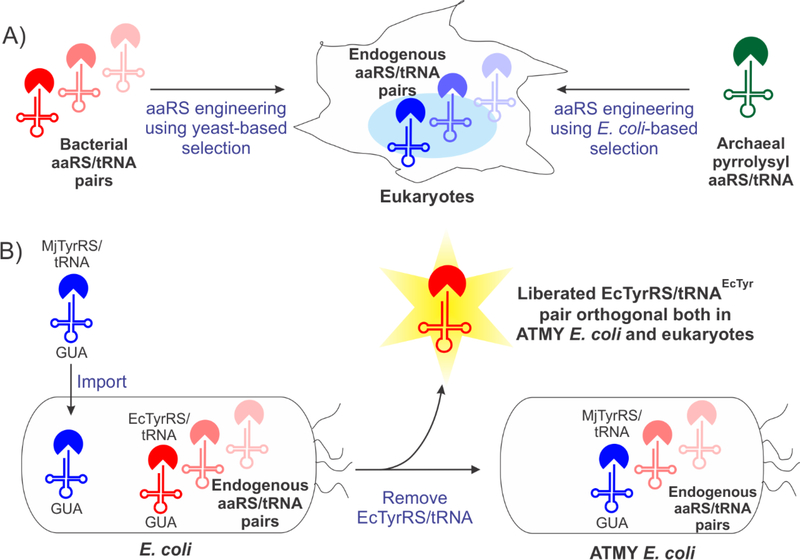
A) Bacteria-derived aaRS/tRNA pairs are typically suitable for expanding the genetic code of eukaryotes, but engineering their substrate specificity must be performed using a yeast-based selection system. The unique pyrrolysyl pair from archaea can be used for Uaa mutagenesis in both bacteria and eukaryotes. Thus, it can be engineered to charge desired Uaas using the E. coli selection system, followed by application in eukaryotes. B) Functionally substituting the endogenous EcTyrRS/tRNA pair of E. coli with an archaeal counterpart liberates it for reintroduction into the resulting ATMY strain as an orthogonal nonsense suppressor, where its substrate specificity can be engineered using the facile E. coli based selection system.
Figure 2.
Figure 2.
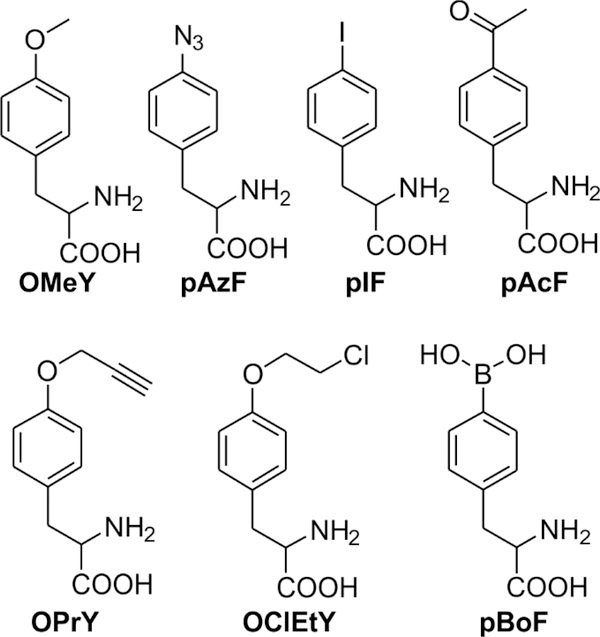
Uaas used in this study.
Figure 3.
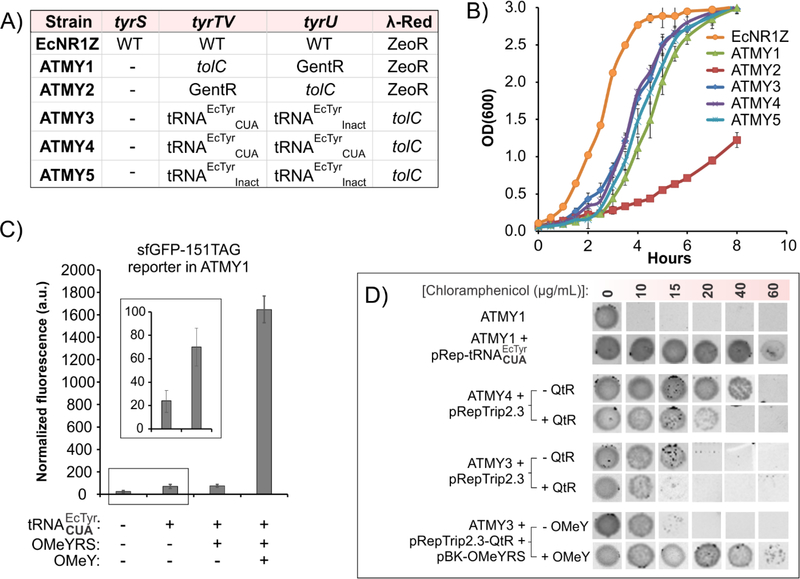
Figure 3.. Replacement of the EcTyrRS/tRNA pair of E. coli with MjTyrRS/tRNA, followed by its reintroduction in the resulting strain as an orthogonal nonsense suppressor.
A) Strains ATMY1–5 were created by first scarlessly deleting tyrS in the presence of pUltraBR-MjY, followed by the removal of tyrTV, tyrU and the λ-Red machinery using the indicated cassettes (Also see Figure S1, Table S1). B) Growth rates of the resulting strains. Data represent mean ± SD (n = 3). C) tRNAEcTyrCUA is weakly active in ATMY1 cells in the absence of EcTyrRS, as indicated by a small but significant increase in sfGFP-151TAG reporter expression (magnified in the inset). Co-expression of the OMeY-selective EcTyrRS (OMeYRS) significantly increases TAG suppression levels, leading to strong OMeY-dependent sfGFP-151TAG expression (Also see Figure S2). Expression of full-length sfGFP was measured using OD600-normalized fluorescence of cells suspended in PBS (the normalized fluorescence of ATMY1 cells not harboring a GFP reporter was subtracted from each). Data represent mean ± SD (n = 3). D) The cross-reactivity of tRNAEcTyrCUA in ATMY1 is further confirmed using a CAT-TAG reporter, which leads to cellular survival at up to 60 μg/mL of chloramphenicol. Lowering the tRNAEcTyrCUA levels by expressing it from the genome in ATMY4 and ATMY3 strains reduces this cross-reactivity (survival up to 40 μg/mL and 20 μg/mL, respectively), which can be further attenuated by overexpressing the native tRNAGln from the pRepTrip2.3-QtR plasmid in ATMY4 and ATMY3. Co-expressing OMeYRS in ATMY3 enables OMeY-dependent survival at up to 60 μg/mL, revealing a range where Uaa-selective aaRS-variants can be efficiently selected.
Figure 4.
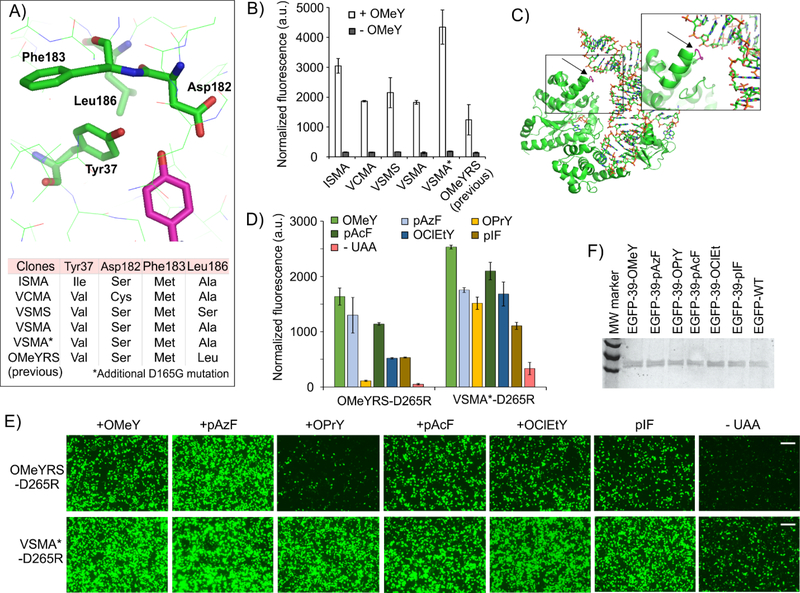
Figure 4.. Selection and characterization of OMeY-selective EcTyrRS mutants.
A) Active site of EcTyrRS. The bound tyrosine is shown in magenta and the active site residues subjected to randomization are highlighted. Sequence of mutants that show OMeY-dependent survival under positive selection conditions. B) OMeY-selective EcTyrRS mutants show OMeY-dependent sfGFP-151TAG reporter expression in ATMY4 (OD600-normalized fluorescence of suspended cells). The activity of the previously developed OMeYRS is shown for comparison (Also see Table S2). Data represent mean ± SD (n = 3). C) The location of the D165G mutation mapped to T. thermophilus TyrRS/tRNA co-crystal structure (PDB: 1H3E). The VSMA* mutant also facilitates improved OMeY incorporation into the EGFP-39TAG reporter expressed in HEK293T cells, relative to the previously reported OMeYRS, observed by fluorescence microscopy (E), and measuring EGFP fluorescence in clarified cell-free extract (D). Like the previous OMeYRS, VSMA* charges additional Uaas and show higher efficiency (Also see Table S2). Data represent mean ± SD (n = 3). Scale bars: 200 μm. F) SDS-PAGE analysis of EGFP-39TAG reporters incorporating different Uaas, charged by the VSMA* mutant in HEK293T cells.
Figure 5.
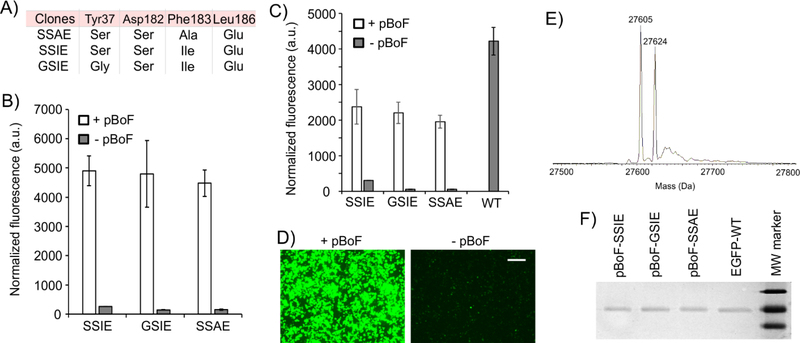
Figure 5.. Selection and activity of pBoF-selective EcTyrRS mutants from a naïve mutant library.
A) Sequence of mutants that show pBoF-dependent survival under positive selection conditions. B) Each of three mutants facilitate pBoF-dependent sfGFP-151TAG reporter expression in ATMY4 (Also see Table S2). C) These mutants also charge pBoF into the EGFP-39TAG reporter expressed in HEK293T cells monitored by EGFP-fluorescence in cell-free extract. Expression of the wild-type EGFP reporter is also shown for reference, demonstrating high efficiency of pBoF incorporation (Also see Table S2). Data represent mean ± SD (n = 3). D) Fluorescence microscopy images of HEK293T cells showing pBoF-dependent EGFP-39TAG expression facilitated by the GSIE-mutant (Also see Figure S3). Scale bar: 200 μm. E) MS-analysis of the reporter protein confirm pBoF incorporation (expected mass: 27626 Da, additional dehydration peak is an established behavior of phenylboronates). F) SDS-PAGE of pBoF-incorporating reporter proteins.

References

    1. Amiram M, Haimovich AD, Fan C, Wang Y-S, Aerni H-R, Ntai I, Moonan DW, Ma NJ, Rovner AJ, and Hong SH (2015). Evolution of translation machinery in recoded bacteria enables multi-site incorporation of nonstandard amino acids. Nature biotechnology 33, 1272 DOI: 10.1038/nbt.3372 - DOI - PMC - PubMed
    1. Bandyopadhyay A, and Gao J (2016). Iminoboronate-Based Peptide Cyclization That Responds to pH, Oxidation, and Small Molecule Modulators. Journal of the American Chemical Society 138, 2098–2101. DOI: 10.1021/jacs.5b12301 - DOI - PMC - PubMed
    1. Bose M, Groff D, Xie J, Brustad E, and Schultz PG (2006). The incorporation of a photoisomerizable amino acid into proteins in E. coli. Journal of the American Chemical Society 128, 388–389. DOI: 10.1021/ja055467u - DOI - PubMed
    1. Brustad E, Bushey ML, Lee JW, Groff D, Liu W, and Schultz PG (2008). A genetically encoded boronate-containing amino acid. Angewandte Chemie (International ed in English) 47, 8220–8223. DOI: 10.1002/anie.200803240 - DOI - PMC - PubMed
    1. Cal PM, Vicente JB, Pires E, Coelho AV, Veiros LF, Cordeiro C, and Gois PM (2012). Iminoboronates: a new strategy for reversible protein modification. Journal of the American Chemical Society 134, 10299–10305. DOI: 10.1021/ja303436y - DOI - PubMed

Publication types