. 2018 Jun 20;9(27):5999-6005.
doi: 10.1039/c8sc02019a. eCollection 2018 Jul 21.

Selective activation of organocatalysts by specific signals

Affiliations

Selective activation of organocatalysts by specific signals

Chandan Maity et al. Chem Sci. .

Abstract

Reminiscent of signal transduction in biological systems, artificial catalysts whose activity can be controlled by physical or chemical signals would be of high interest in the design of chemical systems that can respond to their environment. Self-immolative chemistry offers a generic method for the development of catalysts that can be activated by different signals. To demonstrate the versatility of that concept, we synthesized organocatalysts that can be activated by three different signals and that can be used to control two different reactions. In this way the organocatalyst proline is designed as a pro-catalyst that is activated either by the chemical signal H2O2, by light or by the enzyme penicillin acylase. The pro-catalysts were used to exert temporal control over the rate of an aldol reaction and a Michael reaction.


Figures
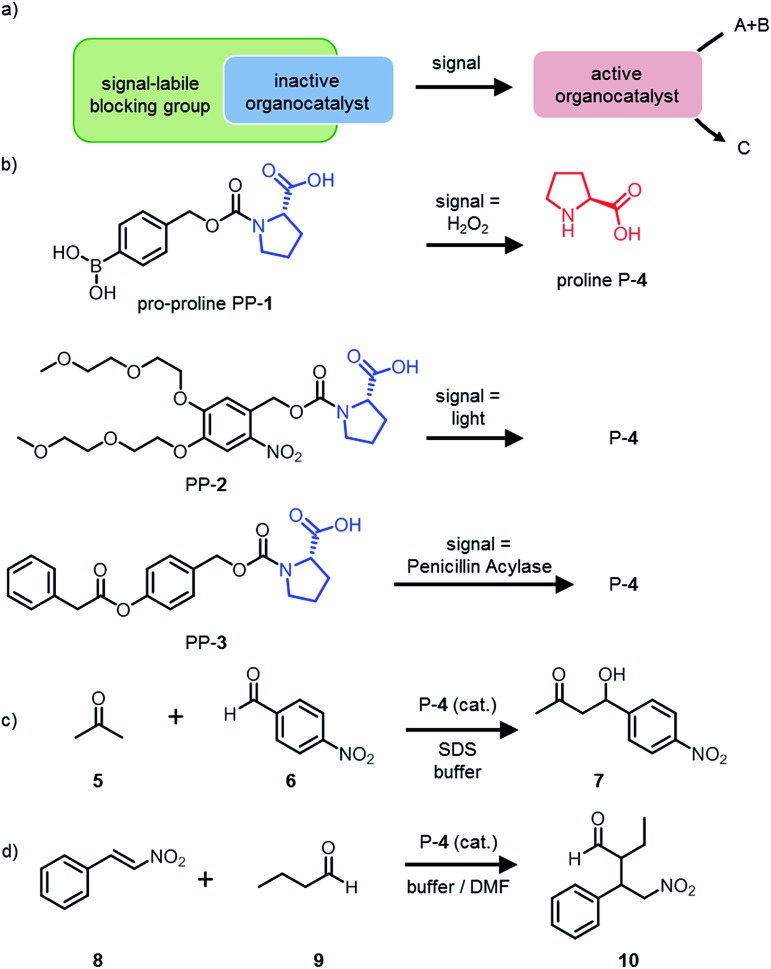
Fig. 1
Fig. 1. A generic design for a pro-catalyst that can be activated by a signal to catalyse a reaction. (a) Schematic representation of the protected organocatalyst that is activated by the signal and then catalyses a reaction. (b) The pro-proline PP-1 is activated by the chemical signal H2O2 and releases the organocatalyst proline P-4. PP-2 is activated by light and releases P-4. PP-3 is activated by the enzyme Penicillin Acylase (PA) and releases P-4. (c) The aldol reaction between acetone 5 and 4-nitrobenzaldehyde 6 is catalysed by P-4. (d) The Michael reaction between trans-β-nitrostyrene 8 and butanal 9 is catalysed by P-4.
Fig. 2
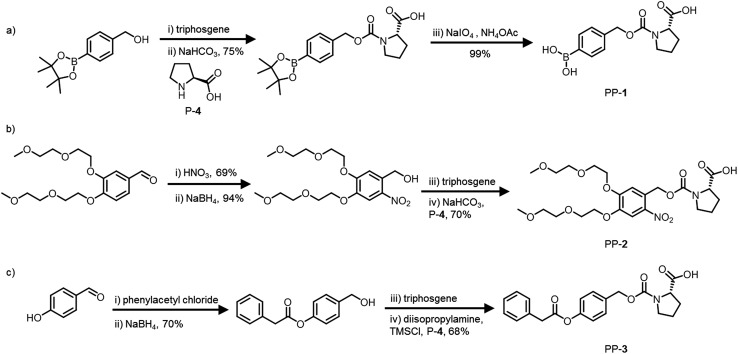
Fig. 2. Synthetic route to form pro-prolines PP-1, PP-2 and PP-3. (a) Synthesis of PP-1, reaction conditions: (i) Na2CO3, triphosgene, toluene, 0 °C – room temperature, 6 h. (ii) NaHCO3, proline P-4, water, 0 °C – room temperature, overnight, (iii) NaIO4, NH4OAc, water/acetone (2 : 1 v/v). (b) Synthesis of PP-2, reaction conditions: (i) HNO3 (70% in water), 0–20 °C, 2 h, (ii) NaBH4, methanol, 1 h, room temperature, (iii) K2CO3, triphosgene, toluene, 0 °C – room temperature, 6 h, (iv) NaHCO3, P-4, water, 0 °C – room temperature, overnight. (c) Synthesis of PP-3, reaction conditions: (i) phenylacetyl chloride, triethylamine, THF, 0 °C – room temperature, overnight, (ii) NaBH4, 2-propanol, 1 h, room temperature, (iii) K2CO3, triphosgene, toluene, 0 °C – room temperature, 6 h, (iv) trimethylsilylchloride (TMSCl), diisopropylamine, DCM, 0 °C – room temperature, 4 h.
Fig. 3
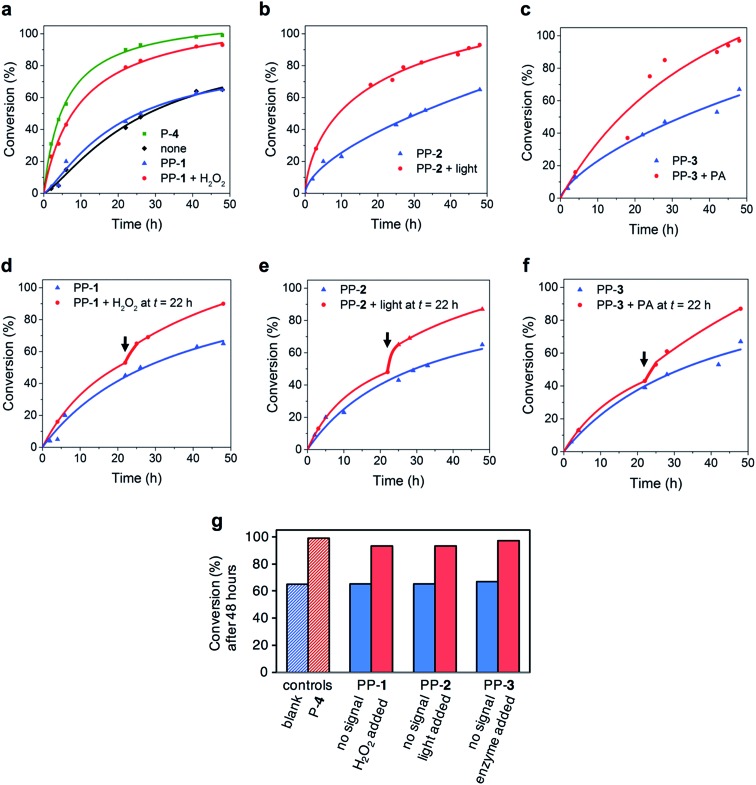
Fig. 3. Kinetic analysis of the aldol reaction between 4-nitrobenzaldehyde 6 and acetone 5. Conditions: 10 mM 4-nitrobenzaldehyde 6, 20 volume% acetone 5, 2 mM (20 mol%) pro-proline, and a signal, in sodium phosphate buffer (100 mM, pH 7.4) with 10 v% D2O and 1 mM sodium dodecyl sulfate (SDS). (a) Conversion of the aldol product follow with NMR spectroscopy in the presence of P-4 (green), without catalyst (black), PP-1 without activation (blue), PP-1 and H2O2 (red). (b) Conversion of the aldol reaction in the presence of PP-2 without activation (blue) and in the presence of PP-2 after irradiation with light (red). (c) Conversion of the aldol reaction in the presence of PP-3 without activation (blue) and in the presence of PP-3 after addition of penicillin acylase (red). (d) Conversion of the aldol reaction in the presence of unactivated PP-1 (blue) or when the signal H2O2 was added after 22 h (red). (e) Conversion of the aldol reaction in the presence of PP-2 (blue), after 22 h, the reaction mixture was irradiated with light (red). (f) Aldol reaction in the presence of PP-3 (blue), after 22 h, penicillin acylase was added (red). In (d–f) the arrow indicates the moment of signal addition. (g) Conversion to the aldol product after 48 hours, in the absence or presence of the appropriate signal.
Fig. 4
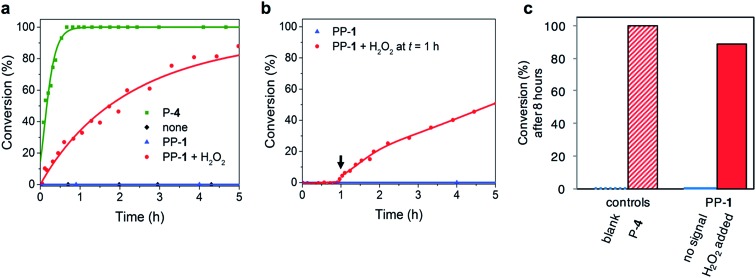
Fig. 4. Kinetic analysis of the Michael reaction between trans-β-nitrostyrene 8 and butanal 9. Reaction conditions: 10 mM trans-β-nitrostyrene 8, 100 mM butanal 9, 10 mM PP-1, 100 mM (10 eq.) H2O2 in phosphate buffer (10 mM, pH 8.0) + dimethyl formamide-d7 (DMF-d7). (a) Conversion to the Michael product 10 followed with NMR spectroscopy, reaction with PP-1 (10 mM, blue), without catalyst (black, overlapping with blue), with P-4 (10 mM, green) and with PP-1 (10 mM) and H2O2 (100 mM, red). (b) Conversion to the Michael product 10 followed with 1H-NMR spectroscopy, reaction with PP-1 (10 mM, blue) and the reaction with PP-1 (10 mM) where H2O2 (100 mM) was added after 1 hour (red). The arrow indicates the moment of signal addition. (c) Conversion (%) after 8 hours of reaction time, without signal (blue), with signal (red). With P-4 the reaction reaches >99% conversion in 8 h and with PP-1 and the H2O2 the reaction reaches 89% conversion. Without catalyst or signal, there is no conversion.

References

    1. Whitehead E. Prog. Biophys. Mol. Biol. 1970;21:321. - PubMed
    1. Traut T., Allosteric regulatory enzymes, Springer, Boston, 2008.
    1. Blanco V., Leigh D. A., Marcos V. Chem. Soc. Rev. 2015;44:5341. - PubMed
    1. Stoll R. S., Hecht S. Angew. Chem., Int. Ed. 2010;49:5054. - PubMed
    2. Neri S., Garcia Martin S., Pezzato C., Prins L. J. J. Am. Chem. Soc. 2017;139:1794. - PubMed
    3. Zhao H., Sen S., Udayabhaskararao T., Sawczyk M., Kučanda K., Manna D., Kundu P. K., Lee J.-W., Král P., Klajn R. Nat. Nanotechnol. 2016;11:82. - PubMed
    4. Maity C., Hendriksen W. E., van Esch J. H., Eelkema R. Angew. Chem., Int. Ed. 2015;54:998. - PubMed
    1. Gianneschi N. C., Bertin P. A., Nguyen S. T., Mirkin C. A., Zakharov L. N., Rheingold A. L. J. Am. Chem. Soc. 2003;125:10508. - PubMed

LinkOut - more resources