


Data Talks: Obesity-Related Influences on US Mortality Rates
- PMID: 30079383
- PMCID: PMC6070145
- DOI: 10.22158/rhs.v3n3p65
Data Talks: Obesity-Related Influences on US Mortality Rates
Abstract
Background: In the US, obesity is an epidemiologic challenge and the population fails to comprehend this complex public health issue. To evaluate underlying obesity-impact patterns on mortality rates, we data-mined the 1999-2016 Center for Disease Control WONDER database's vital records.
Methods: Adopting SAS programming, we scrutinized the mortality and population counts. Using ICD-10 diagnosis codes connected to overweight and obesity, we obtained the obesity-related crude and age-adjusted causes of death. To understand divergent and prevalence trends we compared and contrasted the tabulated obesity-influenced mortality rates with demographic information, gender, and age-related data.
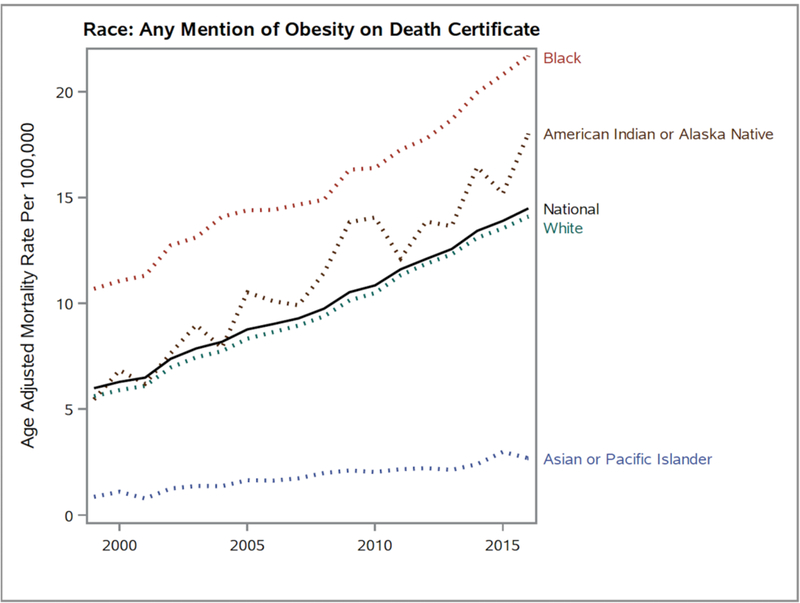
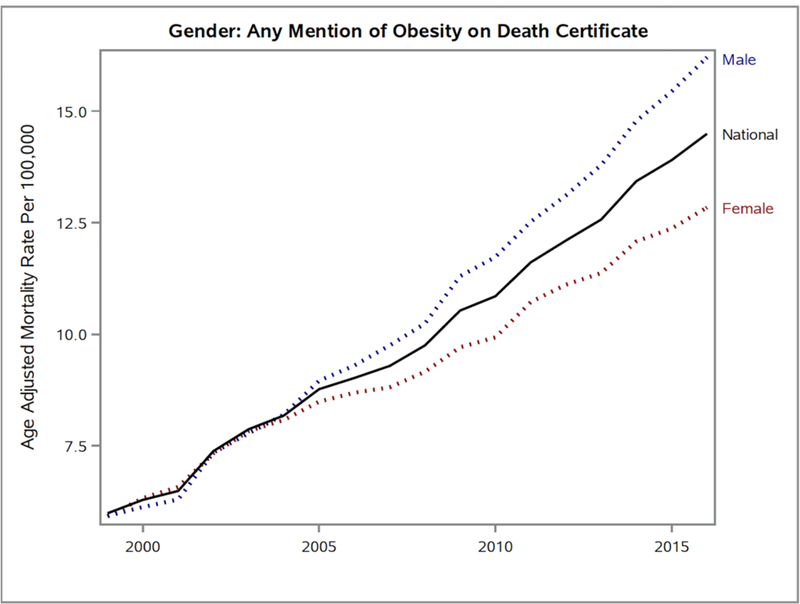
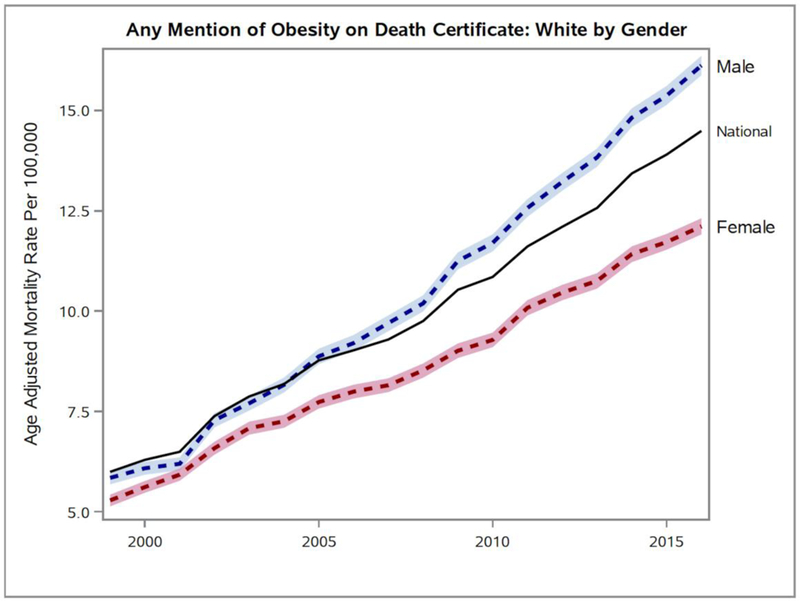
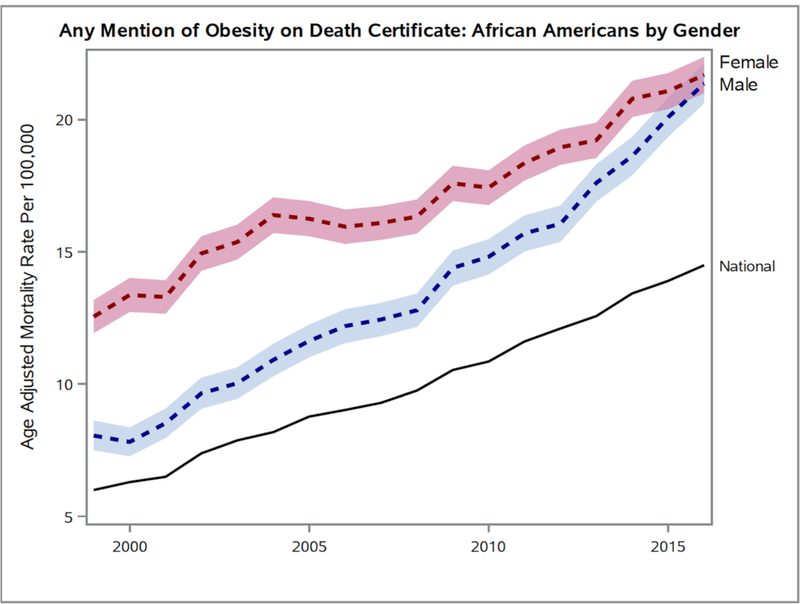
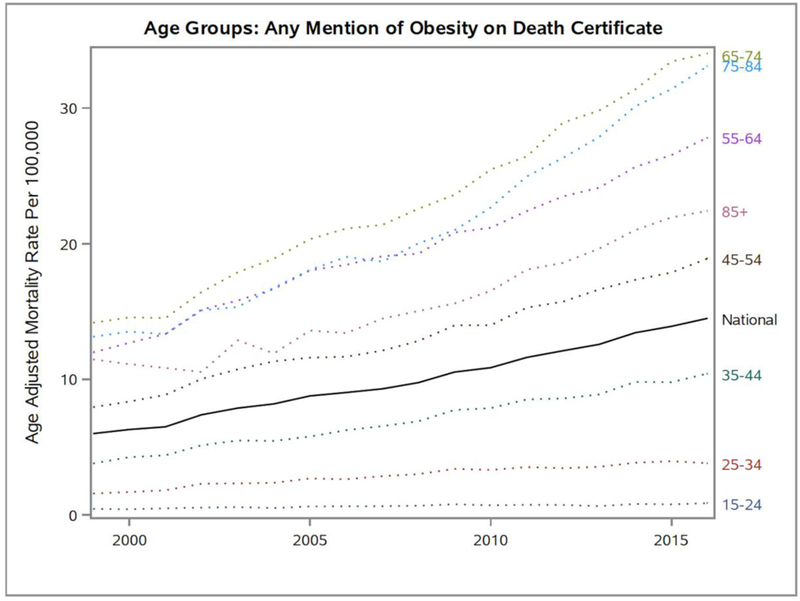
Key results: From 1999 to 2016, the obesity-related age-adjusted mortality rates increased by 142%. The ICD-10 overweight and obesity-related death-certificate coding showed clear evidence that obesity factored in the male age-adjusted mortality rate increment to 173% and the corresponding female rate to 117%. It also disproportionately affected the nation-wide minority population death rates. Furthermore, excess weight distributions are coded as contributing features in the crude death rates for all decennial age-groups.
Conclusions: The 1999-2016 data from ICD-10 death certificate coding for obesity-related conditions indicate that it is affecting all segments of the US population.
Keywords: ICD-10; mortality rates; obesity; overweight.
Figures
References
-
- Abarca-Gómez L, Abdeen ZA, Hamid ZA, Abu-Rmeileh NM, Acosta-Cazares B, Acuin C, … Agyemang C (2017). Worldwide trends in body-mass index, underweight, overweight, and obesity from 1975 to 2016: A pooled analysis of 2416 population-based measurement studies in 128.9 million children, adolescents, and adults. The Lancet, 390(10113), 2627–2642. 10.1016/S0140-6736(17)32129-3 - DOI - PMC - PubMed
-
- Bowman SE (2008). Why ICD-10 is worth the trouble. Journal of AHIMA, 79(3), 24–29. - PubMed
Grants and funding
LinkOut - more resources
Full Text Sources
Other Literature Sources