Review
. 2018 Aug 6;7(8):201.
doi: 10.3390/jcm7080201.

Idiopathic Pulmonary Fibrosis (IPF): An Overview

Affiliations
Review

Idiopathic Pulmonary Fibrosis (IPF): An Overview

Shaney L Barratt et al. J Clin Med. .

Abstract

Idiopathic pulmonary fibrosis (IPF) is an interstitial lung disease characterised by chronic, progressive scarring of the lungs and the pathological hallmark of usual interstitial pneumonia. Current paradigms suggest alveolar epithelial cell damage is a key initiating factor. Globally, incidence of the disease is rising, with associated high morbidity, mortality, and economic healthcare burden. Diagnosis relies on a multidisciplinary team approach with exclusion of other causes of interstitial lung disease. Over recent years, two novel antifibrotic therapies, pirfenidone and nintedanib, have been developed, providing treatment options for many patients with IPF, with several other agents in early clinical trials. Current efforts are directed at identifying key biomarkers that may direct more customized patient-centred healthcare to improve outcomes for these patients in the future.

Keywords: idiopathic pulmonary fibrosis; interstitial lung disease; nintedanib; pirfenidone.


Conflict of interest statement

The authors declare no conflicts of interest.

Figures
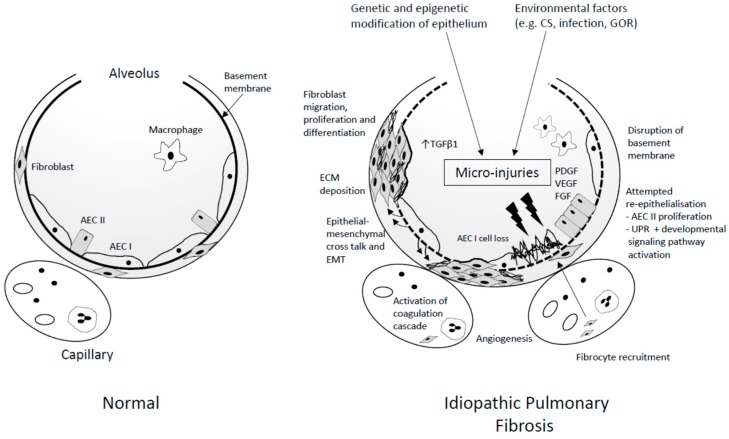
Figure 1
Figure 1
Schematic view of idiopathic pulmonary fibrosis (IPF) pathogenesis. Genetic and epigenetic phenomenon contribute to the development of an inherently dysfunctional epithelium. This epithelium is susceptible to recurrent micro-injury from environmental exposures (such as cigarette smoke (CS), inhaled dusts, infection, and gastro-oesophageal reflux (GOR)). The inability of the dysfunctional epithelium to regenerate following repetitive injury is a significant juncture in the propagation of IPF. Damage to the epithelium, disrupts the basement membrane and thus the alveolar capillary barrier. Capillary leakage of proteins (including fibrin and fibronectin) into the interstitial and alveolar spaces occurs, with activation of the coagulation cascade and abnormal vascular remodelling as part of the ongoing attempted repair process. Activated epithelial and endothelial cells create a milieu whereby aberrant epithelial–mesenchymal crosstalk, alongside fibrocyte/fibroblast recruitment, migration, proliferation, and differentiation, flourishes. Transforming growth factor β1 (TGFβ1), platelet-derived growth factor (PDGF), vascular endothelial growth factor (VEGF), and fibroblast growth factor (FGF) are some of the pro-fibrotic mediators implicated in these processes. Collections of active fibroblasts and myofibroblasts form fibrotic foci (FF), considered to be at the leading edge of extracellular matrix (ECM) deposition, with progressive lung remodelling and architectural distortion. AEC I/II: alveolar epithelial type I/II cell; UPR: unfolded protein response; EMT: epithelial–mesenchymal transition; UPR: unfolded protein response.
Figure 2
Figure 2
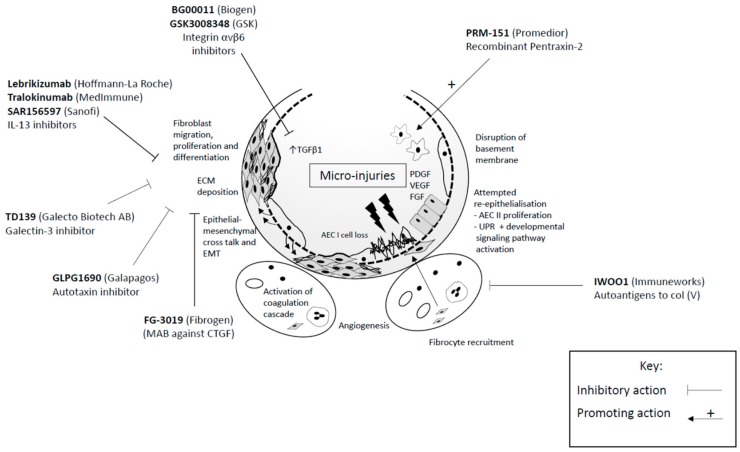
Novel therapeutic agents in idiopathic pulmonary fibrosis (IPF). Growing understanding of the pathogenesis of IPF has enabled the identification of a variety of putative molecular targets and has led to the development of multiple novel agents, many of which are in early clinical trials. Several of these agents and their mode of action are highlighted above. Please refer to text for full description of action. Abbreviations: MAB: monoclonal antibody; CTGF: connective tissue growth factor; Col (V): type V collagen; IL-13: interleukin-13. The lead pharmaceutical company for each agent is highlighted in brackets.

References

    1. American Thoracic Society Idiopathic pulmonary fibrosis: Diagnosis and treatment. International consensus statement. American Thoracic Society (ATS), and the European Respiratory Society (ERS) Am. J. Respir. Crit. Care Med. 2000;161:646–664. doi: 10.1164/ajrccm.161.2.ats3-00. - DOI - PubMed
    1. Navaratnam V., Fleming K.M., West J., Smith C.J., Jenkins R.G., Fogarty A., Hubbard R.B. The rising incidence of idiopathic pulmonary fibrosis in the U.K. Thorax. 2011;66:462–467. doi: 10.1136/thx.2010.148031. - DOI - PubMed
    1. Raghu G., Chen S.Y., Yeh W.S., Maroni B., Li Q., Lee Y.C., Collard H.R. Idiopathic pulmonary fibrosis in US Medicare beneficiaries aged 65 years and older: Incidence, prevalence, and survival, 2001–11. Lancet Respir. Med. 2014;2:566–572. doi: 10.1016/S2213-2600(14)70101-8. - DOI - PubMed
    1. Hopkins R.B., Burke N., Fell C., Dion G., Kolb M. Epidemiology and survival of idiopathic pulmonary fibrosis from national data in Canada. Eur. Respir. J. 2016;48:187–195. doi: 10.1183/13993003.01504-2015. - DOI - PubMed
    1. Strongman H., Kausar I., Maher T.M. Incidence, Prevalence, and Survival of Patients with Idiopathic Pulmonary Fibrosis in the UK. Adv. Ther. 2018;35:724–736. doi: 10.1007/s12325-018-0693-1. - DOI - PMC - PubMed