Attendance, engagement and performance in a medical school curriculum: early findings from competency-based progress testing in a new medical school curriculum
- PMID: 30083445
- PMCID: PMC6071618
- DOI: 10.7717/peerj.5283
Attendance, engagement and performance in a medical school curriculum: early findings from competency-based progress testing in a new medical school curriculum
Abstract
Introduction: Medical students often do not value attending in-person large group sessions. It is also not clear from prior research whether attendance at large group sessions impact on performance in medical school. The goal of this study was to assess the relationship between voluntary attendance in large group sessions organized as a "flipped classroom" in a new innovative curriculum and students' mastery of clinical applications of basic science knowledge.
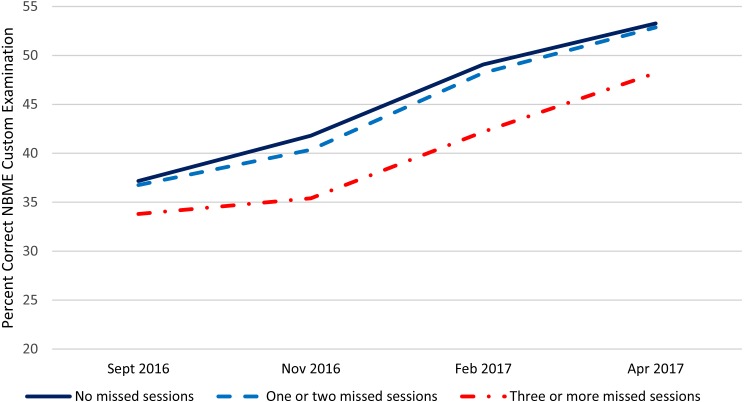
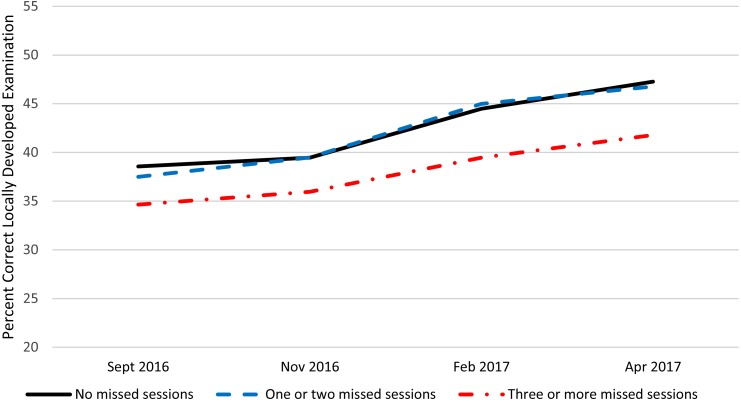
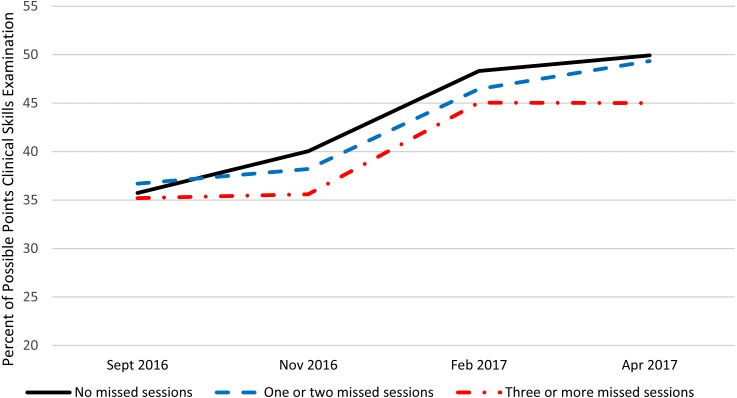
Methodology: Our students' ability to apply basic science knowledge to clinical problems is assessed via progress testing using three methodologies: a locally developed multiple-choice examination, written examination developed through the National Board of Medical Examiners (NBME) Customized Assessment Services Program and post encounter questions included in a clinical skills examination. We analyzed the relationship between voluntary attendance at weekly large group "flipped classroom" sessions and the students' performance on examinations given at four intervals over the initial 24-week module of the medical school curriculum.
Results: Complete data were available for 167 students. A total of 82 students (49.1%) attended all large group sessions, 65 students (38.9%) missed one or two sessions and 20 students (12.0%) missed three or more sessions. There were no difference between the students in the groups on their medical admission (MCAT) examination scores. The growth in performance from each time point until the next was statistically significant. There was no statistically significant difference in growth between the students who had no absences and those who had one or two absences. Students who missed three or more sessions performed significantly lower than their peers over the 24 week module and were more likely to score one or more standard deviations below the class mean on the assessments.
Conclusions: We found no relationship between attendance and MCAT scores suggesting the differences in performance on the progress tests was not due to initial differences in knowledge or reasoning skills. While the study was not experimental, it suggests large group sessions using a "flipped classroom" approach to provide reinforcement, feedback and practice may be effective for increasing learning and retention in the application of basic science knowledge among first year medical students.
Keywords: Attendance; Education; Performance Assessment.
Conflict of interest statement
The authors declare there are no competing interests.
Figures
References
-
- Azab E, Saksena Y, Alghanem T, Midle JB, Molgaard K, Albright S, Karimbux N. Relationship among dental students’ class lecture attendance, use of online resources, and performance. Journal of Dental Education. 2015;80(4):452–458. - PubMed
-
- Credé M, Roch SG, Kieszczynka UM. Class attendance in college: a meta-analytic review of the relationship of class attendance with grades and student characteristics. Review of Educational Research. 2010;80(2):272–295. doi: 10.3102/0034654310362998. - DOI
-
- Fogleman BS, Cleghorn GD. Relationship between class attendance and NBME Part I Examination. Journal of Medical Education. 1983;58(10):904. - PubMed
LinkOut - more resources
Full Text Sources
Other Literature Sources