


Examining the Financial Feasibility of Using a New Special Health Fund to Provide Universal Coverage for a Basic Maternal and Child Health Benefit Package in Nigeria
- PMID: 30083533
- PMCID: PMC6064932
- DOI: 10.3389/fpubh.2018.00200
Examining the Financial Feasibility of Using a New Special Health Fund to Provide Universal Coverage for a Basic Maternal and Child Health Benefit Package in Nigeria
Abstract
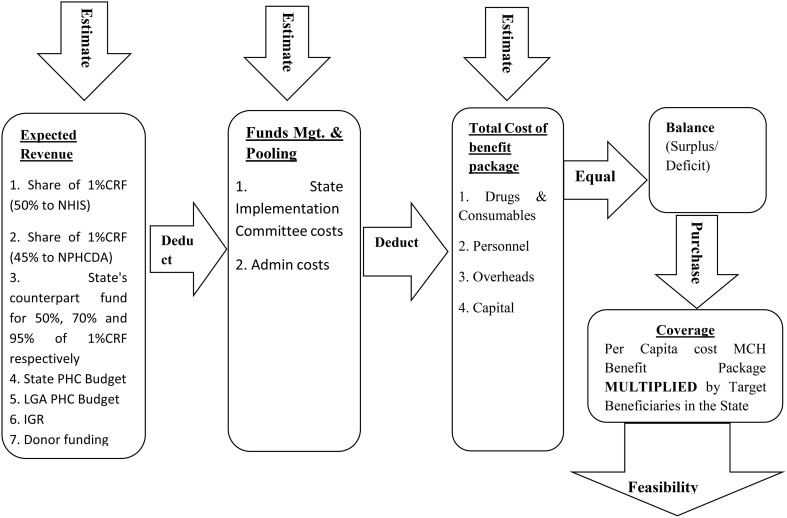
Background: A special health fund was established in Nigeria in 2014 and is known as the Basic Health Care Provision Fund (BHCPF). The fund is equivalent to at least 1% of the Consolidated Revenue of the Federation. The BHCPF will provide additional revenue to fund primary healthcare services and help Nigeria to achieve universal health coverage (UHC). This fund is to be matched with counterpart funds from states and local government areas (LGAs), and is expected to provide at least a basic benefit health package that will cover maternal and child health (MCH) services for pregnant women and under-five children. Objective: To determine the financial feasibility of using the BHCPF to provide a minimum benefit package to cover all pregnant women and under-five children in Nigeria. Methods: The study focused on three states in Nigeria: Imo, Kaduna, and Niger. The feasibility analysis was performed using 3 scenarios but the main analysis was Scenario 1, which was based on the funding of drugs and consumables only. All the costs and revenues were in 2015 levels. The standard costs of a minimum benefit package for the different states were multiplied by the number of target beneficiaries to determine the amount required for the year. Financial feasibility is determined by the excess or otherwise of revenue over costs. Findings: It was found that in the best case funding scenario of using 95% of the CRF with 25% counterpart funding from states and LGAs, the entire available funds were not adequate to cover the benefit package for all the pregnant women and under-five children in the three states. The funds were also inadequate to cover the target beneficiaries that live below the poverty line in two of the states. Conclusion: The BHCPF is a good step toward providing essential MCH services, but the current level of funding will not assure UHC for all the target beneficiaries. However, the available funds should be used immediately to target priority mothers and children such as vulnerable groups, whilst sourcing for additional funds to ensure universal coverage of MCH services.
Keywords: MCH; Nigeria; financial feasibility; financing; health fund; universal health coverage.
Figures
References
-
- National Population Commission, ICF Macro National Demographic Health Survey 2013. Abuja: National Population Commission and ICF Macro; (2013).
-
- National Health Insurance Scheme (NHIS) Operational Manual for the FREE MCH-MDG Program. Abuja: NHIS; (2010).
-
- World Health Organization Centre for Health Development Financial Feasibility: A Glossary of Terms for Community Health Care and Services for Older Persons (2004). Available online at: https://definedterm.com/financial_feasibility (2018).
-
- Björnsdóttir AR. Financial Feasibility Assessments: Building and Using Assessment Models for Financial Feasibility Analysis of Investment Projects. PhD thesis. Faculty of Industrial Engineering, Mechanical Engineering and Computer Science, Reykjavik: University of Iceland; (2010).
-
- Morales-Pinzón T, Lurueña R, Rieradevall J, Gasol CM, Gabarrell X. Financial feasibility and environmental analysis of potential rainwater harvesting systems: a case study in Spain. Resour Conserv Recycl. (2012) 69:130–40. 10.1016/j.resconrec.2012.09.014 - DOI
LinkOut - more resources
Full Text Sources
Other Literature Sources
Molecular Biology Databases
