


Actin's N-terminal acetyltransferase uncovered
- PMID: 30084538
- PMCID: PMC6226318
- DOI: 10.1002/cm.21455
Actin's N-terminal acetyltransferase uncovered
Abstract
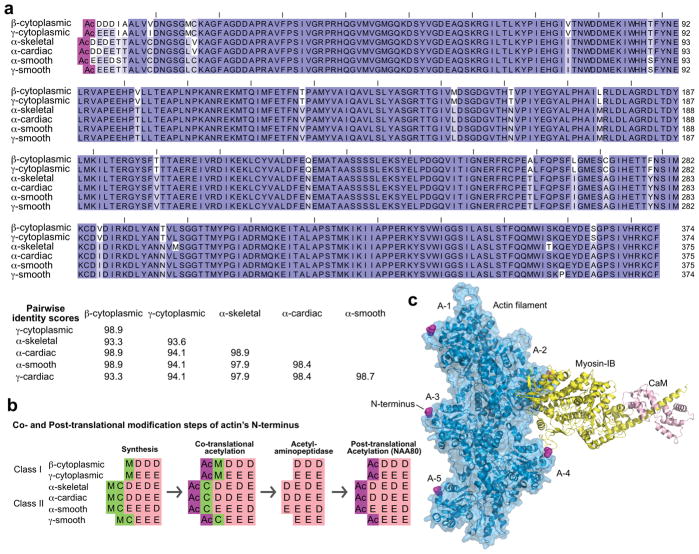
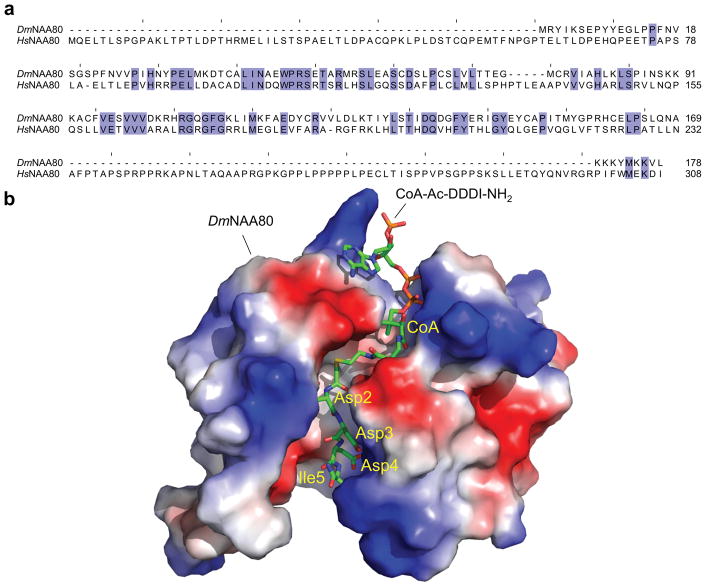
Humans express six highly conserved actin isoforms, which differ the most at their N-termini. Actin's N-terminus undergoes co- and post-translational processing unique among eukaryotic proteins. During translation, the initiator methionine of the two cytoplasmic isoforms is N-terminally acetylated (Nt-acetylated) and that of the four muscle isoforms is removed and the exposed cysteine is Nt-acetylated. Then, an unidentified acetylaminopeptidase post-translationally removes the Ac-Met (or Ac-Cys), and all six isoforms are re-acetylated at the N-terminus. Despite the vital importance of actin for cellular processes ranging from cell motility to organelle trafficking and cell division, the mechanism and functional consequences of Nt-acetylation remained unresolved. Two recent studies significantly advance our understanding of actin Nt-acetylation. Drazic et al. (2018, Proc Natl Acad Sci U S A, 115, 4399-4404) identify actin's dedicated N-terminal acetyltransferase (NAA80/NatH), and demonstrate that Nt-acetylation critically impacts actin assembly in vitro and in cells. NAA80 knockout cells display increased filopodia and lamellipodia formation and accelerated cell motility. In vitro, the absence of Nt-acetylation leads to a decrease in the rates of filament depolymerization and elongation, including formin-induced elongation. Goris et al. (2018, Proc Natl Acad Sci U S A, 115, 4405-4410] describe the structure of Drosophila NAA80 in complex with a peptide-CoA bi-substrate analog mimicking the N-terminus of β-actin. The structure reveals the source of NAA80's specificity for actin's negatively-charged N-terminus. Nt-acetylation neutralizes a positive charge, thus enhancing the overall negative charge of actin's unique N-terminus. Actin's N-terminus is exposed in the filament and influences the interactions of many actin-binding proteins. These advances open the way to understanding the many likely consequences and functional roles of actin Nt-acetylation.
Keywords: N-terminal acetylation; actin assembly; cell motility.
© 2018 Wiley Periodicals, Inc.
Conflict of interest statement
The authors declare not having any conflict of interest to declare
Figures
References
-
- Aksnes H, Drazic A, Marie M, Arnesen T. First Things First: Vital Protein Marks by N-Terminal Acetyltransferases. Trends Biochem Sci. 2016;41(9):746–60. - PubMed
-
- Aksnes H, Van Damme P, Goris M, Starheim KK, Marie M, Stove SI, Hoel C, Kalvik TV, Hole K, Glomnes N, et al. An organellar nalpha-acetyltransferase, naa60, acetylates cytosolic N termini of transmembrane proteins and maintains Golgi integrity. Cell Rep. 2015;10(8):1362–74. - PubMed
-
- Arnesen T, Van Damme P, Polevoda B, Helsens K, Evjenth R, Colaert N, Varhaug JE, Vandekerckhove J, Lillehaug JR, Sherman F, et al. Proteomics analyses reveal the evolutionary conservation and divergence of N-terminal acetyltransferases from yeast and humans. Proc Natl Acad Sci U S A. 2009;106(20):8157–62. - PMC - PubMed
-
- Behnia R, Panic B, Whyte JR, Munro S. Targeting of the Arf-like GTPase Arl3p to the Golgi requires N-terminal acetylation and the membrane protein Sys1p. Nat Cell Biol. 2004;6(5):405–13. - PubMed
-
- Berger EM, Cox G, Weber L, Kenney JS. Actin acetylation in Drosophila tissue culture cells. Biochem Genet. 1981;19(3–4):321–31. - PubMed
Publication types
MeSH terms
Substances
Grants and funding
LinkOut - more resources
Full Text Sources
Other Literature Sources
Molecular Biology Databases
Research Materials
Miscellaneous
