Are Global Breast Cancer Incidence and Mortality Patterns Related to Country-Specific Economic Development and Prevention Strategies?
- PMID: 30085889
- PMCID: PMC6223528
- DOI: 10.1200/JGO.17.00207
Are Global Breast Cancer Incidence and Mortality Patterns Related to Country-Specific Economic Development and Prevention Strategies?
Abstract
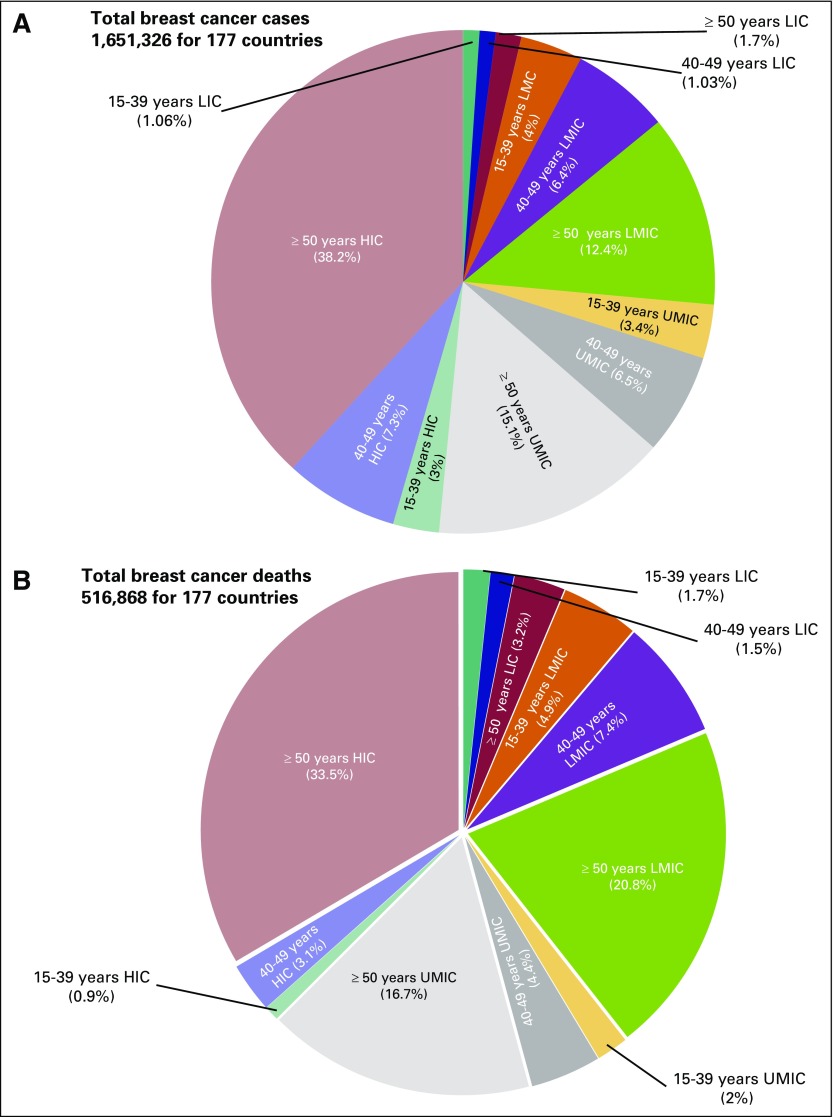
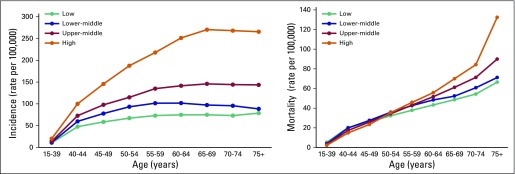
Purpose There remains considerable international variation in breast cancer incidence and mortality, but a comprehensive examination of rates by country level economic, development and cancer prevention policies is lacking. Materials and Methods We compared GLOBOCAN 2012 age-specific breast cancer incidence and mortality rates for 177 countries by using development and policy data available from the WHO Global Cancer Country Profiles data base. We classified each country on the basis of gross national income per capita from the World Development Indicators data base, as follows: low-income country (LIC), lower-middle-income country (LMIC), upper-middle-income country (UMIC), and high-income country (HIC). Results There were 1,651,326 breast cancer cases and 516,868 breast cancer deaths estimated in 2012. Approximately three quarters of all breast cancer cases and 60% of the breast cancer deaths were in women from HICs and UMICs. Age and country-level income explained approximately 60% of the international variation in breast cancer incidence and mortality in women of all ages (adjusted R2 = 58% and 60%, respectively). Economic development indicators additionally increased the overall variation in incidence and mortality by approximately 5%. In women younger than age 50 years, country-level income explained 68% of incidence and 59% of mortality; economic development indicators additionally increased this percentage by approximately 4%. Country-level cancer prevention policy indicators contributed little to explanation of the overall variation in incidence and mortality after analysis accounted for age and country-level income; however, an overall resource summary index of greater economic development and cancer prevention policies was related to lower mortality within each major income level. Conclusion Although breast cancer incidence increases with higher income levels in all ages, women in the poorest countries bear a relatively higher burden of breast cancer mortality, particularly women younger than age 50 years.
Figures
References
-
- Fitzmaurice C, Allen C, Barber RM, et al. Global, regional, and national cancer incidence, mortality, years of life lost, years lived with disability, and disability-adjusted life-years for 32 cancer groups, 1990 to 2015: A systematic analysis for the global burden of disease study. JAMA Oncol. 2017;3:524–548. - PMC - PubMed
-
- Torre LA, Siegel RL, Ward EM, et al. Global cancer incidence and mortality rates and trends: An update. Cancer Epidemiol Biomarkers Prev. 2016;25:16–27. - PubMed
-
- Torre LA, Islami F, Siegel RL, et al. Global cancer in women: Burden and trends. Cancer Epidemiol Biomarkers Prev. 2017;26:444–457. - PubMed
-
- Institute for Health Metrics and Evaluation https://vizhub.healthdata.org/gbd/compare
-
- Denny L, de Sanjose S, Mutebi M, et al. Interventions to close the divide for women with breast and cervical cancer between low-income and middle-income countries and high-income countries. Lancet. 2017;389:861–870. - PubMed
Publication types
MeSH terms
LinkOut - more resources
Full Text Sources
Other Literature Sources
Medical