


Blind spots in telemedicine: a qualitative study of staff workarounds to resolve gaps in diabetes management
- PMID: 30086743
- PMCID: PMC6081904
- DOI: 10.1186/s12913-018-3427-9
Blind spots in telemedicine: a qualitative study of staff workarounds to resolve gaps in diabetes management
Abstract
Background: Novel telemedicine platforms have expanded access to critical retinal screening into primary care settings. This increased access has contributed to improved retinal screening uptake for diabetic patients, particularly those treated in Federally Qualified Health Centers ('safety net' clinics). The aim of this study was to understand how the implementation of telemedical screening for diabetic retinopathy within primary care settings is improving the delivery of critical preventative services, while also introducing changes into clinic workflows and creating additional tasks and responsibilities within resource-constrained clinics.
Methods: A qualitative approach was employed to track workflows and perspectives from a range of medical personnel involved in the telemedicine platform for diabetic retinopathy screening and subsequent follow-up treatment. Data were collected through semi-structured interviews and participant observation at three geographically-dispersed Federally Qualified Health Centers in California. Qualitative analysis was performed using standard thematic analytic approaches within a qualitative data analysis software program.
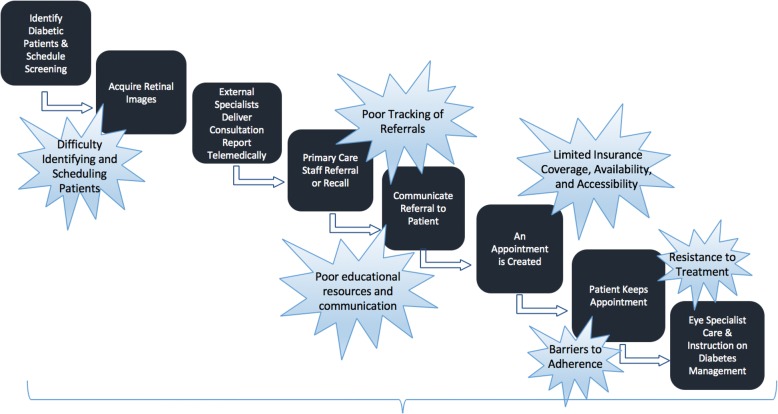
Results: The introduction of telemedicine platforms, such as diabetic retinopathy screening, into primary care settings is creating additional strain on medical personnel across the diabetes eye care management spectrum. Central issues are related to scheduling patients, issuing referrals for follow-up care and treatment, and challenges to improving adherence to treatment and diabetes management. These issues are overcome in many cases through workarounds, or when medical staff work outside of their job descriptions, purview, and permission to move patients through the diabetes management continuum.
Conclusions: This study demonstrates how the implementation of a novel telemedical platform for diabetic retinopathy screening contributes to the phenomenon of workarounds that account for additional tasks and patient volume. These workarounds should not be considered a sustainable model of health care delivery, but rather as an initial step to understanding where issues are and how clinics can adapt to the inclusion of telemedicine and ultimately increase access to care. The presence of workarounds suggests that as telemedicine is expanded, adequate resources, as well as collaborative, cross-sectoral co-design of new workflows must be simultaneously provided. Systematic bolstering of resources would contribute to more consistent success of telemedicine screening platforms and improved treatment and prevention of disease-related complications.
Keywords: Diabetes care; Diabetic retinopathy; Telemedicine; Workarounds.
Conflict of interest statement
Ethics approval and consent to participate
Approval was obtained from the Riverside University Health System Medical Center Institutional Review Board IRB [Study #: 824116–1]. All participants provided written and verbal consent.
Consent for publication
Not applicable.
Competing interests
KB none; CS-M none; ERP is an employee at Google, LLC; GB and JC are each part-owner of EyePACS, LLC. KB and CS-M performed the data collection independently.
Publisher’s Note
Springer Nature remains neutral with regard to jurisdictional claims in published maps and institutional affiliations.
Figures
References
-
- Armfield NR, Coulthard MG, Slater A, McEniery J, Elcock M, Ware RS, Scuffham PA, Bensink ME, Smith AC. The effectiveness of telemedicine for paediatric retrieval consultations: rationale and study design for a pragmatic multicentre randomised controlled trial. BMC Health Serv Res. 2014;14:546. doi: 10.1186/s12913-014-0546-9. - DOI - PMC - PubMed
Publication types
MeSH terms
LinkOut - more resources
Full Text Sources
Other Literature Sources
Medical
