


Mindfulness-based cognitive therapy for patients with chronic, treatment-resistant depression: A pragmatic randomized controlled trial
- PMID: 30088834
- PMCID: PMC6175087
- DOI: 10.1002/da.22788
Mindfulness-based cognitive therapy for patients with chronic, treatment-resistant depression: A pragmatic randomized controlled trial
Abstract
Background: Chronic and treatment-resistant depressions pose serious problems in mental health care. Mindfulness-based cognitive therapy (MBCT) is an effective treatment for remitted and currently depressed patients. It is, however, unknown whether MBCT is effective for chronic, treatment-resistant depressed patients.
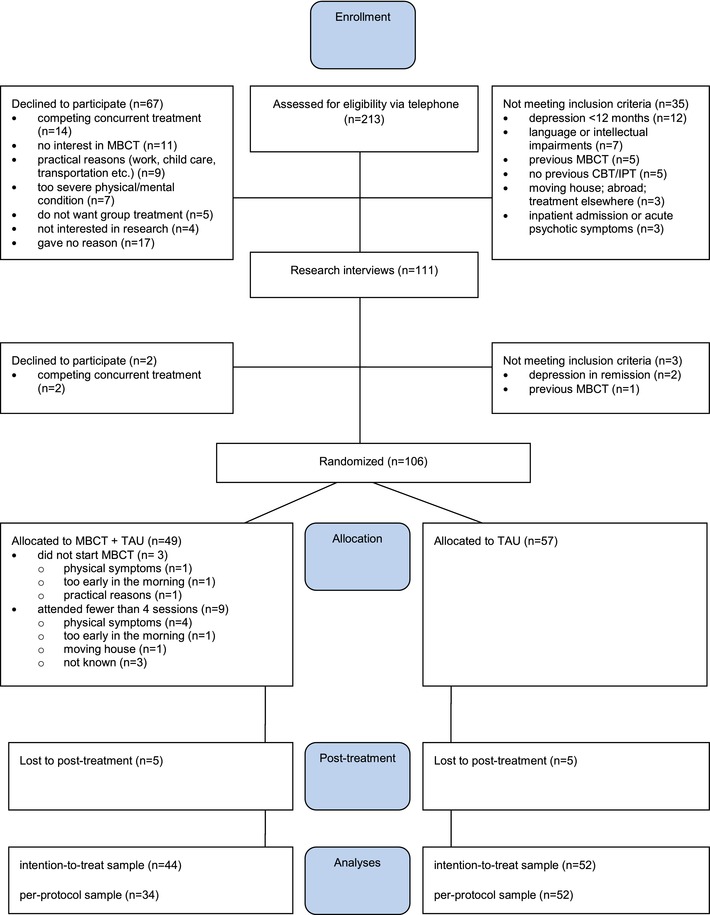
Method: A pragmatic, multicenter, randomized-controlled trial was conducted comparing treatment-as-usual (TAU) with MBCT + TAU in 106 chronically depressed outpatients who previously received pharmacotherapy (≥4 weeks) and psychological treatment (≥10 sessions).
Results: Based on the intention-to-treat (ITT) analysis, participants in the MBCT + TAU condition did not have significantly fewer depressive symptoms than those in the TAU condition (-3.23 [-6.99 to 0.54], d = 0.35, P = 0.09) at posttreatment. However, compared to TAU, the MBCT + TAU group reported significantly higher remission rates (χ2 (2) = 4.25, φ = 0.22, P = 0.04), lower levels of rumination (-3.85 [-7.55 to -0.15], d = 0.39, P = 0.04), a higher quality of life (4.42 [0.03-8.81], d = 0.42, P = 0.048), more mindfulness skills (11.25 [6.09-16.40], d = 0.73, P < 0.001), and more self-compassion (2.91 [1.17-4.65], d = 0.64, P = 0.001). The percentage of non-completers in the MBCT + TAU condition was relatively high (n = 12, 24.5%). Per-protocol analyses revealed that those who completed MBCT + TAU had significantly fewer depressive symptoms at posttreatment compared to participants receiving TAU (-4.24 [-8.38 to -0.11], d = 0.45, P = 0.04).
Conclusion: Although the ITT analysis did not reveal a significant reduction in depressive symptoms of MBCT + TAU over TAU, MBCT + TAU seems to have beneficial effects for chronic, treatment-resistant depressed patients in terms of remission rates, rumination, quality of life, mindfulness skills, and self-compassion. Additionally, patients who completed MBCT showed significant reductions in depressive symptoms. Reasons for non-completion should be further investigated.
Keywords: depressive disorder; mindfulness; quality of life; randomized controlled trial; treatment-resistant depression.
© 2018 The Authors. Depression and Anxiety published by Wiley Periodicals, Inc.
References
-
- Baer, R. A. , Smith, G. T. , Lykins, E. , Button, D. , Krietemeyer, J. , Sauer, S. , … Williams, J. M. G. (2008). Construct validity of the five facet mindfulness questionnaire in meditating and nonmeditating samples. Assessment, 15(3)329–342. - PubMed
-
- Cladder‐Micus, M. B. , Vrijsen, J. N. , Becker, E. S. , Donders, R. , Spijker, J. , & Speckens, A. E. (2015). A randomized controlled trial of mindfulness‐based cognitive therapy (MBCT) versus treatment‐as‐usual (TAU) for chronic, treatment‐resistant depression: Study protocol. BMC Psychiatry, 15(1), 1–8. - PMC - PubMed
Publication types
MeSH terms
Grants and funding
LinkOut - more resources
Full Text Sources
Other Literature Sources
Medical
Molecular Biology Databases
