


doi: 10.1523/JNEUROSCI.2486-17.2018.
Persistent Spiking Activity Underlies Working Memory
Affiliations
- PMID: 30089641
- PMCID: PMC6083457
- DOI: 10.1523/JNEUROSCI.2486-17.2018
Item in Clipboard
Persistent Spiking Activity Underlies Working Memory
J Neurosci.
.
Abstract
Persistent activity generated in the PFC during the delay period of working memory tasks represents information about stimuli held in memory and determines working memory performance. Alternative models of working memory, depending on the rhythmicity of discharges or exclusively on short-term synaptic plasticity, are inconsistent with the neurophysiological data.Dual Perspectives Companion Paper:Working Memory: Delay Activity, Yes! Persistent Activity? Maybe Not, by Mikael Lundqvist, Pawel Herman, and Earl K. Miller.
Keywords: delay period; monkey; neurophysiology; prefrontal cortex; working memory.
Copyright © 2018 the authors 0270-6474/18/387020-09$15.00/0.
Figures
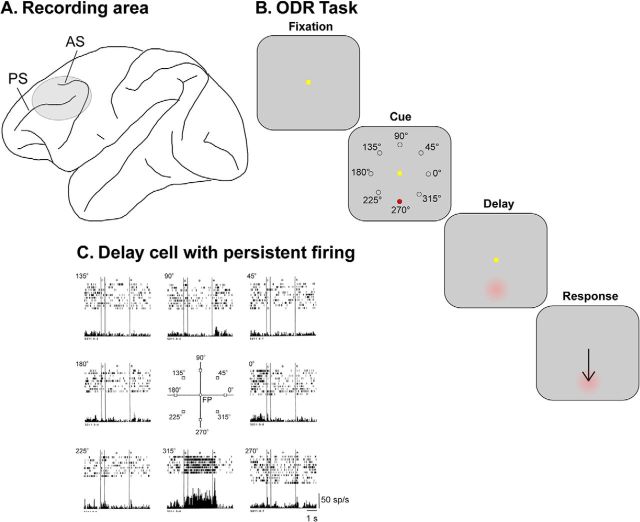
A, Schematic diagram of the monkey brain with caudal area of the principal sulcus highlighted. AS, Arcuate sulcus; PS, principal sulcus. B, Sequence of events in the oculomotor delayed response task. C, Example neuron with persistent activity. From Funahashi et al. (1989).
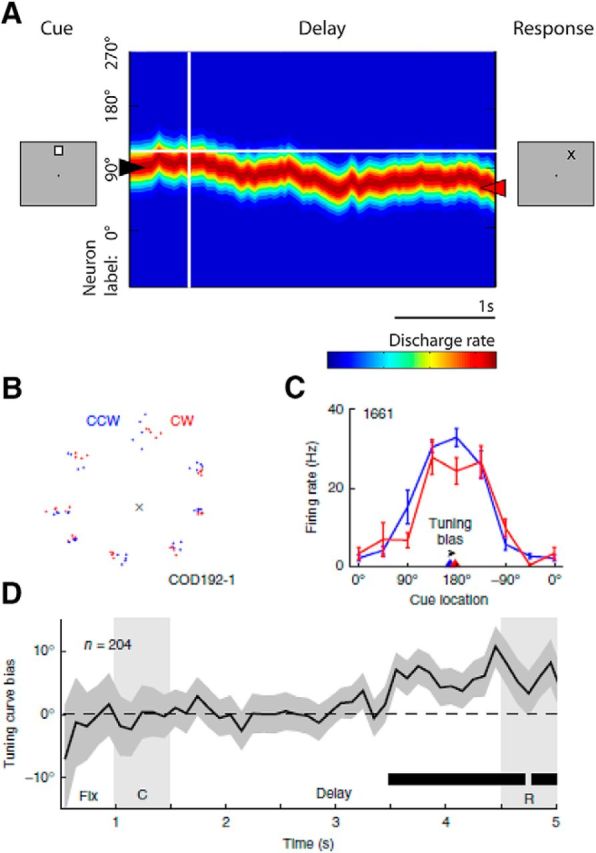
A, Illustration of the bump attractor model. Appearance of a stimulus elicits activity in a network of neurons (arranged in the y-axis based on preferred location). The bump of activity drifts during the delay period. The monkey's recall is determined by the position of the bump at the end of the delay period. From Constantinidis and Klingberg (2016). B, Representation of saccade endpoints for one session. For each cue, trials are separated in half based on their relative clockwise (red) and counterclockwise (blue) saccadic responses. C, Sample neuron delay-period responses in the clockwise and counterclockwise conditions. Triangles represent the circular mean of the responses, an estimate of the cue position for each condition. The distance between these two circular means is the tuning bias. D, Population average of the tuning bias for all neurons across time showed significantly positive values by the end of the delay. From Wimmer et al. (2014).
References
Publication types
MeSH terms
Grants and funding
LinkOut - more resources
Full Text Sources
Other Literature Sources
Miscellaneous
