Electronic Medical Alerts Increase Screening for Chronic Hepatitis B: A Randomized, Double-Blind, Controlled Trial
- PMID: 30089680
- PMCID: PMC6214733
- DOI: 10.1158/1055-9965.EPI-18-0448
Electronic Medical Alerts Increase Screening for Chronic Hepatitis B: A Randomized, Double-Blind, Controlled Trial
Abstract
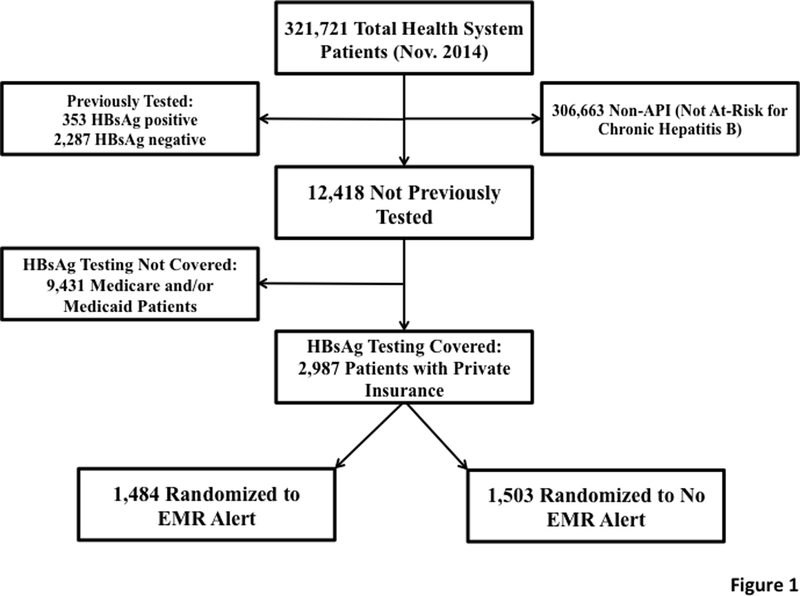
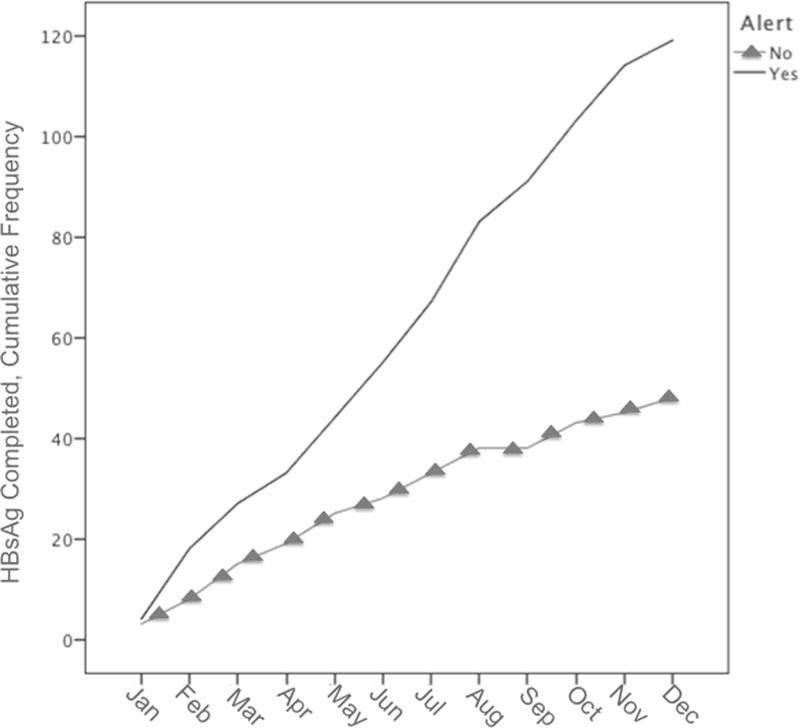
Background: Implementation of screening recommendations for chronic hepatitis B (CHB) among foreign-born persons at risk has been sub-optimal. The use of alerts and reminders in the electronic health record (EHR) has led to increased screening for other common conditions. The aim of our study was to measure the effectiveness of an EHR alert on the implementation of hepatitis B surface antigen (HBsAg) screening of foreign-born Asian and Pacific Islander (API) patients.Methods: We used a novel technique to identify API patients by self-identified ethnicity, surname, country of origin, and language preference, and who had no record of CHB screening with HBsAg within the EHR. Patients with Medicare and/or Medicaid insurance were excluded due to lack of coverage for routine HBsAg screening at the time of this study. At-risk API patients were randomized to alert activation in their EHR or not (control).Results: A total of 2,987 patients met inclusion criteria and were randomized to the alert (n = 1,484) or control group (n = 1,503). In the alert group, 119 patients were tested for HBsAg, compared with 48 in the control group (odds ratio, 2.64; 95% confidence interval, 1.88-3.73; P < 0.001). In the alert group, 4 of 119 (3.4%) tested HBsAg-positive compared with 5 of 48 (10.4%) in the control group (P = 0.12).Conclusions: An EHR alert significantly increased HBsAg testing among foreign-born APIs.Impact: Utilization of EHR alerts has the potential to improve implementation of hepatitis B-screening guidelines. Cancer Epidemiol Biomarkers Prev; 27(11); 1352-7. ©2018 AACR.
©2018 American Association for Cancer Research.
Conflict of interest statement
Figures
References
-
- Centers for Disease Control and Prevention (CDC). Vaccine Information Statement. https://www.cdc.gov/vaccines/hcp/vis/vis-statements/hep-b.html July 7, 2016; December 27, 2017.
-
- Roberts H, Kruszon-Moran D, Ly KN, et al. Prevalence of chronic hepatitis B virus (HBV) infection in U.S. households: National Health and Nutrition Examination Survey (NHANES), 1988–2012. Hepatology 2016; 63: 388–97. - PubMed
-
- Kowdley KV, Wang CC, Welch S, Roberts H, Brosgart CL. Prevalence of chronic hepatitis B among foreign-born persons living in the United States by country of origin. Hepatology 2012; 56: 422–33. - PubMed
Publication types
MeSH terms
Grants and funding
LinkOut - more resources
Full Text Sources
Other Literature Sources
Miscellaneous