. 2018 Aug 9;3(15):e121468.
doi: 10.1172/jci.insight.121468.

Ivacaftor-induced sweat chloride reductions correlate with increases in airway surface liquid pH in cystic fibrosis

Affiliations

Ivacaftor-induced sweat chloride reductions correlate with increases in airway surface liquid pH in cystic fibrosis

Mahmoud H Abou Alaiwa et al. JCI Insight. .

Abstract

Background: Disruption of cystic fibrosis transmembrane conductance regulator (CFTR) anion channel function causes cystic fibrosis (CF), and lung disease produces most of the mortality. Loss of CFTR-mediated HCO3- secretion reduces the pH of airway surface liquid (ASL) in vitro and in neonatal humans and pigs in vivo. However, we previously found that, in older children and adults, ASL pH does not differ between CF and non-CF. Here, we tested whether the pH of CF ASL increases with time after birth. Finding that it did suggested that adaptations by CF airways increase ASL pH. This conjecture predicted that increasing CFTR activity in CF airways would further increase ASL pH and also that increasing CFTR activity would correlate with increases in ASL pH.

Methods: To test for longitudinal changes, we measured ASL pH in newborns and then at 3-month intervals. We also studied people with CF (bearing G551D or R117H mutations), in whom we could acutely stimulate CFTR activity with ivacaftor. To gauge changes in CFTR activity, we measured changes in sweat Cl- concentration immediately before and 48 hours after starting ivacaftor.

Results: Compared with that in the newborn period, ASL pH increased by 6 months of age. In people with CF bearing G551D or R117H mutations, ivacaftor did not change the average ASL pH; however reductions in sweat Cl- concentration correlated with elevations of ASL pH. Reductions in sweat Cl- concentration also correlated with improvements in pulmonary function.

Conclusions: Our results suggest that CFTR-independent mechanisms increase ASL pH in people with CF. We speculate that CF airway disease, which begins soon after birth, is responsible for the adaptation.

Funding: Vertex Inc., the NIH (P30DK089507, 1K08HL135433, HL091842, HL136813, K24HL102246), the Cystic Fibrosis Foundation (SINGH17A0 and SINGH15R0), and the Burroughs Wellcome Fund.

Keywords: Epithelial transport of ions and water; Ion channels; Pulmonology.


Conflict of interest statement

Conflict of interest: The authors have declared that no conflict of interest exists.

Figures

Figure 1
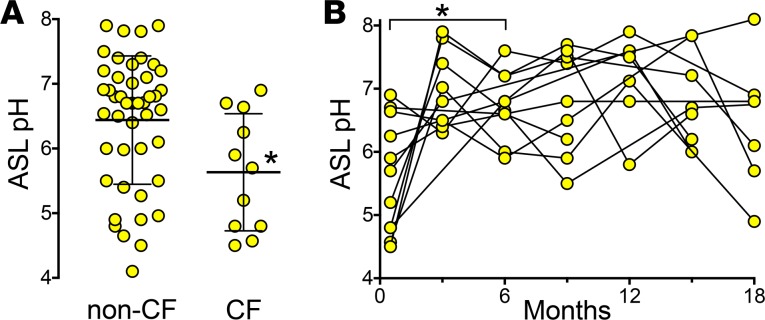
Figure 1. Airway surface liquid pH is abnormally acidic in cystic fibrosis neonates and increases by 3 months of age.
(A) The non-CF group includes 4 neonates without cystic fibrosis transmembrane conductance regulator (CFTR) mutations and 41 neonates heterozygous for a CFTR mutation. The cystic fibrosis (CF) group includes 11 neonates. Bars and whiskers indicate mean ± SD. *P = 0.01 by Mann-Whitney test. (B) Airway surface liquid (ASL) pH in CF neonates (n = 11) measured at birth and at 3-month intervals. Data points and connecting lines represent values for individuals. We compared values at birth and at 6 months, a time point when we had data for 10 of the participants. *P = 0.025 by Wilcoxon matched-pairs signed-rank test.
Figure 2
Figure 2. Ivacaftor acutely reduces sweat Cl concentration and increases forced expiratory volume in 1 second.
(A) Sweat Cl concentration, (B) forced expiratory volume in 1 second (FEV1%), and (C) airway surface liquid (ASL) pH on day 0 and 2 days after beginning ivacaftor. Each pair of data points and connecting lines indicate a different person. n= 22 for sweat [Cl] and FEV1%; n= 21 for ASL pH (1 person declined ASL pH measurements). Bars and whiskers indicate mean ± SD. We did not detect an effect of sex or genotype on the results. *P < 0.001 by Wilcoxon matched-pairs signed-rank test.
Figure 3
Figure 3. Ivacaftor-induced changes in sweat Cl concentration correlate with changes in forced expiratory volume in 1 second and airway surface liquid pH.
(A) Relationship between changes in sweat Cl concentration and changes in forced expiratory volume in 1 second (FEV1%) (P = 0.034 Spearman rank correlation, 0.46 correlation coefficient, n = 22). (B) Relationship between changes in sweat Cl concentration and changes in airway surface liquid (ASL) pH (P = 0.038 Spearman rank correlation, 0.45 correlation coefficient, n = 21). (C) Relationship between changes in ASL pH and changes in FEV1% (P = 0.132 Spearman rank correlation, 0.34 correlation coefficient, n = 21).

References

    1. Quinton PM. Physiological basis of cystic fibrosis: a historical perspective. Physiol Rev. 1999;79(1 Suppl):S3–S22. - PubMed
    1. Stoltz DA, Meyerholz DK, Welsh MJ. Origins of cystic fibrosis lung disease. N Engl J Med. 2015;372(4):351–362. doi: 10.1056/NEJMra1300109. - DOI - PMC - PubMed
    1. Cutting GR. Cystic fibrosis genetics: from molecular understanding to clinical application. Nat Rev Genet. 2015;16(1):45–56. - PMC - PubMed
    1. Poulsen JH, Fischer H, Illek B, Machen TE. Bicarbonate conductance and pH regulatory capability of cystic fibrosis transmembrane conductance regulator. Proc Natl Acad Sci USA. 1994;91(12):5340–5344. doi: 10.1073/pnas.91.12.5340. - DOI - PMC - PubMed
    1. Lee RJ, Limberis MP, Hennessy MF, Wilson JM, Foskett JK. Optical imaging of Ca2+-evoked fluid secretion by murine nasal submucosal gland serous acinar cells. J Physiol (Lond) 2007;582(Pt 3):1099–1124. - PMC - PubMed

Publication types

MeSH terms