Review
. 2018 Jul 25:9:1088.
doi: 10.3389/fpls.2018.01088. eCollection 2018.

Multifunctional Roles of Plant Cuticle During Plant-Pathogen Interactions

Affiliations
Review

Multifunctional Roles of Plant Cuticle During Plant-Pathogen Interactions

Carmit Ziv et al. Front Plant Sci. .

Abstract

In land plants the cuticle is the outermost layer interacting with the environment. This lipophilic layer comprises the polyester cutin embedded in cuticular wax; and it forms a physical barrier to protect plants from desiccation as well as from diverse biotic and abiotic stresses. However, the cuticle is not merely a passive, mechanical shield. The increasing research on plant leaves has addressed the active roles of the plant cuticle in both local and systemic resistance against a variety of plant pathogens. Moreover, the fruit cuticle also serves as an important determinant of fruit defense and quality. It shares features with those of vegetative organs, but also exhibits specific characteristics, the functions of which gain increasing attention in recent years. This review describes multiple roles of plant cuticle during plant-pathogen interactions and its responses to both leaf and fruit pathogens. These include the dynamic changes of plant cuticle during pathogen infection; the crosstalk of cuticle with plant cell wall and diverse hormone signaling pathways for plant disease resistance; and the major biochemical, molecular, and cellular mechanisms that underlie the roles of cuticle during plant-pathogen interactions. Although research developments in the field have greatly advanced our understanding of the roles of plant cuticle in plant defense, there still remain large gaps in our knowledge. Therefore, the challenges thus presented, and future directions of research also are discussed in this review.

Keywords: cuticle-cell wall continuum; cutin and wax; hormone signaling; plant cuticle; plant defense; plant-pathogen interaction.


Figures
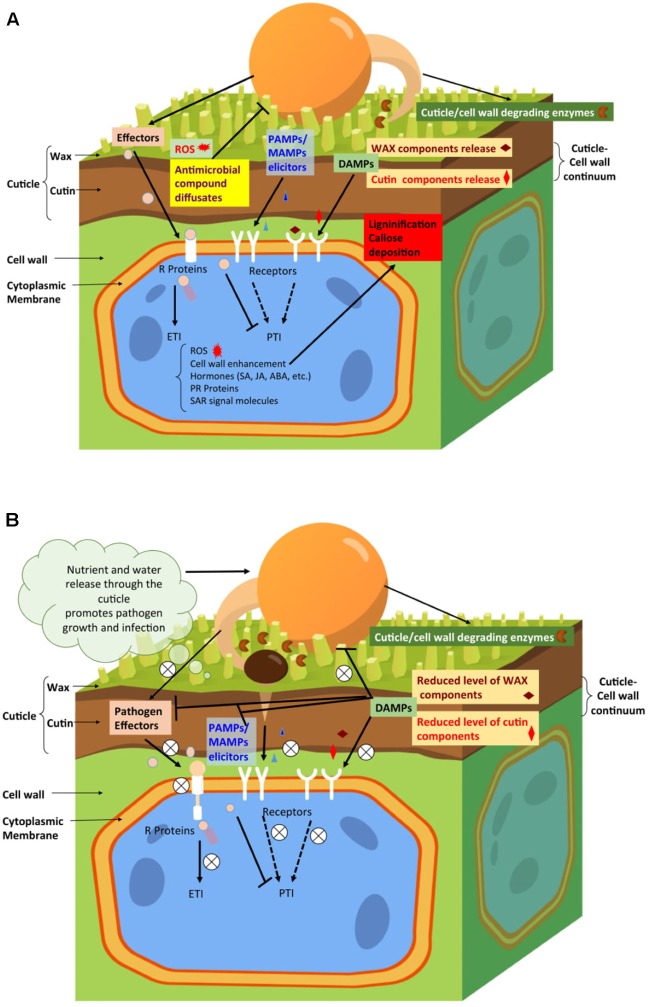
FIGURE 1
FIGURE 1
Hypothetical model representing the involvement of plant cuticle during plant interactions with various pathogens. (A). During pathogen infection of resistant plants, the specific cuticle properties may affect the outcome of the interaction. For example, in response to infection, plants with a more permeable cuticle could release defense signals much faster. These signals comprise certain cutin monomers or wax components (e.g., DAMPs), elicited by cuticle- or/and cell wall-degrading enzymes secreted by the pathogens. Plants with a more permeable cuticle could also respond faster to the pathogen elicitors (e.g., MAMPs/PAMPs) and effectors in activating the plant disease resistance through PTI and ETI, respectively. Both PTI and ETI activate plant disease resistance, but ETI is a stronger and more efficient response through the interactions of R proteins with pathogen effectors. The ETI response might include cuticle and cell wall remodeling, release of antimicrobial compounds and ROS, and production of defense hormones, PR proteins, and SAR signaling molecules. (B). During pathogen infection on susceptible plant hosts, the enhancement of specific cuticle properties, such as permeability, might lead to reduced levels of certain cutin monomers and/or wax components that could repress the virulence and pathogenicity of pathogens and their effectors. These specific cutin monomers and/or wax components could serve as signals to activate plant defense locally and/or systemically. The enhanced cuticle permeability might also disrupt the elicitors (MAMPs/PAMPs) that could be detected by plant receptors to trigger the defense. The increased release of water and dissolved nutrient compounds at the leaf surface could enhance pathogen fitness and support its growth and pathogenicity, and facilitate pathogens’ entry through the plant cuticle and/or cell wall and the injection of their virulent and pathogenic effectors. All these effects will impair the ability of plants to activate their defense mechanisms and eventually result in their susceptibility to the pathogens.

References

    1. Alkan N., Fortes A. M. (2015). Insights into molecular and metabolic events associated with fruit response to post-harvest fungal pathogens. Front. Plant Sci. 6:889. 10.3389/fpls.2015.00889 - DOI - PMC - PubMed
    1. Alkan N., Friedlander G., Ment D., Prusky D., Fluhr R. (2015). Simultaneous transcriptome analysis of Colletotrichum gloeosporioides and tomato fruit pathosystem reveals novel fungal pathogenicity and fruit defense strategies. New Phytol. 205 801–815. 10.1111/nph.13087 - DOI - PubMed
    1. Aragón W., Reina-Pinto J. J., Serrano M. (2017). The intimate talk between plants and microorganisms at the leaf surface. J. Exp. Bot. 68 5339–5350. 10.1093/jxb/erx327 - DOI - PubMed
    1. Arif T., Bhosale J. D., Kumar N., Mandal T. K., Bendre R. S., Lavekar G. S., et al. (2009). Natural products–antifungal agents derived from plants. J. Asian Nat. Prod. Res. 11 621–638. 10.1080/10286020902942350 - DOI - PubMed
    1. Bargel H., Neinhuis C. (2005). Tomato (Lycopersicon esculentum Mill.) fruit growth and ripening as related to the biomechanical properties of fruit skin and isolated cuticle. J. Exp. Bot. 56 1049–1060. 10.1093/jxb/eri098 - DOI - PubMed

LinkOut - more resources
