Review
. 2018 Dec:42:100-110.
doi: 10.1016/j.smrv.2018.07.002. Epub 2018 Jul 6.

Sleep disturbances and their impact in pediatric cystic fibrosis

Affiliations
Review

Sleep disturbances and their impact in pediatric cystic fibrosis

Aarti Shakkottai et al. Sleep Med Rev. 2018 Dec.

Abstract

Cystic fibrosis is a chronic, life-shortening illness that affects multiple systems and results in frequent respiratory infections, chronic cough, fat malabsorption and malnutrition. Poor sleep is often reported by patients with cystic fibrosis. Although objective data to explain these complaints have been limited, they do show poor sleep efficiency and frequent arousals. Abnormalities in gas exchange are also observed during sleep in patients with cystic fibrosis. The potential impact of these abnormalities in sleep on health and quality of life remains largely unstudied. This review summarizes what is known about sleep in children with cystic fibrosis, and implications for clinical practice. This report also highlights new evidence on the impact of sleep problems on disease-specific outcomes such as lung function, and identifies areas that need further exploration.

Keywords: Adolescents; Children; Cystic fibrosis; Hypoxemia; Obstructive sleep apnea; Sleep; Sleep-disordered breathing.


Conflict of interest statement

Conflict of Interest

The authors report no conflicts of interest pertinent to this review.

Figures
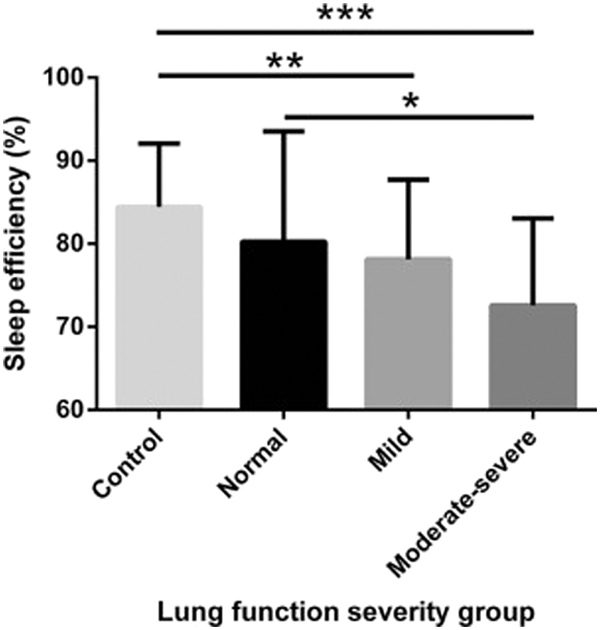
Figure 1:
Figure 1:
Sleep efficiency of control children and children with CF across 3 different groups of FEV1 (normal [≥90%], mild [70%−89%], moderate-severe [<70%]). A significant difference was found in the children with CF across the 3 groups (P = .03) after controlling for sex, age, and SES (univariate analysis). A significant difference was measured between CF patients with normal lung function vs CF patients with moderate-severe lung function (*P < .05). A significant difference also was measured between control children and CF patients with mild (**P < .01) and moderate-severe (***P < .001) lung function but not those with normal lung function (P = .08). Reprinted from Journal of Pediatrics, 182, Vandeleur M, Walter LM, Armstrong DS, Robinson P, Nixon GM, Horne RS, How Well Do Children with Cystic Fibrosis Sleep? An Actigraphic and Questionnaire-Based Study, 170–176, Copyright (2017), with permission from Elsevier.
Figure 2:
Figure 2:
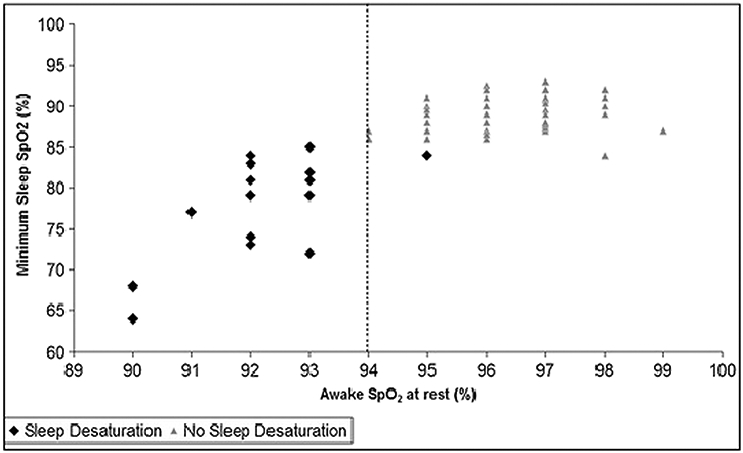
Relationship between the minimum sleep SpO2 and awake SpO2 at rest in sitting position. The vertical line represents the threshold (awake SpO2 = 94%) that best separates patients who did desaturate (diamonds) from those who did not desaturate (triangles). Reprinted from Sleep and Breathing, Sleep findings and predictors of sleep desaturation in adult cystic fibrosis patients, 16, 2012, 1041–1048, Perin C, Fagondes SC, Casarotto FC, Pinotti AF, Menna Barreto SS, Dalcin Pde T, © Springer-Verlag 2011, with permission of Springer.
Figure 3:
Figure 3:
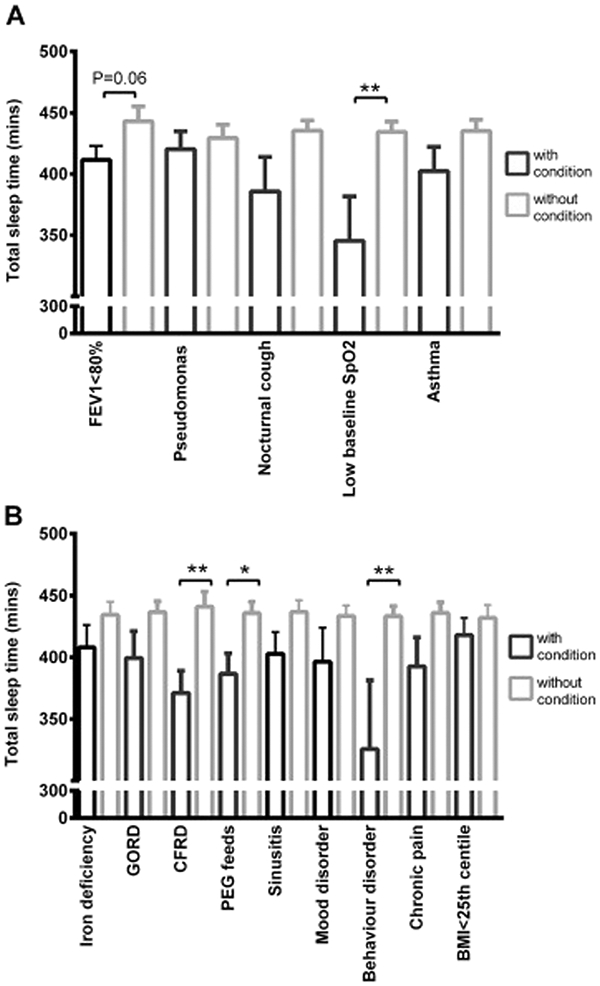
Total sleep time of children with CF, with and without (A) respiratory co-morbidities or (B) non-respiratory co-morbidities. Data presented as mean ± SEM * p ≤ 0.05, **p ≤ 0.01. Reprinted from Journal of Cystic Fibrosis, 16(6), Vandeleur M, Walter LM, Armstrong DS, Robinson P, Nixon GM, Horne RSC, What keeps children with cystic fibrosis awake at night?, 719–726, Copyright (2017), with permission from Elsevier.

References

    1. Owens J Classification and epidemiology of childhood sleep disorders. Prim Care. 2008;35(3):533–46, vii. - PubMed
    1. O’Brien LM, Mervis CB, Holbrook CR, Bruner JL, Klaus CJ, Rutherford J, et al. Neurobehavioral implications of habitual snoring in children. Pediatrics. 2004;114(1):44–9. - PubMed
    1. Chervin RD, Ruzicka DL, Archbold KH, Dillon JE. Snoring predicts hyperactivity four years later. Sleep. 2005;28(7):885–90. - PubMed
    1. Chervin RD, Ruzicka DL, Giordani BJ, Weatherly RA, Dillon JE, Hodges EK, et al. Sleep-disordered breathing, behavior, and cognition in children before and after adenotonsillectomy. Pediatrics. 2006;117(4):e769–78. - PMC - PubMed
    1. O’Brien LM. The neurocognitive effects of sleep disruption in children and adolescents. Child Adolesc Psychiatr Clin N Am. 2009;18(4):813–23. - PubMed

Publication types

MeSH terms