Right ventricle to pulmonary artery coupling in patients undergoing transcatheter aortic valve implantation
- PMID: 30093545
- PMCID: PMC6320315
- DOI: 10.1136/heartjnl-2018-313385
Right ventricle to pulmonary artery coupling in patients undergoing transcatheter aortic valve implantation
Abstract
Objectives: To evaluate the prognostic value of the ratio between tricuspid annular plane systolic excursion (TAPSE)-pulmonary artery systolic pressure (PASP) as a determinant of right ventricular to pulmonary artery (RV-PA) coupling in patients undergoing transcatheter aortic valve replacement (TAVI).
Background: RV function and pulmonary hypertension (PH) are both prognostically important in patients receiving TAVI. RV-PA coupling has been shown to be prognostic important in patients with heart failure but not previously evaluated in TAVI patients.
Methods: Consecutive patients with severe aortic stenosis who received TAVI from July 2011 through January 2016 and with comprehensive baseline echocardiogram were included. All individual echocardiographic images and Doppler data were independently reviewed and blinded to the clinical information and outcomes. Cox models quantified the effect of TAPSE/PASP quartiles on subsequent all-cause mortality while adjusting for confounders.
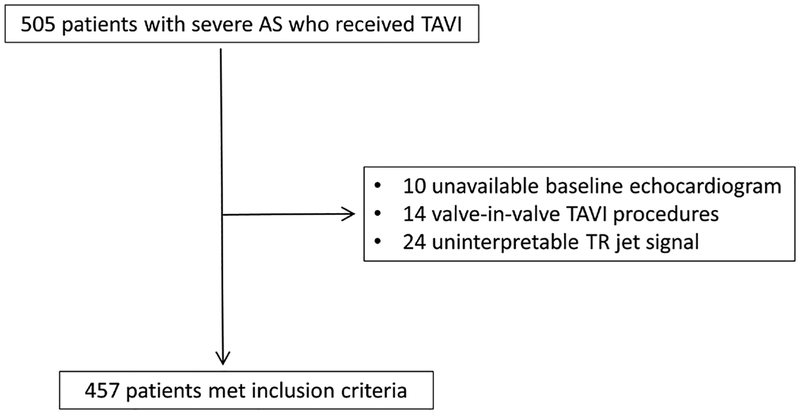
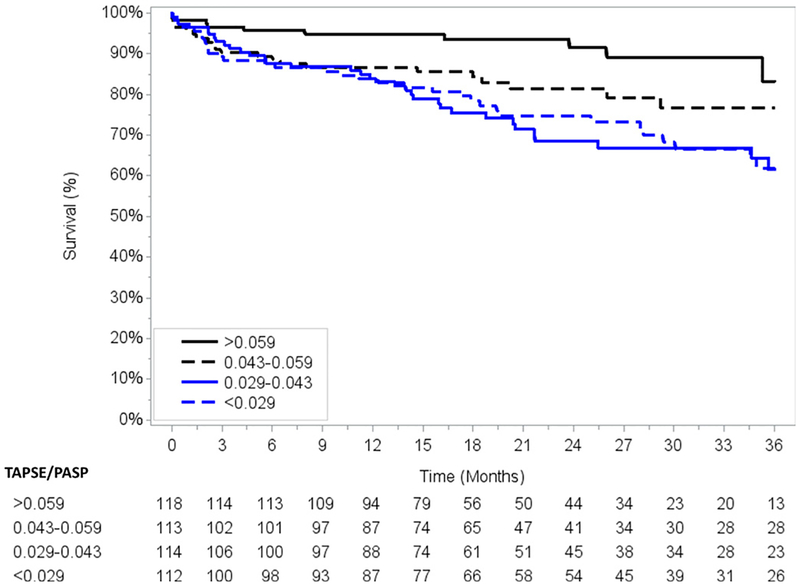
Results: A total of 457 patients were included with mean age of 82.8±7.2 years, left ventricular ejection fraction (LVEF) 54%±13%, PASP 44±17 mm Hg. TAPSE/PASP quartiles showed a dose-response relationship with survival. This remained significant (HR for lowest quartile vs highest quartile=2.21, 95% CI 1.07 to 4.57, p=0.03) after adjusting for age, atrial fibrillation, LVEF, stroke volume index, Society of Thoracic Surgeons Predicted Risk of Mortality.
Conclusion: Baseline TAPSE/PASP ratio is associated with all-cause mortality in TAVI patients as it evaluates RV systolic performance at a given degree of afterload. Incorporation of right-side unit into the risk stratification may improve optimal selection of patients for TAVI.
Keywords: aortic stenosis; secondary pulmonary hypertension; transcatheter valve interventions.
© Author(s) (or their employer(s)) 2019. No commercial re-use. See rights and permissions. Published by BMJ.
Conflict of interest statement
Competing interests: None declared.
Figures
Comment in
-
Right ventricular-pulmonary artery coupling-an emerging perspective in transcatheter aortic valve replacement.J Thorac Dis. 2019 Feb;11(2):345-348. doi: 10.21037/jtd.2018.11.92. J Thorac Dis. 2019. PMID: 30962969 Free PMC article. No abstract available.
-
Right ventricular-pulmonary artery coupling in patients undergoing transcatheter aortic valve replacement: is it relevant?J Thorac Dis. 2019 Feb;11(2):349-350. doi: 10.21037/jtd.2018.11.93. J Thorac Dis. 2019. PMID: 30962970 Free PMC article. No abstract available.
References
-
- Kodali SK, Williams MR, Smith CR, et al. Two-year outcomes after transcatheter or surgical aortic-valve replacement. N Engl J Med 2012;366:1686–95. - PubMed
-
- Otto CM, Kumbhani DJ, Alexander KP, et al. ACC Expert Consensus Decision Pathway for Transcatheter Aortic Valve Replacement in the Management of Adults With Aortic Stenosis: A Report of the American College of Cardiology Task Force on Clinical Expert Consensus Documents. Journal of the American College of Cardiology 2017;2017:1313–46. - PubMed
-
- Schwartz LA, Rozenbaum Z, Ghantous E, et al. Impact of Right Ventricular Dysfunction and Tricuspid Regurgitation on Outcomes in Patients Undergoing Transcatheter Aortic Valve Replacement. J Am Soc Echocardiogr 2017;30:36–46. - PubMed
-
- Guazzi M, Dixon D, Labate V, et al. RV Contractile Function and its Coupling to Pulmonary Circulation in Heart Failure With Preserved Ejection Fraction: Stratification of Clinical Phenotypes and Outcomes. JACC Cardiovasc Imaging 2017;10:1211–21. - PubMed
MeSH terms
Grants and funding
LinkOut - more resources
Full Text Sources
Other Literature Sources
Medical