


Iron deficiency anemia in children with cyanotic congenital heart disease and effect on cyanotic spells
- PMID: 30093766
- PMCID: PMC6081276
- DOI: 10.1016/j.mjafi.2017.07.003
Iron deficiency anemia in children with cyanotic congenital heart disease and effect on cyanotic spells
Abstract
Background: Iron deficiency anemia (IDA) in cyanotic congenital heart disease (CCHD) and its association with cyanotic spells has been documented in literature. However, Indian data especially in the pediatric age group is scarce. This study was conducted to find out the prevalence of IDA in this population.
Methods: An observational study was conducted in a tertiary care hospital. Children with CCHD in the age group of birth-12 years were included in the study. Hematological parameters of these patients were determined and compared. An assessment of the incidence of cyanotic spells in the iron-deficient and iron non-deficient children was also done. Data analysis was done using Fischer's exact test.
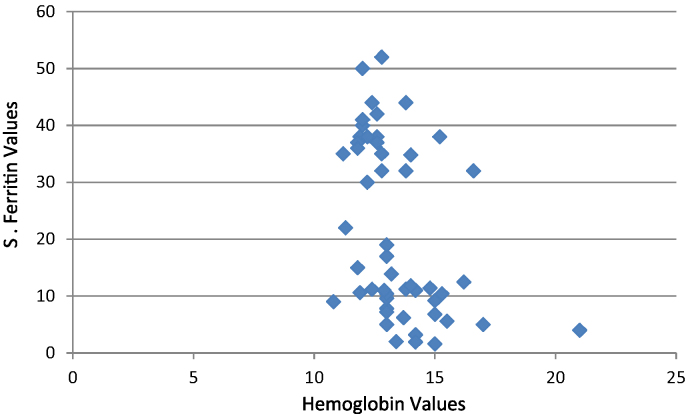
Results: The prevalence of IDA was 47.06% in the study population. The study also showed that hemoglobin and hematocrit levels were paradoxically higher in the iron-deficient group as compared to the non-deficient, though the iron studies revealed the iron deficiency. The incidence of cyanotic spells was higher in the iron-deficient group. The mean corpuscular volume (MCV), red cell distribution width (RDW), serum ferritin, serum iron, total iron binding capacity (TIBC), and transferrin saturation (TS) values were the parameters, which were found to be statistically significant to differentiate the study groups.
Conclusion: The prevalence of IDA in children with CCHD was found to be high. Iron-deficient group had an increased frequency of cyanotic spells as compared to the non-deficient group, which was statistically significant.
Keywords: Cyanotic congenital heart disease; Cyanotic spells; Iron deficiency anemia.
Figures
References
-
- Onur C.B., Sipahi T., Tavil B. Diagnosing iron deficiency in cyanotic heart disease. Indian J Pediatr. 2003;70(1):29–31. - PubMed
-
- Freidland M., Grant S. Hematocrit, viscosity and cerebral blood flow. Am Heart J. 1979;97:405–407. - PubMed
-
- Perloff J.K., Roseve M.H. Adults with congenital cyanotic heart disease: hematologic management. Ann Intern Med. 1988;109:406–413. - PubMed
-
- Stanley F.Lo. Reference, intervals for laboratory tests and procedures. In: Kliegman R.M., Stanton B.F., St Geme J.W., Schor N.F., editors. Nelson Textbook of Pediatrics. 20th ed. Elsevier; New Delhi: 2016. pp. 3471–3472.
-
- Brugnara C., Oski F.A., Nathan D.G. Diagnostic approach to the anaemic patients. In: Orkin S.H., Nathan D.G., Ginsburg D., editors. Nathan and Oski's Hematology of Infancy and Childhood. 8th ed. Elsevier; Canada: 2014. p. 460.
LinkOut - more resources
Full Text Sources
Other Literature Sources
Medical
