


Laryngeal Injury and Upper Airway Symptoms After Oral Endotracheal Intubation With Mechanical Ventilation During Critical Care: A Systematic Review
- PMID: 30096101
- PMCID: PMC7219530
- DOI: 10.1097/CCM.0000000000003368
Laryngeal Injury and Upper Airway Symptoms After Oral Endotracheal Intubation With Mechanical Ventilation During Critical Care: A Systematic Review
Abstract
Objectives: To systematically review the symptoms and types of laryngeal injuries resulting from endotracheal intubation in mechanically ventilated patients in the ICU.
Data sources: PubMed, Embase, CINAHL, and Cochrane Library from database inception to September 2017.
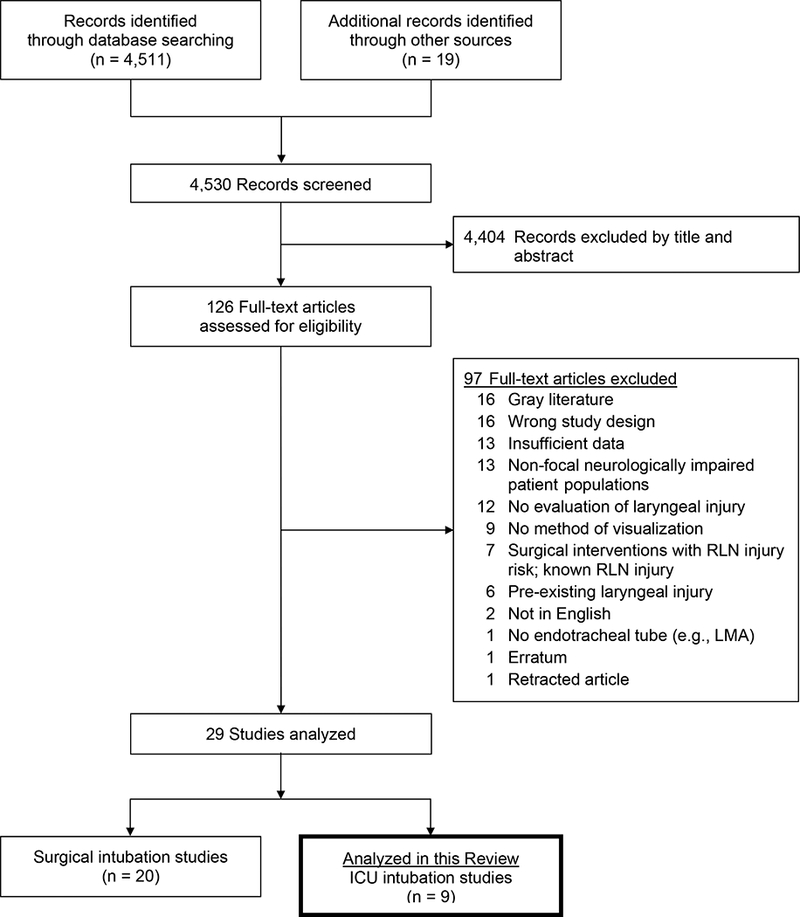
Study selection: Studies of adult patients who were endotracheally intubated with mechanical ventilation in the ICU and completed postextubation laryngeal examinations with either direct or indirect visualization.
Data extraction: Independent, double-data extraction and risk of bias assessment followed the Preferred Reporting Items for Systematic Reviews and Meta-Analyses guidelines. Risk of bias assessment followed the Cochrane Collaboration's criteria.
Data synthesis: Nine studies (seven cohorts, two cross-sectional) representing 775 patients met eligibility criteria. The mean (SD; 95% CI) duration of intubation was 8.2 days (6.0 d; 7.7-8.7 d). A high prevalence (83%) of laryngeal injury was found. Many of these were mild injuries, although moderate to severe injuries occurred in 13-31% of patients across studies. The most frequently occurring clinical symptoms reported post extubation were dysphonia (76%), pain (76%), hoarseness (63%), and dysphagia (49%) across studies.
Conclusions: Laryngeal injury from intubation is common in the ICU setting. Guidelines for laryngeal assessment and postextubation surveillance do not exist. A systematic approach to more robust investigations could increase knowledge of the association between particular injuries and corresponding functional impairments, improving understanding of both time course and prognosis for resolution of injury. Our findings identify targets for future research and highlight the long-known, but understudied, clinical outcomes from endotracheal intubation with mechanical ventilation in ICU.
Conflict of interest statement
Comment in
-
Did God Shape Humans to Be Long-Term Intubated and if Not-Does it Matter?Crit Care Med. 2018 Dec;46(12):2057-2058. doi: 10.1097/CCM.0000000000003460. Crit Care Med. 2018. PMID: 30444814 No abstract available.
References
-
- Bishop MJ, Weymuller EA, Fink BR. Laryngeal effects of prolonged intubation. Anesth Analg. 1984;63:335–342. - PubMed
-
- Santos PM, Afrassiabi A, Weymuller EA Jr. Prospective studies evaluating the standard endotracheal tube and a prototype endotracheal tube. Ann Otol Rhinol Laryngol. 1989;98(12 Pt 1): 935–940. - PubMed
-
- Benjamin B, Holinger LD. Laryngeal complications of endotracheal intubation. Ann Otol Rhinol Laryngol. 2008;117(9 (Suppl 200)):1–20. - PubMed
-
- Alexopoulos C, Lindholm CE. Airway complaints and laryngeal pathology after intubation with an anatomically shaped endotracheal tube. Acta Anaesthesiol Scand. 1983;27(4):339–344. - PubMed
Publication types
MeSH terms
Grants and funding
LinkOut - more resources
Full Text Sources
Other Literature Sources
Medical
Miscellaneous
