


Vaccination demonstration zone successfully controls rabies in Guangxi Province, China
- PMID: 30097026
- PMCID: PMC6086044
- DOI: 10.1186/s12879-018-3301-8
Vaccination demonstration zone successfully controls rabies in Guangxi Province, China
Abstract
Background: Guangxi is the province most seriously affected by rabies virus (RABV) in China. Those most affected by RABV each year are people in rural areas, where dogs are the main cause of human infection with the virus.
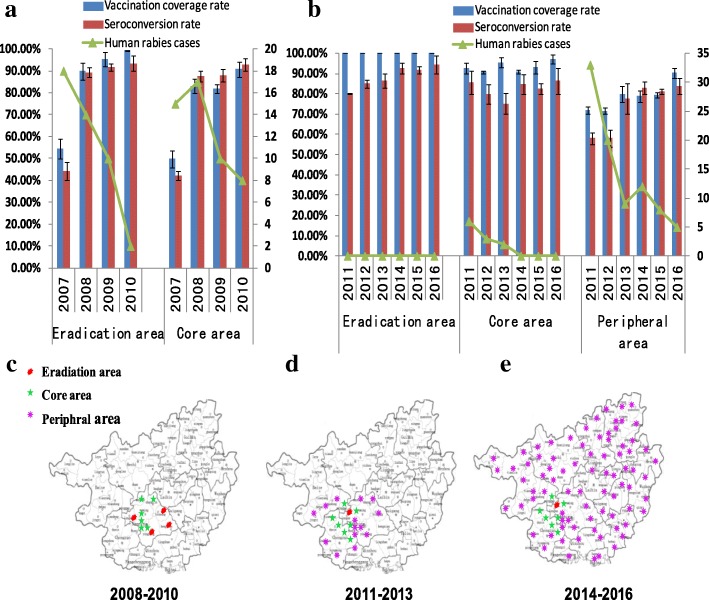
Methods: In this study, we established a rabies vaccination demonstration program that included eradication, core, and peripheral areas. This program was implemented for 9 years and comprised three stages: 12 counties in the first stage (2008-2010), 21 counties in the second stage (2011-2013), and then extending to all counties of Guangxi Province in the third stage (2014-2016). The program included a dog vaccination campaign, surveillance of clinically healthy dogs who may be potential RABV carriers, monitoring anti-RABV antibody titers in vaccinated dogs, and compiling and reporting statistics of human rabies cases.
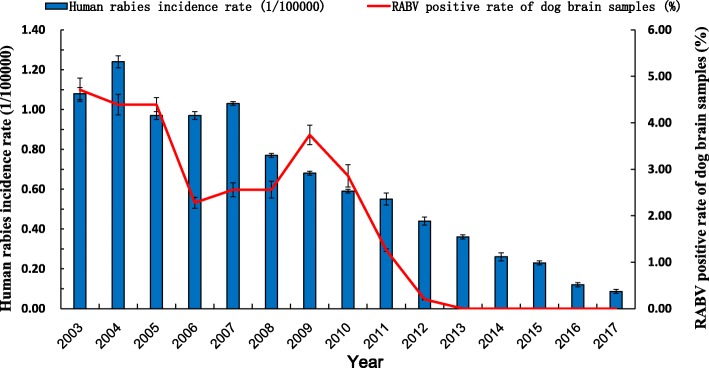
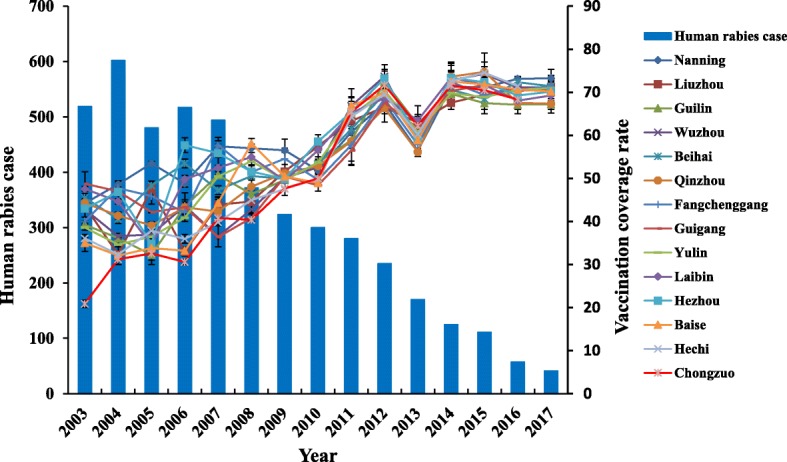
Results: The target effectiveness was achieved in the eradication, core, and peripheral areas in all three stages. The vaccination demonstration program successfully promoted RABV vaccination of domestic dogs throughout Guangxi Province by drawing upon the experience gained at key points. Compared with a vaccination coverage rate of 39.42-46.85% in Guangxi Province overall during 2003-2007, this rate gradually increased to 48.98-52.67% in 2008-2010, 60.24-69.67% in 2011-2013, and 70.09-71.53% in 2014-2016, thereby meeting World Health Organization requirements. The total cases of human rabies in the province decreased from 602 in 2004 to 41 cases in 2017.
Conclusions: The present pilot vaccination program obviously increased the rabies vaccination and seroconversion rates, and effectively reduced the spread of rabies from dogs to humans as well as the number of human rabies cases, thus successfully controlling rabies in Guangxi.
Keywords: Rabies; Seroconversion rate; Vaccination coverage rate; Vaccination demonstration program.
Conflict of interest statement
All animal experiments described in this paper were conducted according to the National Guideline on the Humane Treatment of Laboratory Animals Welfare (MOST of People’s Republic of China, 2006, China) and were approved by the Animal Welfare and the Animal Experimental Ethical Committee (Guangxi University, No. Xidakezi2000138). All husbandry procedures were conducted in compliance with the Animal Welfare Act and the Guide for the Care and Use of Laboratory Animals.
Not applicable.
All authors declare that they have no competing interests.
Springer Nature remains neutral with regard to jurisdictional claims in published maps and institutional affiliations.
Figures
References
MeSH terms
Substances
Grants and funding
LinkOut - more resources
Full Text Sources
Other Literature Sources
Medical
