


Citrulline malate supplementation does not improve German Volume Training performance or reduce muscle soreness in moderately trained males and females
- PMID: 30097067
- PMCID: PMC6086018
- DOI: 10.1186/s12970-018-0245-8
Citrulline malate supplementation does not improve German Volume Training performance or reduce muscle soreness in moderately trained males and females
Abstract
Background: Use of supplements to aid performance is common practice amongst recreationally active individuals, including those without a sufficient evidence base. This investigation sought to assess whether acute supplementation with 8 g of citrulline malate (CM) (1.11: 1 ratio) would improve anaerobic performance.
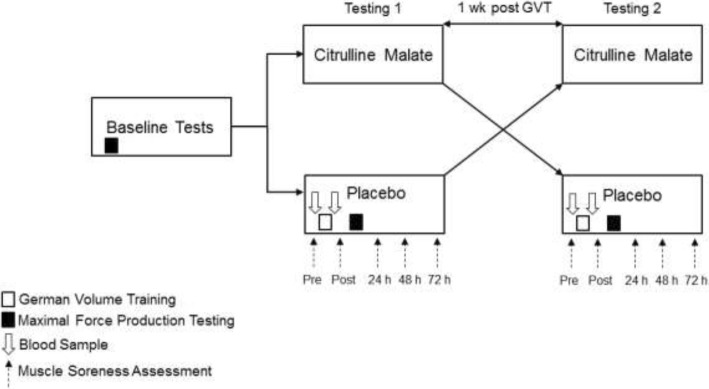
Methods: A randomised double blind placebo control trial was employed, using a counterbalanced design. We recruited recreationally active men and women to take part in an isokinetic chair protocol, based on German Volume Training (GVT) whereby participants attempted to perform 10 sets of 10 repetitions against a force representing 70% of their peak concentric force.
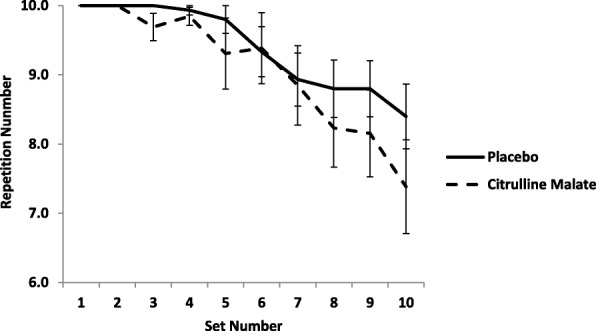
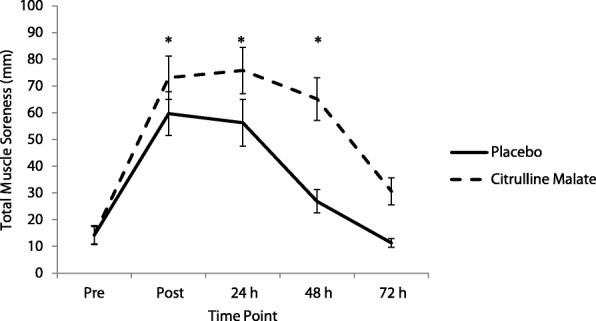
Results: The number of repetitions achieved over the course of the GVT was 94.0 ± 7.9 and 90.9 ± 13.9 for placebo and CM respectively. There was no significant difference between the placebo and CM treatment for number of repetitions (P = 0.33), isometric (P = 0.60), concentric (P = 0.38), or eccentric (P = 0.65) peak force following the GVT. Total muscle soreness was significantly higher in the CM compared to the placebo treatment following the GVT protocol over 72 h (P = 0.01); although this was not accompanied by a greater workload/number of repetitions in the CM group.
Conclusions: We conclude that an acute dose of CM does not significantly affect anaerobic performance using an isokinetic chair in recreational active participants. Practical implications include precaution in recommending CM supplementation. Coaches and athletes should be aware of the disparity between the chemical analyses of the products reviewed in the present investigation versus the manufacturers' claims.
Keywords: Anaerobic exercise; Citrulline malate; GVT; Isometric force; Lactate; Muscle soreness; Return of force.
Conflict of interest statement
The present investigation had prior ethical approval by the Sheffield Hallam University School of Business Ethics Committee, ethics reference SBS-695.
Not applicable.
The authors declare that they have no competing interests.
Springer Nature remains neutral with regard to jurisdictional claims in published maps and institutional affiliations.
Figures
References
-
- Creff AF. Double-blind placebo-controlled trial of Stimol® in the treatment of fatigue states. Gazette Médicale de France. 1982;89(16):1926–1929.
-
- López-Cabral JA, Rivera-Cisneros A, Rodríguez-Camacho H, Sánchez-González JM, Serna-Sánchez I, Trejo-Trejo M. Modification of fatigue indicators using citrulline malate for high performance endurance athletes. Revista Latinoamericana de Patologia Clinica y Medicina de Laboratorio. 2012;59:194–201.
-
- Kiyici F, Eroglu H, Kishali NF, Burmaoglu G. The Effect of Citrulline/Malate on Blood Lactate Levels in Intensive Exercise. Biochem Genet 2017;55(5-6):387–94. - PubMed
Publication types
MeSH terms
Substances
LinkOut - more resources
Full Text Sources
Other Literature Sources
Medical
