Review
. 2018 Nov;175(22):4195-4208.
doi: 10.1111/bph.14470. Epub 2018 Oct 5.

P2X7 as a scavenger receptor for innate phagocytosis in the brain

Affiliations
Review

P2X7 as a scavenger receptor for innate phagocytosis in the brain

Ben J Gu et al. Br J Pharmacol. 2018 Nov.

Abstract

The P2X7 receptor has been widely studied for its ATP-induced pro-inflammatory effect, but in the absence of a ligand, P2X7 has a second function as a scavenger receptor, which is active in the development of the human brain. The scavenger activity of P2X7 is only evident in the absence of serum but is fully active in cerebrospinal fluid. P2X7 on the cell surface is present as a membrane complex, and an attachment to non-muscle myosin of the cytoskeleton is required for particle engulfment. Selective antagonists of P2X7 pro-inflammatory function have little effect on phagocytosis, but inheritance of a variant haplotype spanning the P2RX7 and P2RX4 genes has been associated with loss of P2X7-mediated phagocytosis. Recent studies in mice suggest that the innate phagocytosis mediated by P2X7 receptors declines with ageing. Thus, defective P2X7-mediated phagocytosis may contribute to age-related neuro-degenerative diseases including Alzheimer's disease, age-related macular degeneration and primary progressive multiple sclerosis.


Figures

Figure 1
Figure 1
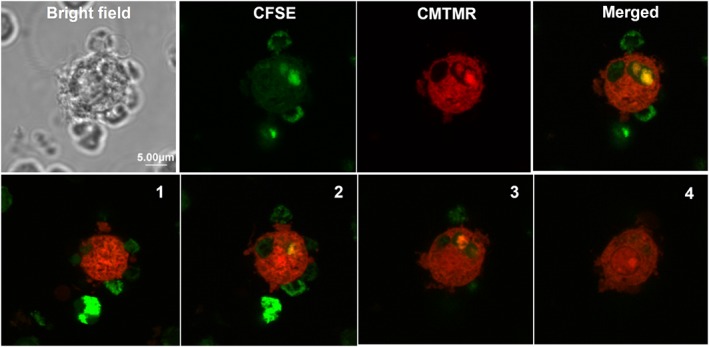
Phagocytosis of apoptotic lymphocytes by monocyte‐derived macrophages expressing P2X7 receptors. Bright field image and a series of Z‐stack confocal images depicting CMTMR‐labelled macrophage (red) which has engulfed three CFSE‐labelled lymphocytes (green, indicated with arrows) (from Gu et al., 2011, with permission).
Figure 2
Figure 2
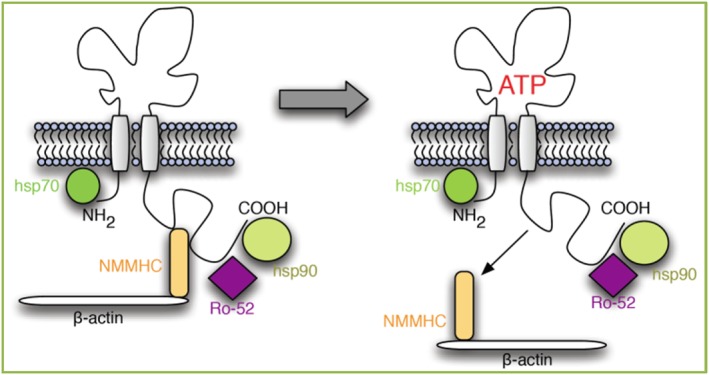
Change in the complex conformation of the P2X7 receptor upon ATP binding. In the absence of ATP (left panel), the P2X7 complex is anchored to actin cytoskeleton via non‐muscle myosin heavy chain (NMMHC) to mediate phagocytosis. ATP binding (right panel) dissociates non‐muscle myosin from the complex, leading to loss of phagocytic ability. Heat shock protein‐70 and ‐90 and Ro‐52 remain closely associated with P2X7 (from Gu et al., 2015b, with permission).
Figure 3
Figure 3
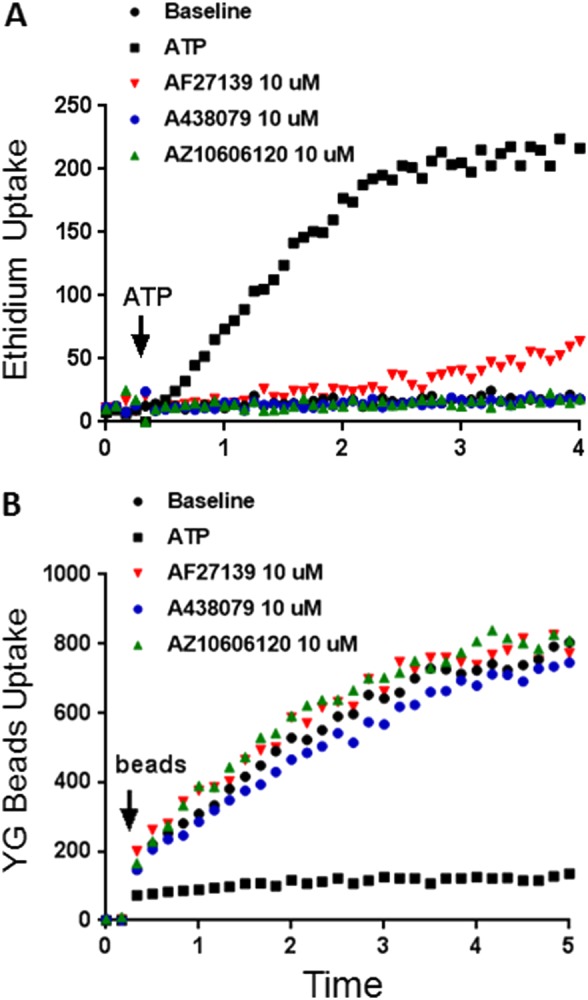
Three potent P2X7 antagonists abolish ATP‐induced ethidium uptake but not phagocytosis. (A) Pore function detected by ethidium uptake was measured in fresh human peripheral blood mononuclear cells (PBMCs), prelabelled with FITC‐CD14 antibody and incubated with AF27139, A438079, AZ10606120 and KN62 for 10 min. (B) Fresh human PBMCs prelabelled with APC‐CD14 antibody were incubated with YG fluorescent beads and bead uptake into CD14+ cells measured.

References

    1. Adinolfi E, Kim M, Young MT, Di Virgilio F, Surprenant A (2003). Tyrosine phosphorylation of HSP90 within the P2X7 receptor complex negatively regulates P2X7 receptors. J Biol Chem 278: 37344–37351. - PubMed
    1. Alexander SPH, Christopoulos A, Davenport AP, Kelly E, Marrion NV, Peters JA et al (2017a). The Concise Guide to PHARMACOLOGY 2017/18: G protein‐coupled receptors. Br J Pharmacol 174: S17–S129. - PMC - PubMed
    1. Alexander SPH, Fabbro D, Kelly E, Marrion NV, Peters JA, Faccenda E et al (2017b). The Concise Guide to PHARMACOLOGY 2017/18: Catalytic receptors. Br J Pharmacol 174: S225–S271. - PMC - PubMed
    1. Alexander SPH, Fabbro D, Kelly E, Marrion NV, Peters JA, Faccenda E et al (2017c). The Concise Guide to PHARMACOLOGY 2017/18: Enzymes. Br J Pharmacol 174: S272–S359. - PMC - PubMed
    1. Alexander SP, Peters JA, Kelly E, Marrion NV, Faccenda E, Harding SD et al (2017d). The Concise Guide to PHARMACOLOGY 2017/18: Ligand‐gated ion channels. Br J Pharmacol 174: S130–S159. - PMC - PubMed

Publication types

Substances