


Triple-Negative Breast Cancer Risk Genes Identified by Multigene Hereditary Cancer Panel Testing
- PMID: 30099541
- PMCID: PMC6093350
- DOI: 10.1093/jnci/djy106
Triple-Negative Breast Cancer Risk Genes Identified by Multigene Hereditary Cancer Panel Testing
Abstract
Background: Germline genetic testing with hereditary cancer gene panels can identify women at increased risk of breast cancer. However, those at increased risk of triple-negative (estrogen receptor-negative, progesterone receptor-negative, human epidermal growth factor receptor-negative) breast cancer (TNBC) cannot be identified because predisposition genes for TNBC, other than BRCA1, have not been established. The aim of this study was to define the cancer panel genes associated with increased risk of TNBC.
Methods: Multigene panel testing for 21 genes in 8753 TNBC patients was performed by a clinical testing laboratory, and testing for 17 genes in 2148 patients was conducted by a Triple Negative Breast Cancer Consortium (TNBCC) of research studies. Associations between deleterious mutations in cancer predisposition genes and TNBC were evaluated using results from TNBC patients and reference controls.
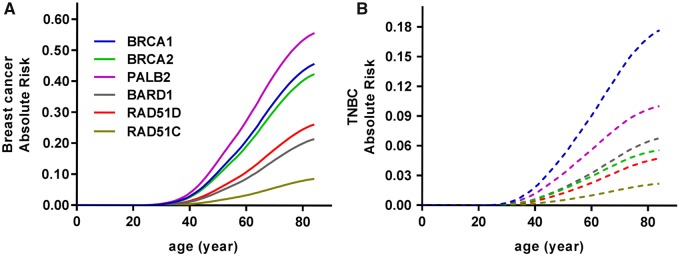
Results: Germline pathogenic variants in BARD1, BRCA1, BRCA2, PALB2, and RAD51D were associated with high risk (odds ratio > 5.0) of TNBC and greater than 20% lifetime risk for overall breast cancer among Caucasians. Pathogenic variants in BRIP1, RAD51C, and TP53 were associated with moderate risk (odds ratio > 2) of TNBC. Similar trends were observed for the African American population. Pathogenic variants in these TNBC genes were detected in 12.0% (3.7% non-BRCA1/2) of all participants.
Conclusions: Multigene hereditary cancer panel testing can identify women with elevated risk of TNBC due to mutations in BARD1, BRCA1, BRCA2, PALB2, and RAD51D. These women can potentially benefit from improved screening, risk management, and cancer prevention strategies. Patients with mutations may also benefit from specific targeted therapeutic strategies.
© The Author(s) 2018. Published by Oxford University Press.
Figures
References
-
- Boyle P. Triple-negative breast cancer: Epidemiological considerations and recommendations. Ann Oncol. 2012;23(suppl 6):vi7–v12. - PubMed
-
- Li X, Yang J, Peng L, et al. Triple-negative breast cancer has worse overall survival and cause-specific survival than non-triple-negative breast cancer. Breast Cancer Res Treat. 2017;1612:279–287. - PubMed
-
- Buys SS, Sandbach JF, Gammon A, et al. A study of over 35,000 women with breast cancer tested with a 25-gene panel of hereditary cancer genes. Cancer. 2017;12310:1721–1730. - PubMed
Publication types
MeSH terms
Substances
Grants and funding
- HHSN268201700001I/HL/NHLBI NIH HHS/United States
- U01 CA164975/CA/NCI NIH HHS/United States
- HHSN268201700004I/HL/NHLBI NIH HHS/United States
- HHSN268201700002I/HL/NHLBI NIH HHS/United States
- P50 CA116201/CA/NCI NIH HHS/United States
- HHSN268201700005I/HL/NHLBI NIH HHS/United States
- HHSN268201700003I/HL/NHLBI NIH HHS/United States
- R01 CA192393/CA/NCI NIH HHS/United States
- 19187/CRUK_/Cancer Research UK/United Kingdom
- R01 CA166150/CA/NCI NIH HHS/United States
- P30 CA006973/CA/NCI NIH HHS/United States
- R25 CA092049/CA/NCI NIH HHS/United States
- R01 CA176785/CA/NCI NIH HHS/United States
LinkOut - more resources
Full Text Sources
Other Literature Sources
Medical
Research Materials
Miscellaneous
