doi: 10.1136/jnnp-2018-318570.
Epub 2018 Aug 12.
Multisensory bionic limb to achieve prosthesis embodiment and reduce distorted phantom limb perceptions
Affiliations
- PMID: 30100550
- PMCID: PMC6791810
- DOI: 10.1136/jnnp-2018-318570
Item in Clipboard
Multisensory bionic limb to achieve prosthesis embodiment and reduce distorted phantom limb perceptions
J Neurol Neurosurg Psychiatry.
2019 Jul.
No abstract available
Keywords: consciousness; electrical stimulation.
Conflict of interest statement
Competing interests: SM, SR, FMP hold shares of Sensars Neuroprosthetics, a company working to commercialise novel solutions for transradial amputees.
Figures
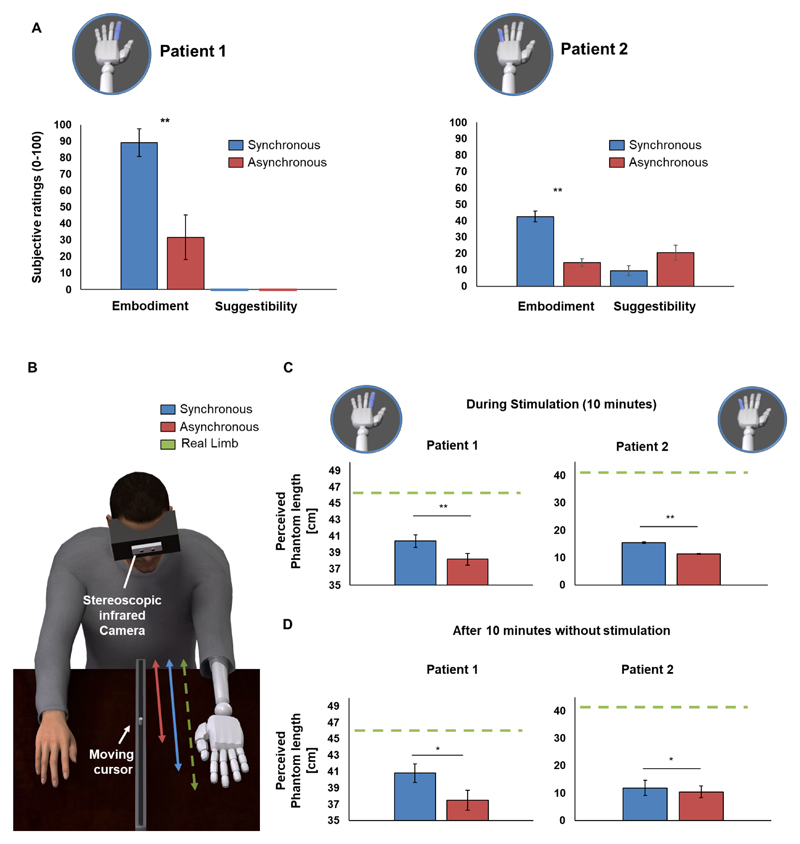
(A) Prosthesis embodiment. Average ratings of embodiment (Q1–3) and suggestibility items (Q4–5) are shown for all experimental conditions are shown for both patient 1 and patient 2 (see online supplementary material 1). embodiment was highest when VTNS was administered synchronously with illumination of the prosthetic hand (as compared with the asynchronous condition). the synchronous stimulation was characterised by a delay smaller than 10ms between the neurally induced tactile sensation and the visual illumination, whereas in the asynchronous condition the temporal mismatch (1.5–2.5s) between the neural stimulation and the visual illumination was randomly selected on each trial. In patient 1, suggestibility items were always rated 0 (shown as coloured lines). (B) reduction of abnormal phantom limb perceptions (telescoping). to measure the perceived length of the phantom limb, both patients were asked to operate a movable cursor inside a ruler with their right hand. the difference between the perceived position of this phantom finger and elbow was used to estimate the perceived length (in cm) of the phantom limb (average scores are reported). (C) During synchronous VTNS (blue) both perceived the tip of their phantom finger in a more distal position (vs asynchronous condition; p<0.01; red), compatible with an increase in the perceived length of their phantom limb (B; online supplementary video 2). (D) this condition-specific change in telescoping persisted, in both patients, 10min after VTNS had ended. error bars show Se of the mean. *P<0.05; **P<0.01. VTNS, visuo-tactile neural stimulation.
References
-
- Blanke O, Slater M, Serino A. Behavioral, neural, and computational principles of bodily self-consciousness. Neuron. 2015;88:145–66. - PubMed
-
- Raspopovic S, Capogrosso M, Petrini FM, et al. Restoring natural sensory feedback in real-time bidirectional hand prostheses. Sci Transl Med. 2014;6:ra219. - PubMed
Publication types
MeSH terms
Grants and funding
LinkOut - more resources
Full Text Sources
Other Literature Sources
Medical