


Design of an experimental protocol to examine medication non-adherence among young drivers diagnosed with ADHD: A driving simulator study
- PMID: 30101205
- PMCID: PMC6082792
- DOI: 10.1016/j.conctc.2018.07.007
Design of an experimental protocol to examine medication non-adherence among young drivers diagnosed with ADHD: A driving simulator study
Erratum in
-
Erratum regarding missing Declaration of Competing Interest statements in previously published articles.Contemp Clin Trials Commun. 2020 Dec 10;20:100688. doi: 10.1016/j.conctc.2020.100688. eCollection 2020 Dec. Contemp Clin Trials Commun. 2020. PMID: 33392412 Free PMC article.
Abstract
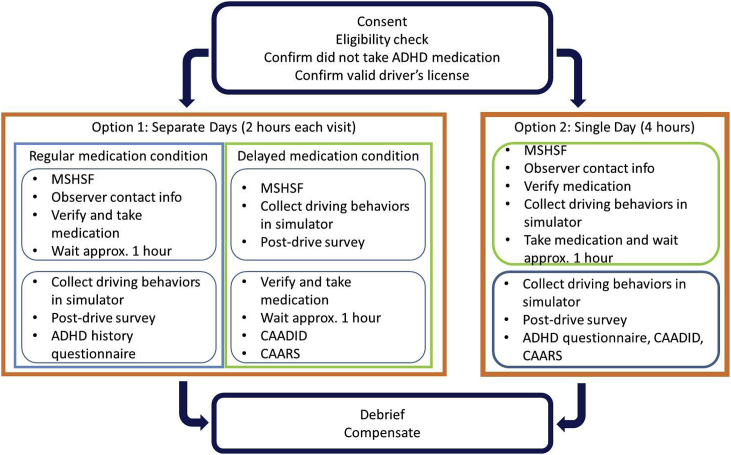
The diagnosis of ADHD among teens and young adults has been associated with a higher likelihood of motor vehicle crashes. Some studies suggest a beneficial effect of ADHD medication but the exact efficacy is still being debated. Further, medication adherence, which is low in this age group, can further reduce effectiveness. Our long-term objective is to reduce unsafe driving among drivers with ADHD by detecting medication non-adherence through driver behavior modeling and monitoring. As a first step, we developed the described lab study protocol to obtain reliable driver behavior data that will then be used to design and train behavior models built through machine learning. This experimental study protocol was developed to systematically compare driving behaviors under two medication conditions (before and after intake of medication) among young adults with ADHD and a control group of non-ADHD. A driving simulator was used to examine driving behaviors and interactions with traffic. The primary outcome was speed management for two comparisons (ADHD vs. non-ADHD and before vs. after medication), and secondary objectives involved understanding differences among the participants utilizing self-reported surveys about ADHD symptoms, drivers' knowledge, and perception about safety. The study protocol was designed to maximize participant safety and efficiency of data collection, as multiple measures were collected over two 2-h study visits. The sampled ADHD drivers were demographically and psychosocially similar but clinically different from the non-ADHD group. Overall, this protocol was effective in participant recruitment and retention, allowed staggered data collection, and can be incorporated in a subsequent clinical trial that examines the efficacy of a machine-learning based driver monitoring intervention.
Keywords: Attention-deficit/hyperactivity disorder (ADHD); Driving; Driving simulator; Machine learning; Medication adherence.
Figures
References
-
- Jillani S.A., Kaminer Y. High risk driving in treated and untreated youth with attention deficit hyperactivity disorder: public health implications. Adolesc. Psychiatr. 2016;6(2):89–99.
-
- Barragan D., Lee Y.-C. Presented at the 6th International Conference on Driver Distraction and Inattention, Gothenburg, Sweden. 2018. Pre-crash driving behaviour of individuals with and without ADHD.
-
- Biederman J., Fried R., Hammerness P., Surman C., Mehler B., Petty C.R., Reimer B. The effects of lisdexamfetamine dimesylate on the driving performance of young adults with ADHD: a randomized, double-blind, placebo-controlled study using a validated driving simulator paradigm. J. Psychiatr. Res. 2012;46(4):484–491. doi: 10.1016/j.jpsychires.2012.01.007. - DOI - PubMed
LinkOut - more resources
Full Text Sources
Other Literature Sources
Research Materials
Miscellaneous
