


Language Matters: Denying the Existence of the 30-Million-Word Gap Has Serious Consequences
- PMID: 30102419
- PMCID: PMC10370358
- DOI: 10.1111/cdev.13128
Language Matters: Denying the Existence of the 30-Million-Word Gap Has Serious Consequences
Abstract
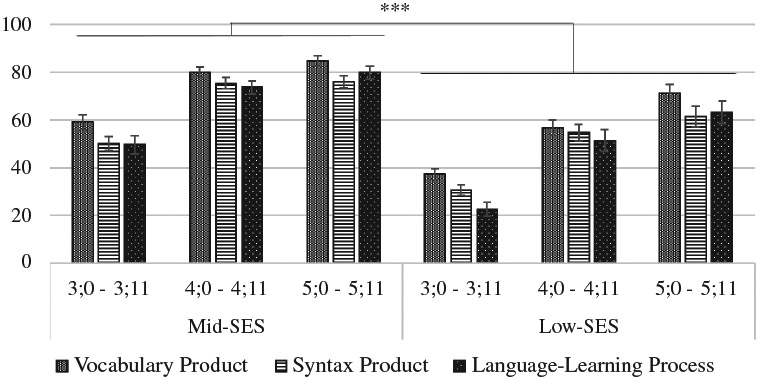
Sperry, Sperry, and Miller (2018) aim to debunk what is called the 30-million-word gap by claiming that children from lower income households hear more speech than Hart and Risley () reported. We address why the 30-million-word gap should not be abandoned, and the importance of retaining focus on the vital ingredient to language learning-quality speech directed to children rather than overheard speech, the focus of Sperry et al.'s argument. Three issues are addressed: Whether there is a language gap; the characteristics of speech that promote language development; and the importance of language in school achievement. There are serious risks to claims that low-income children, on average, hear sufficient, high-quality language relative to peers from higher income homes.
© 2018 Society for Research in Child Development.
Figures
Comment in
-
Language Does Matter: But There is More to Language Than Vocabulary and Directed Speech.Child Dev. 2019 May;90(3):993-997. doi: 10.1111/cdev.13125. Epub 2018 Aug 13. Child Dev. 2019. PMID: 30102424
Comment on
-
Reexamining the Verbal Environments of Children From Different Socioeconomic Backgrounds.Child Dev. 2019 Jul;90(4):1303-1318. doi: 10.1111/cdev.13072. Epub 2018 Apr 30. Child Dev. 2019. PMID: 29707767
References
-
- Bassok D, Latham S, & Rorem A (2016). Is kindergarten the new first grade? American Educational Research Association Open, 1, 1–31. 10.1177/2332858415616358 - DOI
-
- Cartmill EA, Armstrong BF, Gleitman LR, Goldin-Meadow S, Medina TN, & Trueswell JC (2013). Quality of early parent input predicts child vocabulary 3 years later. Proceedings of the National Academy of Sciences of the United States of America, 110, 11278–11283. 10.1073/pnas.1309518110 - DOI - PMC - PubMed
-
- Cocking R, & Mestre J (1988). Introduction: Considerations of language mediators of mathematics learning. In Cocking R & Mestre J (Eds.), Linguistic and cultural influences on learning mathematics (pp. 3–16). Hillsdale, NJ: Erlbaum.
-
- Dickinson D, Griffith J, Golinkoff RM, & Hirsh-Pasek K (2012). How reading books fosters language development around the world. Child Development Research, 2012, 1–15. 10.1155/2012/602807 - DOI
-
- Durham RE, Farkas G, Hammer CS, Tomblin JB, & Catts HW (2007). Kindergarten oral language skill: A key variable in the intergenerational transmission of socioeconomic status. Research in Social Stratification and Mobility, 25, 294–305. 10.1016/j.rssm.2007.03.001 - DOI
Publication types
MeSH terms
Grants and funding
LinkOut - more resources
Full Text Sources
Other Literature Sources
Medical
Miscellaneous
