


Transcatheter arterial embolization of acute bleeding as 24/7 service: predictors of outcome and mortality
- PMID: 30102552
- PMCID: PMC6319850
- DOI: 10.1259/bjr.20180516
Transcatheter arterial embolization of acute bleeding as 24/7 service: predictors of outcome and mortality
Abstract
Objective: To analyze times of occurrence and identify risk factors (RFs) for technical and clinical failure and mortality of transcatheter arterial embolization (TAE) of acute bleeding in a major hospital.
Methods: All TAEs performed at our hospital from 2006 to 2013 (n = 327) were retrospectively analyzed.
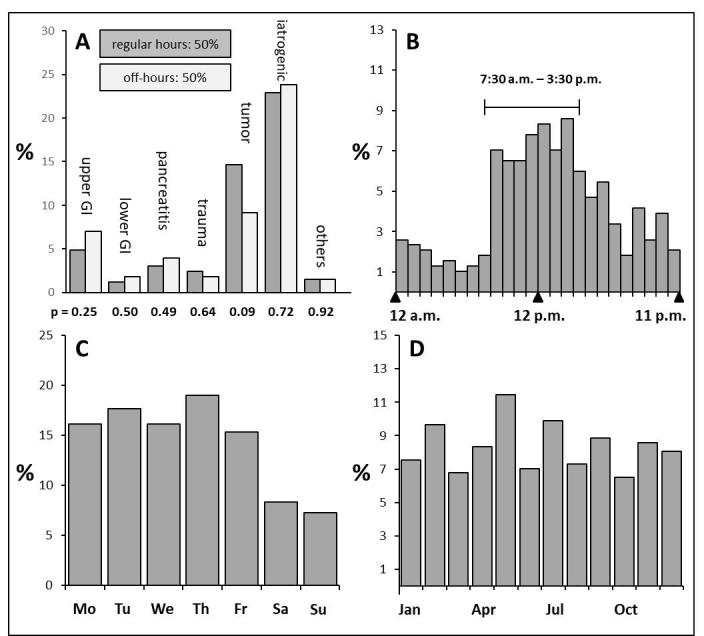
Results: TAEs were performed during regular weekday hours in 165 (50%) and during off-hours in 162 (50%) cases. With 40 regular and 128 off-hours/week, 3.25 times more TAEs were performed during regular hours. There was an even distribution across weekdays (Mon-Fri:16.9 ± 1.5%), while fewer TAEs were performed on weekends (Sat: 8.3%, Sun: 7.3%). Technical success of TAEs was 93.9% with a clinical success of 79.2% and a 30-day mortality of 18.4%. Shock was an RF for technical failure (p = 0.022). RFs for clinical failure were low hemoglobin (Hb) (p = 0.021) and transfusion of ≥6 units packed cells (p = 0.009). Independent RFs for mortality were clinical failure (p < 0.001), coagulopathy (p = 0.005), and shock (p < 0.001).
Conclusion: Our results provide no evidence for a subjectively perceived increase in TAEs during off-hours but rather appear to show that most TAEs are performed during regular hours. Prompt TAE to control acute bleeding is crucial to prevent a drop in Hb with shock and the need for transfusion, which may promote coagulopathy and rebleeding, all of which are risk factors for a negative outcome.
Advances in knowledge: The presented analysis provides insights of occurrences and risk factors for success of transcatheter arterial embolization in acute bleeding in a large study population.
Figures
References
-
- Loffroy R, Rao P, Ota S, De Lin M, Kwak BK, Geschwind JF. Embolization of acute nonvariceal upper gastrointestinal hemorrhage resistant to endoscopic treatment: results and predictors of recurrent bleeding. Cardiovasc Intervent Radiol 2010; 33: 1088–100. doi: 10.1007/s00270-010-9829-7 - DOI - PubMed
MeSH terms
LinkOut - more resources
Full Text Sources
Other Literature Sources
Medical
Research Materials
