. 2019 Mar;19(3):724-736.
doi: 10.1111/ajt.15067. Epub 2018 Sep 17.

Dual targeting: Combining costimulation blockade and bortezomib to permit kidney transplantation in sensitized recipients

Affiliations

Dual targeting: Combining costimulation blockade and bortezomib to permit kidney transplantation in sensitized recipients

Christopher K Burghuber et al. Am J Transplant. 2019 Mar.

Abstract

Previous evidence suggests that a homeostatic germinal center (GC) response may limit bortezomib desensitization therapy. We evaluated the combination of costimulation blockade with bortezomib in a sensitized non-human primate kidney transplant model. Sensitized animals were treated with bortezomib, belatacept, and anti-CD40 mAb twice weekly for a month (n = 6) and compared to control animals (n = 7). Desensitization therapy-mediated DSA reductions approached statistical significance (P = .07) and significantly diminished bone marrow PCs, lymph node follicular helper T cells, and memory B cell proliferation. Graft survival was prolonged in the desensitization group (P = .073). All control animals (n = 6) experienced graft loss due to antibody-mediated rejection (AMR) after kidney transplantation, compared to one desensitized animal (1/5). Overall, histological AMR scores were significantly lower in the treatment group (n = 5) compared to control (P = .020). However, CMV disease was common in the desensitized group (3/5). Desensitized animals were sacrificed after long-term follow-up with functioning grafts. Dual targeting of both plasma cells and upstream GC responses successfully prolongs graft survival in a sensitized NHP model despite significant infectious complications and drug toxicity. Further work is planned to dissect underlying mechanisms, and explore safety concerns.

Keywords: alloantibody; animal models: nonhuman primate; basic (laboratory) research/science; desensitization; immunosuppressant - fusion proteins and monoclonal antibodies: costimulation molecule specific; immunosuppression/immune modulation; kidney transplantation/nephrology; plasma cells.


Conflict of interest statement

DISCLOSURE

The authors of this manuscript have no conflicts of interest to disclose as described by the American Journal of Transplantation.

Figures

FIGURE 1
FIGURE 1
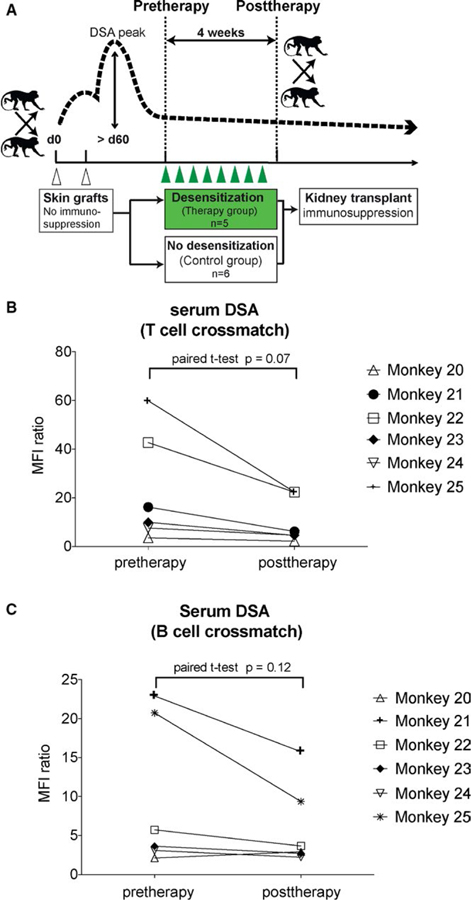
Preformed donor-specific antibody is reduced after costimulation blockade and proteasome inhibitor treatment. (A) Schematic representation of skin transplant for sensitization, immune-stabilization phase, desensitization treatment, or no treatment (control group) over 4 weeks and subsequent kidney transplantation under immunosuppression. (B and C) DSA levels in individual animals after desensitization. T and B cell crossmatches are showing a decrease of DSA after desensitization treatment. Serum from desensitized animals were collected and IgG DSA was quantified in a flow crossmatch. T cell crossmatches showed a strong trend of reduction of DSA in treatment animals. Data presented as MFI ratio compared to preskin transplant DSA level
FIGURE 2
FIGURE 2
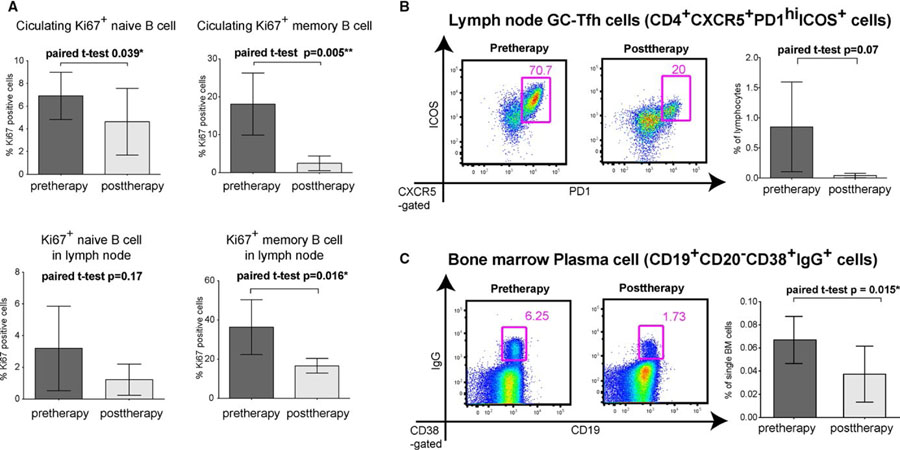
Comparison of cell types involved in antibody-mediated rejection pre- and posttherapy. (A) Proliferating B cells after desensitization. Circulating Ki67+ naïve and memory B cells were decreased significantly while only Ki67+ memory B cells were decreased in the lymph node. (B) Follicular helper T cells (Tfh) populations in the lymph nodes after desensitization. The germinal center Tfh cells (CD4+CXCR5+PD-1hiICOS+) were significantly reduced in the lymph node after desensitization. (C) Plasma cell population from bone marrow biopsies after desensitization. Bone marrow plasma cells (CD19+CD20CD38+IgG+) were significantly reduced after desensitization. Data present mean ± SD of six animals before and after desensitization
FIGURE 3
FIGURE 3
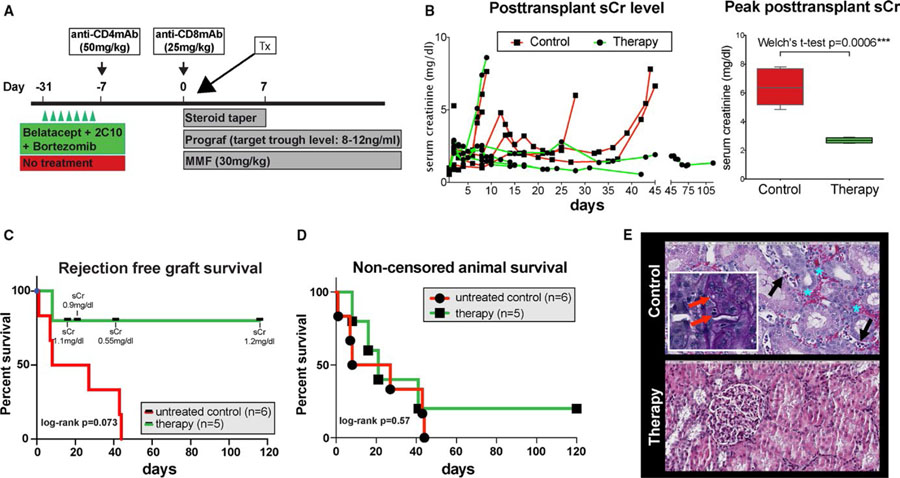
Desensitization with costimulation blockade and proteasome inhibitor prolongs renal allograft survival in sensitized non-human primates. (A) Dosing regimen of desensitization, T cell depletion induction and maintenance immunosuppression for kidney transplantation in the sensitized monkeys. (B) Serum creatinine level after kidney transplantation. Compared with control, sensitized animals treated with belatacept, 2C10R4 and bortezomib for desensitization showed well-maintained sCr level over time and significantly lower posttransplant peak sCr level. (C) Rejection-free graft survival: therapy versus control group. The longest survivor of control group succumbed to rejection on day 43. In the treatment group, animals had to be censored due to non–kidney-related complications, but sCr was excellent at end points. Log-rank test shows a nonsignificant tendency of better survival with treatment. (D) Noncensored animal survival: therapy versus control group. Death noncensored animal survival shown in days by control and therapy group. Log-rank test comparing animals without desensitization (red line) versus receiving dual targeting therapy (green line) determined P values. (E) Representative histology from untreated control and desensitized animals. Untreated control has peritubular capillaritis (black arrow) and red blood cells in peritubular capillaries and the interstitium (blue asterisk) (original magnification: 200×). It also showed glomerulitis with an occlusion of glomerular capillary loops and segmental glomerular basement membrane duplication (red arrow in inset) (original magnification, 400×). Desensitized animal has interstitial inflammation with severe tubulitis but no glomerulitis or peritubular capillaritis and has areas devoid of inflammation, also revealing no glomerultiis or peritubular capillaritis (original magnification: 200×)
FIGURE 4
FIGURE 4
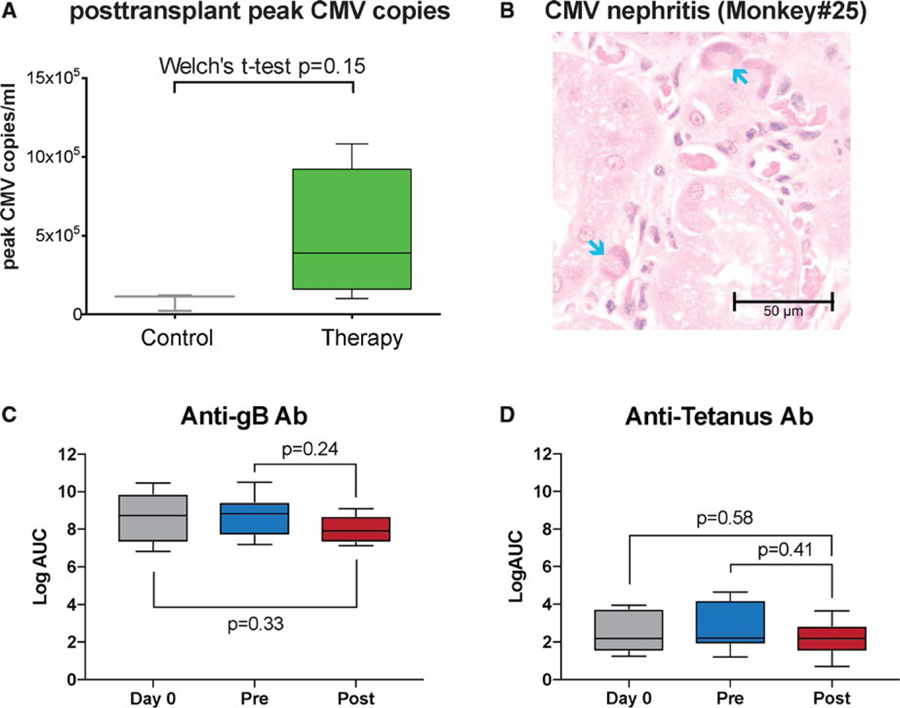
Animals with dual targeting desensitization show increased level of CMV reactivation, CMV nephritis but antibody against CMV or tetanus were not compromised. (A) Increased risk of CMV infection with desensitization. CMV copies at the time of peak showed a strong trend of increase after desensitization compared to untreated animals. (B) Hematoxylin and eosin shows characteristic cytomegalovirus intranuclear inclusions (arrows) in peritubular capillary endothelial cells from desensitized animals. No changes in the level of anti-gB IgG (C) and the level of anti-TT (tetanus) IgG (D) compared to pretreatment or before sensitization
FIGURE 5
FIGURE 5
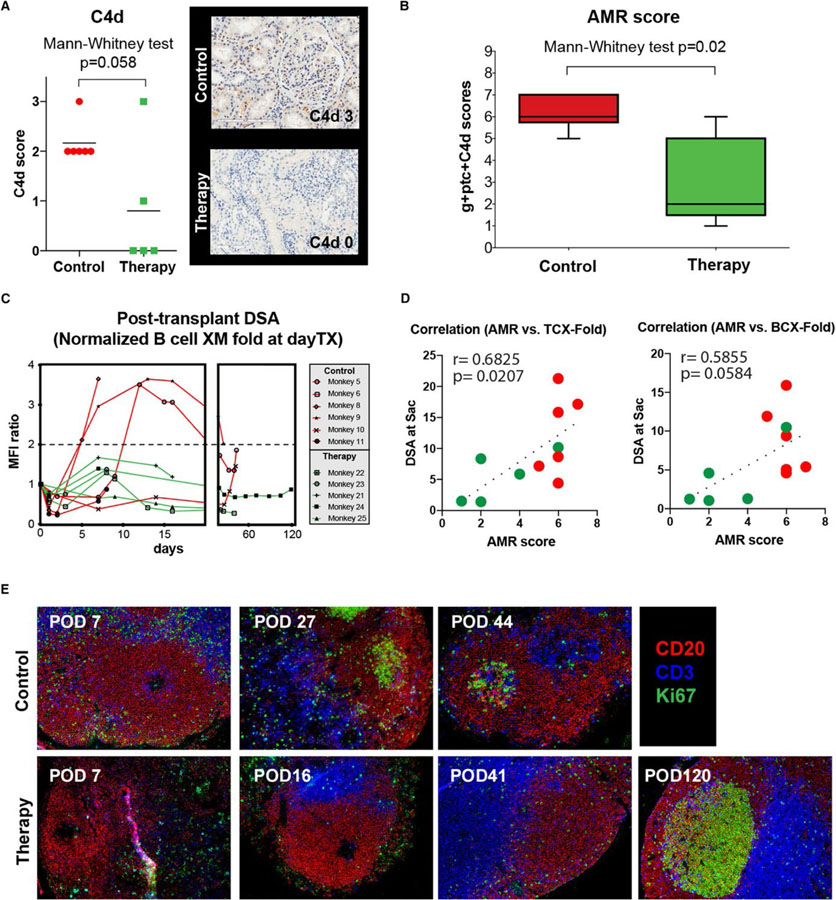
Posttransplant DSA and antibody-mediated rejection was significantly alleviated with costimulation blockade and proteasome inhibitor based desensitization. (A) C4d deposition in renal biopsies taken at the time of rejection after transplant. Animals treated with desensitization showed lower C4d score. (B) Antibody-mediated rejection score (Banff g + ptc + C4d) in end-of-study histology samples. Animals treated with desensitization treatment showed lower AMR scores than control animals. (C) Comparison of posttransplant course of DSA (normalized to prerenal transplant value = 1). Animals with desensitization did not show increased serum DSA. (D) Pearson’s correlation coefficients were calculated between DSA (at sacrifice) by T cell and B cell flow crossmatch to the calculated AMR score. Circulating DSA at sacrifice from both control and desensitized animals showed strong correlation (r = 0.68 and P = .02 for T cell FXM; r = 0.59 and P = .058 for B cell FXM) to the AMR score. (E) Representative immunofluorescence image of GC staining with CD3 (blue), CD20 (red), and Ki67 (green) in mesenteric and peripheral lymph node sections. Lymph nodes were collected at sacrifice (peripheral LNs)

References

    1. Hart A, Smith JM, Skeans MA, et al. OPTN/SRTR 2015 annual data report: kidney. Am J Transplant. 2017;17(suppl 1):21–116. - PMC - PubMed
    1. Gloor JM, DeGoey SR, Pineda AA, et al. Overcoming a positive crossmatch in living-donor kidney transplantation. Am J Transplant. 2003;3(8):1017–1023. - PubMed
    1. Riella LV, Safa K, Yagan J, et al. Long-term outcomes of kidney transplantation across a positive complement-dependent cytotoxicity crossmatch. Transplantation. 2014;97(12):1247–1252. - PubMed
    1. Bartel G, Wahrmann M, Regele H, et al. Peritransplant immunoadsorption for positive crossmatch deceased donor kidney transplantation. Am J Transplant. 2010;10(9):2033–2042. - PubMed
    1. Gloor JM, Winters JL, Cornell LD, et al. Baseline donor-specific antibody levels and outcomes in positive crossmatch kidney transplantation. Am J Transplant. 2010;10(3):582–589. - PubMed

Publication types

MeSH terms