


A barcode of multilocus nuclear DNA identifies genetic relatedness in pre- and post-Artemether/Lumefantrine treated Plasmodium falciparum in Nigeria
- PMID: 30103683
- PMCID: PMC6205152
- DOI: 10.1186/s12879-018-3314-3
A barcode of multilocus nuclear DNA identifies genetic relatedness in pre- and post-Artemether/Lumefantrine treated Plasmodium falciparum in Nigeria
Abstract
Background: The decline in the efficacy of artemisinin-based combination treatment (ACT) in some endemic regions threatens the progress towards global elimination of malaria. Molecular surveillance of drug resistance in malaria-endemic regions is vital to detect the emergence and spread of mutant strains.
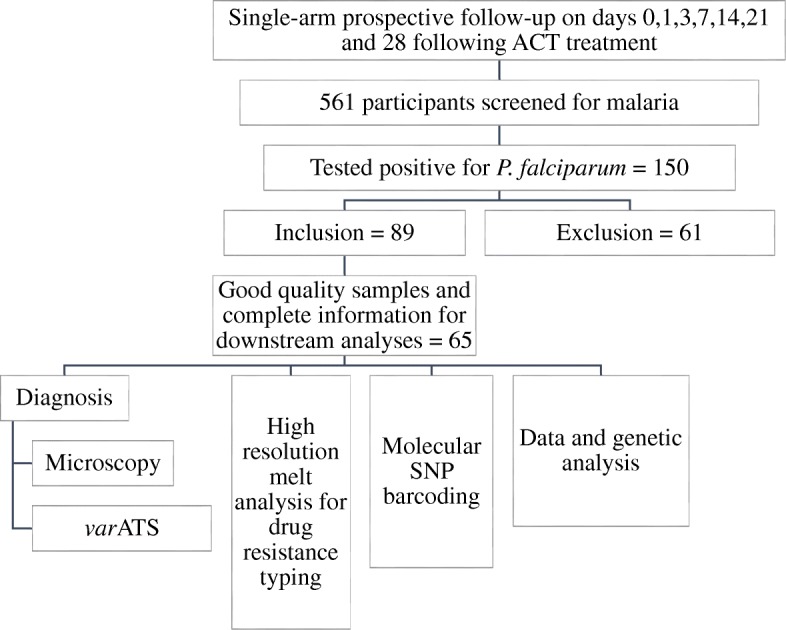
Methods: We observed 89 malaria patients for the efficacy of artemether-lumefantrine for the treatment of uncomplicated Plasmodium falciparum infections in Lagos, Nigeria and determined the prevalence of drug resistant strains in the population. Parasite clearance rates were determined by microscopy and the highly sensitive var gene acidic terminal sequence (varATS) polymerase chain reaction for 65 patients with samples on days 0, 1, 3, 7, 14, 21 and 28 after commencement of treatment. The genomic finger print of parasite DNA from pre- and post-treatment samples were determined using 24 nuclear single nucleotide polymorphisms (SNP) barcode for P. falciparum. Drug resistance associated alleles in chloroquine resistance transporter gene (crt-76), multidrug resistance genes (mdr1-86 and mdr1-184), dihydropteroate synthase (dhps-540), dihydrofolate reductase (dhfr-108) and kelch domain (K-13580) were genotyped by high resolution melt analysis of polymerase chain reaction (PCR) fragments.
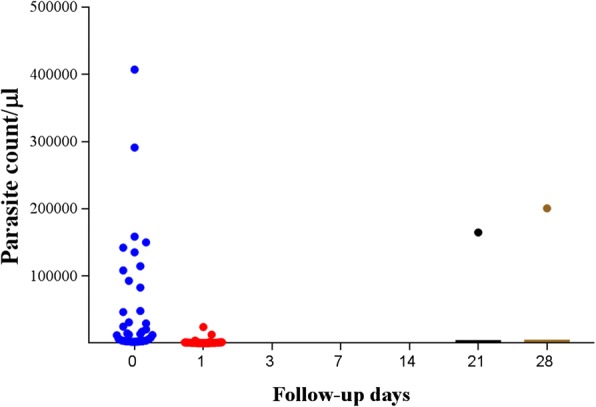
Results: By varATS qPCR, 12 (18.5%) of the participants had detectable parasite DNA in their blood three days after treatment, while eight (12.3%) individuals presented with genotypable day 28 parasitaemia. Complexity of infection (CoI) was 1.30 on day 0 and 1.34 on day 28, the mean expected heterozygosity (HE) values across all barcodes were 0.50 ± 0.05 and 0.56 ± 0.05 on days 0 and 28 respectively. Barcode (π) pairwise comparisons showed high genetic relatedness of day 0 and day 28 parasite isolates in three (37.5%) of the eight individuals who presented with re-appearing infections. Crt-76 mutant allele was present in 38 (58.5%) isolates. The mdr1-86 mutant allele was found in 56 (86.2%) isolates. No mutation in the K-13580 was observed.
Conclusions: Persistence of DNA-detectable parasitaemia in more than 18% of cases after treatment and indications of genetic relatedness between pre- and post-treatment infections warrants further investigation of a larger population for signs of reduced ACT efficacy in Nigeria.
Keywords: Artemisinin-based combination; Drug resistance; Genetic relatedness; Parasite clearance; Residual parasitaemia; SNP barcode.
Conflict of interest statement
Ethical approval and consent to participate
Individuals were requested to provide a written informed consent or assent (by parents/guardians of children below 16 years) before progressing on any study-related procedure. Ethical approval for the study was obtained from the Nigerian Institute of Medical Research Ethics Committee (IRB/17/019) and the Management Board of the health facilities.
Consent for publication
Not applicable.
Competing interests
The authors declare that they have no competing interests.
Publisher’s Note
Springer Nature remains neutral with regard to jurisdictional claims in published maps and institutional affiliations.
Figures


References
-
- WHO, 2016: Summary. Geneva: World Health Organization; 2017 (WHO/HTM/GMP/2017.4).
-
- Adjuik M, Babiker A, Garner P, Olliaro P, Taylor W, White N et al. Artesunate combinations for treatment of malaria: meta-analysis. Lancet. 2004; 3:363(9402):9–17. - PubMed
Publication types
MeSH terms
Substances
Grants and funding
LinkOut - more resources
Full Text Sources
Other Literature Sources
Research Materials
Miscellaneous
