


How adverse childhood experiences relate to single and multiple health risk behaviours in German public university students: a cross-sectional analysis
- PMID: 30103728
- PMCID: PMC6090638
- DOI: 10.1186/s12889-018-5926-3
How adverse childhood experiences relate to single and multiple health risk behaviours in German public university students: a cross-sectional analysis
Abstract
Background: Adverse childhood experiences (ACEs) have been shown to be linked to health risk behaviours (HRBs). This study aims to identify risk factors for ACEs and to examine the associations between ACEs and single and multiple HRBs in a sample of university students in Germany.
Methods: An online-based cross-sectional study was conducted among public university students (N = 1466). The widely applied ACE questionnaire was used and extended to operationalise 13 categories of childhood adversity. First, variables for each type of ACE and HRB were dichotomised (single ACEs and single HRBs), and then used for cumulative scores (multiple ACEs and multiple HRBs). Frequencies were assessed, and (multinomial) logistic regression analyses were performed.
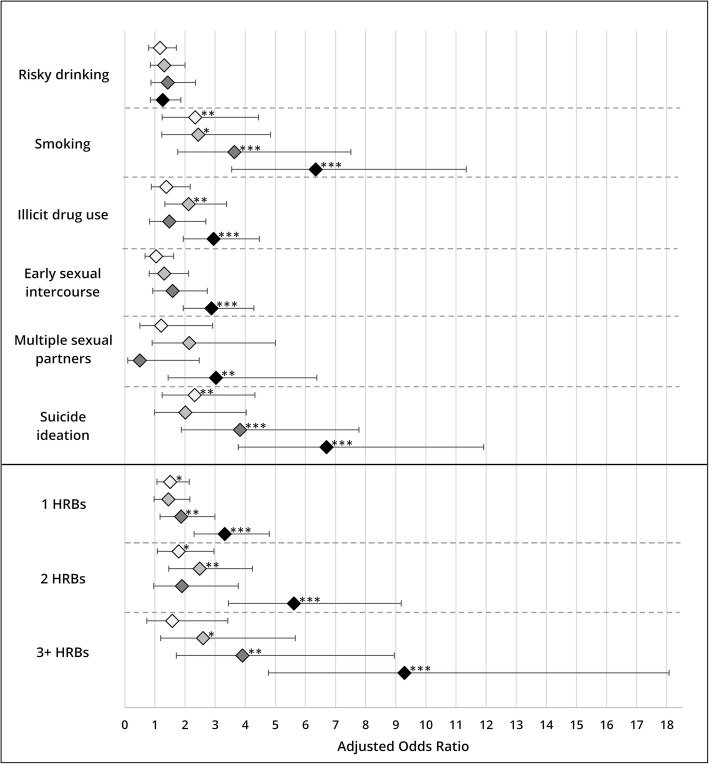
Results: Prevalence rates of ACEs ranged from 3.9 to 34.0%, depending on the type of childhood adversity. Sociodemographic risk and protective factors for single/multiple ACEs varied strongly depending on the outcome. In particular, a high family socioeconomic status seemed to be a consistent protective factor for most ACEs. After adjusting for sociodemographic characteristics, both single and multiple HRBs were associated with single events of ACEs. Moreover, dose-response relationships between multiple ACEs and various single and multiple HRBs were found.
Conclusions: The study provides strong evidence that ACEs are associated with HRBs. The number of ACEs may play a role in single or multiple HRBs. Reducing the number of ACEs could thus decrease HRBs, which account for many of the leading causes of morbidity and death. The findings highlight the importance of trauma-informed health interventions designed to prevent the occurrence of ACEs, and build capacity among children and adults.
Keywords: Adverse childhood experiences; Child maltreatment; Germany; Health; Life course approach; Risky behaviours; Stress-related trauma; Violence.
Conflict of interest statement
The protocol for this study was approved by the ethics committee of Bielefeld University. Participants gave their informed consent by clicking on a button before proceeding with the online-based survey.
Not applicable.
FF serves on the Editorial Board of BMC Public Health as Associate Editor.
Springer Nature remains neutral with regard to jurisdictional claims in published maps and institutional affiliations.
Figures
References
-
- Felitti VJ, Anda RF, Nordenberg D, Williamson DF, Spitz AM, Edwards V, et al. Relationship of childhood abuse and household dysfunction to many of the leading causes of death in adults: the adverse childhood experiences (ACE) study. Am J Prev Med. 1998;14(4):245–258. doi: 10.1016/S0749-3797(98)00017-8. - DOI - PubMed
-
- Tröbs RB, González-Vásquez R, Barenberg K. Kindesmisshandlung – nicht unfallbedingte Verletzungen bei Kindern. OP-Journal. 2010;26(2):78–83. doi: 10.1055/s-0030-1268225. - DOI
-
- Douglas EM. Child maltreatment fatalities in the United States. Four decades of policy, program, and professional responses. Dordrecht: Springer Netherlands; 2017.
MeSH terms
LinkOut - more resources
Full Text Sources
Other Literature Sources
Miscellaneous
