. 2018 Aug 13;12(1):38.
doi: 10.1186/s40246-018-0172-4.

The impact of genome-wide association studies on biomedical research publications

Affiliations

The impact of genome-wide association studies on biomedical research publications

Travis J Struck et al. Hum Genomics. .

Abstract

The past decade has seen major investment in genome-wide association studies (GWAS). Among the many goals of GWAS, a major one is to identify and motivate research on novel genes involved in complex human disease. To assess whether this goal is being met, we quantified the effect of GWAS on the overall distribution of biomedical research publications and on the subsequent publication history of genes newly associated with complex disease. We found that the historical skew of publications toward genes involved in Mendelian disease has not changed since the advent of GWAS. Genes newly implicated by GWAS in complex disease do experience additional publications compared to control genes, and they are more likely to become exceptionally studied. But the magnitude of both effects has declined over the past decade. Our results suggest that reforms to encourage follow-up studies may be needed for GWAS to most successfully guide biomedical research toward the molecular mechanisms underlying complex human disease.

Keywords: Bibliometrics; Follow-up research; Genome-wide association studies.


Conflict of interest statement

Not applicable.

Not applicable.

The authors declare that they have no competing interests.

Springer Nature remains neutral with regard to jurisdictional claims in published maps and institutional affiliations.

Figures
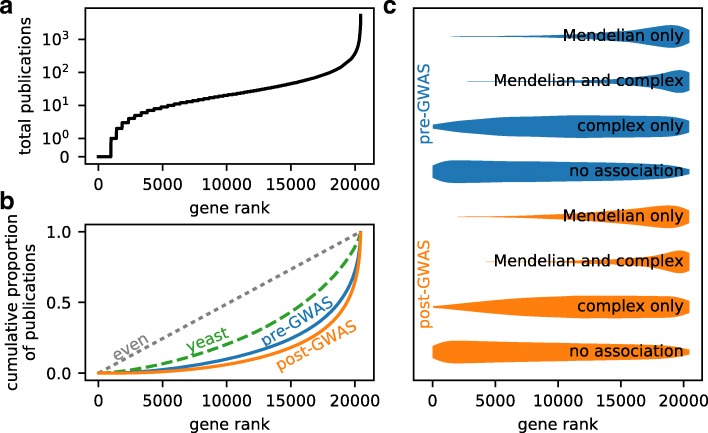
Fig. 1
Fig. 1
Biomedical scientific publications are highly unequally distributed and strongly skewed toward genes involved in Mendelian disease, even after the advent of GWAS. a The distribution of publications among all human genes is highly uneven. Plotted is the number of publications per gene, with genes sorted by number of publications. (The gene with the fewest publications is plotted as rank 1, and the gene with the most publications as rank 20,422.) A few genes are the subject of thousands of publications each, whereas thousands of genes are the subject of fewer than ten publications each. b The distribution of publications among all human genes is more uneven in the post-GWAS era (2005 and later) than in the pre-GWAS era (before 2005). Shown in this Gini plot are the cumulative proportions of publications in each category versus gene rank. The further the curve is from the diagonal, the more uneven the distribution. For comparison, the distribution of publications among yeast genes is shown, with the yeast x-axis stretched to match the number of human genes. c Highly studied genes tend to be involved in Mendelian disease. Plotted are the distributions of genes among publication rank for genes of each possible type of disease association and for both the pre- and post-GWAS eras. (Distributions are not normalized across types of disease association.) In both eras, genes involved in Mendelian diseases are strongly enriched toward high publication ranks. By contrast, many genes involved only in complex disease rank low in terms of publications
Fig. 2
Fig. 2
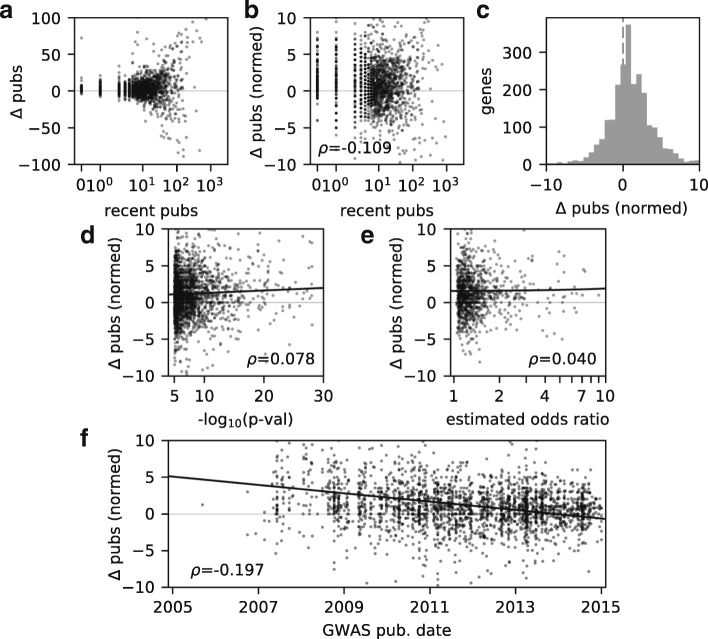
Effect on subsequent publications for genes newly associated with complex disease via GWAS. To quantify the short-term effects of GWAS association, we considered the publication excess of each newly associated gene compared with its control gene. a The variance of the publication excess is strongly correlated with the associated gene’s number of recent publications. b Normalizing the publication excess by the square root of the number of recent publications equalizes the variance. It also reveals a trend for the normalized effect of GWAS association to be smaller for more heavily studied genes. c The distribution of normalized publication excess is shifted toward positive values, indicating a positive effect of GWAS association on subsequent publications. d The normalized publication excess for a newly associated gene is weakly correlated with the p value of the association. e It is not statistically significantly correlated with the estimated effect size of the association, as quantified by the reported odds ratio. f The normalized publication excess is negatively correlated with the publication date of the association. More recently associated genes experience a smaller increase in subsequent publications. Reported correlations ρ are Spearman rank correlations, and thick black lines in panels df are linear regressions
Fig. 3
Fig. 3
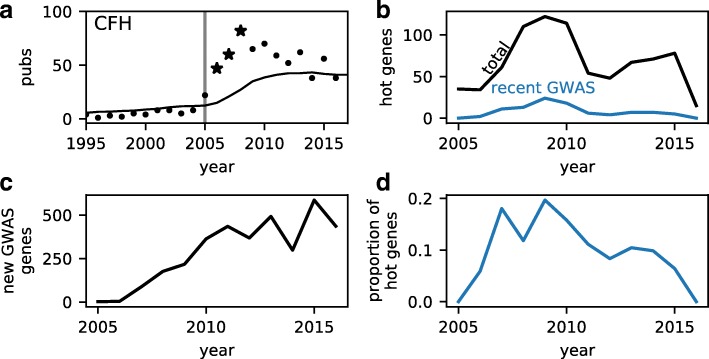
The effect of GWAS in generating exceptionally studied genes. a A significantly elevated number of studies were published on complement factor H following its association with macular degeneration via GWAS in 2005 [2]. Solid line is the predicted publication history from the model of Pfeiffer and Hoffmann [38], points indicate actual publication counts, and starred points indicate years with a statistically significant excess (one-sided Bonferroni-corrected p<0.05). b The total number of genes exhibiting an unusual excess in publications peaked in 2009, as did the number of those genes that were recently newly associated with complex disease via GWAS. c The number of genes newly associated with complex disease through GWAS has grown since the inception of GWAS. d The proportion of genes exhibiting an unusual excess in publications that were recently identified in GWAS peaked at roughly 20% in 2009 and has since declined
Fig. 4
Fig. 4
Total publication excess of new GWAS genes. For 6-month periods, plotted is the total publication excess (compared to control genes) of genes newly associated with complex disease via GWAS during each period

References

    1. Ozaki K, Ohnishi Y, Iida A, Sekine A, Yamada R, Tsunoda T, et al. Functional SNPs in the lymphotoxin- α gene that are associated with susceptibility to myocardial infarction. Nat Genet. 2002;32(4):650–4. doi: 10.1038/ng1047. - DOI - PubMed
    1. Klein RJ, Zeiss C, Chew EY, Tsai JY, Sackler RS, Haynes C, et al. Complement factor H polymorphism in age-related macular degeneration. Science. 2005;308(5720):385–9. doi: 10.1126/science.1109557. - DOI - PMC - PubMed
    1. DeWan A, Liu M, Hartman S, Zhang SSM, Liu DTL, Zhao C, et al. HTRA1 promoter polymorphism in wet age-related macular degeneration. Science. 2006;314:989–92. doi: 10.1126/science.1133807. - DOI - PubMed
    1. Burton PR, Clayton DG, Cardon LR, Craddock N, Deloukas P, Duncanson A, et al. Genome-wide association study of 14,000 cases of seven common diseases and 3000 shared controls. Nature. 2007;447(7145):661–78. doi: 10.1038/nature05911. - DOI - PMC - PubMed
    1. MacArthur J, Bowler E, Cerezo M, Gil L, Hall P, Hastings E, et al. The new NHGRI-EBI Catalog of published genome-wide association studies (GWAS Catalog) Nucleic Acids Res. 2016;45:D896–D901. doi: 10.1093/nar/gkw1133. - DOI - PMC - PubMed

Publication types