


An intraspecific appraisal of the social intelligence hypothesis
- PMID: 30104433
- PMCID: PMC6107571
- DOI: 10.1098/rstb.2017.0288
An intraspecific appraisal of the social intelligence hypothesis
Abstract
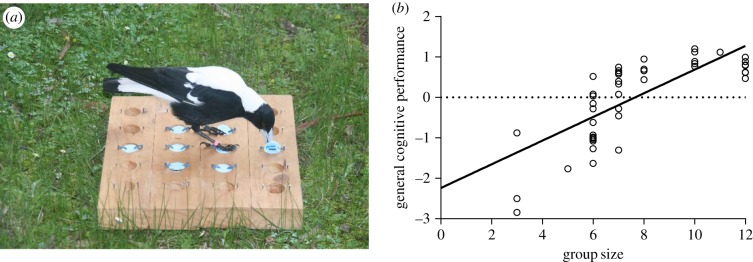
The prevailing hypotheses for the evolution of cognition focus on either the demands associated with group living (the social intelligence hypothesis (SIH)) or ecological challenges such as finding food. Comparative studies testing these hypotheses have generated highly conflicting results; consequently, our understanding of the drivers of cognitive evolution remains limited. To understand how selection shapes cognition, research must incorporate an intraspecific approach, focusing on the causes and consequences of individual variation in cognition. Here, we review the findings of recent intraspecific cognitive research to investigate the predictions of the SIH. Extensive evidence from our own research on Australian magpies (Cracticus tibicen dorsalis), and a number of other taxa, suggests that individuals in larger social groups exhibit elevated cognitive performance and, in some cases, elevated reproductive fitness. Not only do these findings demonstrate how the social environment has the potential to shape cognitive evolution, but crucially, they demonstrate the importance of considering both genetic and developmental factors when attempting to explain the causes of cognitive variation.This article is part of the theme issue 'Causes and consequences of individual differences in cognitive abilities'.
Keywords: Australian magpies; cognition; individual variation; intraspecific; social intelligence hypothesis.
© 2018 The Authors.
Conflict of interest statement
We declare we have no competing interests.
Figures
References
-
- Sol D. 2009. The cognitive buffer hypothesis for the evolution of large brains. In Cognitive ecology II (eds Dukas R, Ratcliffe JM), pp. 111–136. Chicago, IL: Chicago University Press.
Publication types
MeSH terms
Grants and funding
LinkOut - more resources
Full Text Sources
Other Literature Sources
