


Complement Factor C3 Methylation and mRNA Expression Is Associated to BMI and Insulin Resistance in Obesity
- PMID: 30104553
- PMCID: PMC6116013
- DOI: 10.3390/genes9080410
Complement Factor C3 Methylation and mRNA Expression Is Associated to BMI and Insulin Resistance in Obesity
Abstract
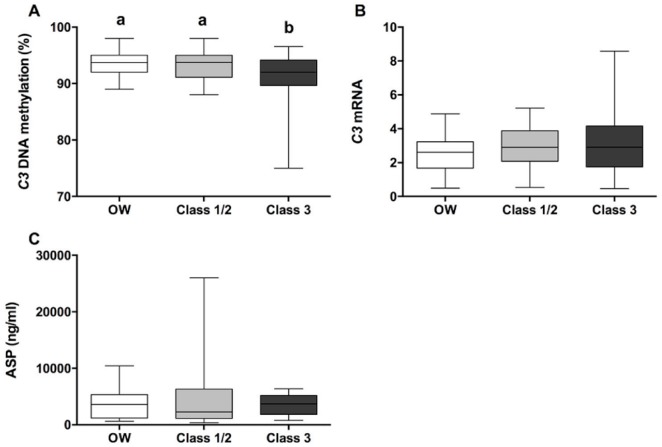
Epigenetic marks, and especially DNA methylation, are becoming an important factor in obesity, which could help to explain its etiology and associated comorbidities. Adipose tissue, now considered as an important endocrine organ, produces complement system factors. Complement component 3 (C3) turns out to be an important protein in metabolic disorders, via either inflammation or the C3 subproduct acylation stimulating protein (ASP) which directly stimulates lipid storage. In this study, we analyze C3 DNA methylation in adipose tissue from subjects with a different grade of obesity. Adipose tissue samples were collected from subjects with a different degree of obesity determined by their body mass index (BMI) as: Overweight subjects (BMI ≥ 25 and <30), obese class 1/2 subjects (BMI ≥ 30 and <40) and obese class 3 subjects (BMI ≥ 40). C3 DNA methylation was measured for 7 CpGs by pyrosequencition using the Pyromark technology (Qiagen, Madrid Spain). C3 messenger RNA (mRNA) levels were analyzed by pre-designed Taqman assays (Applied biosystems, Foster City, CA, USA) and ASP/C3a was measured using a ELISA kit. The data were analyzed using the statistic package SPSS. C3 DNA methylation levels were lower in the morbid obese group. Accordingly, C3 methylation correlated negatively with BMI and leptin. However, C3 mRNA levels were more associated with insulin resistance, and positive correlations with insulin, glucose and homeostasis model assessment-estimated insulin resistance (HOMA-IR) existed. ASP correlated negatively with high density lipoprotein (HDL) cholesterol. C3 methylation levels were associated to adiposity variables, such as BMI and leptin, while the C3 mRNA levels were associated to glucose metabolism.
Keywords: ASP; C3; DNA methylation; complement factor; insulin resistance; obesity.
Conflict of interest statement
The authors declare no conflict of interest.
Figures
References
-
- Choy L.N., Rosen B.S., Spiegelman B.M. Adipsin and an endogenous pathway of complement from adipose cells. J. Boil. Chem. 1992;267:12736–12741. - PubMed
LinkOut - more resources
Full Text Sources
Other Literature Sources
Miscellaneous
